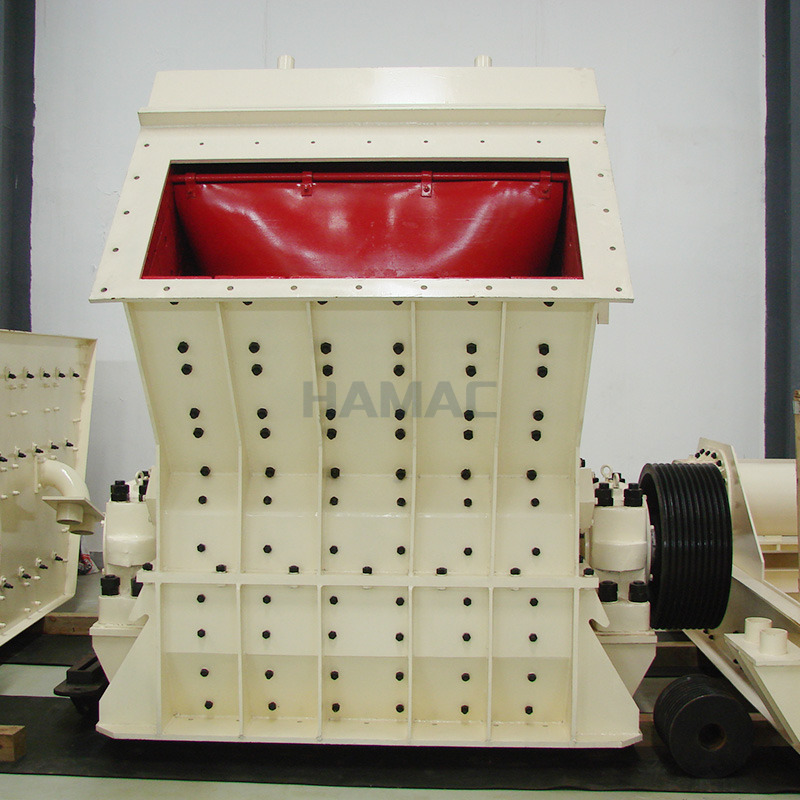
Overview
Iron ore (Mohs 5.5, ~160 MPa, medium abrasion): processing steps, equipment and cost notes for plant buyers.
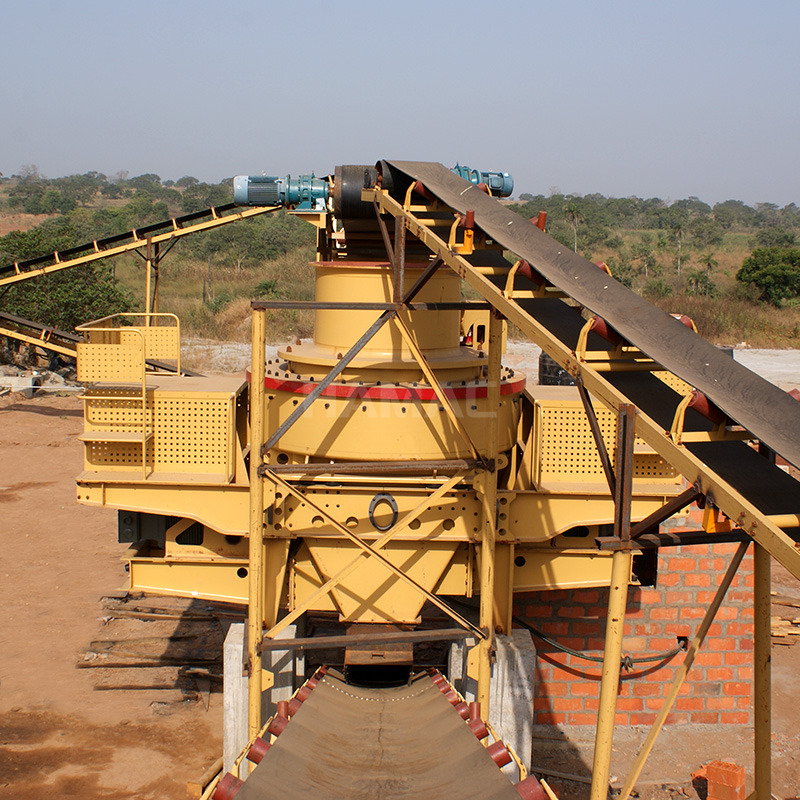
Processing steps
- Primary crushing — jaw.
- Secondary / tertiary — jaw + cone (+ HPGR option).
- Screening for graded products.
- Dewatering / handling.
Recommended equipment
- PE Series Jaw Crusher
- HPT Multi-Cylinder Hydraulic Cone Crusher
- Symons Cone Crusher
Cost notes
Operating cost is dominated by wear parts on medium-abrasion material; choose liner grade by rock, not price.
Reference data for this configuration
| Parameter | Reference value |
|---|---|
| Feed material | Iron ore |
| Mohs hardness | 5.5 |
| Compressive strength | ~160 MPa |
| Abrasiveness | Medium |
| Recommended circuit | jaw + cone (+ HPGR option) |
| Assumed duty | demolition and recycling duties |
| Evaluation horizon | three-year view |
HAMAC engineers fill in the same fields on the project data sheet, which is why two plants of similar tonnage can still require different machines.
Project profile these notes assume
| Assumption | Value |
|---|---|
| Operating duty | demolition and recycling duties |
| Primary objective | minimal civil works |
| Evaluation horizon | three-year view |
| Site condition | an existing quarry bench |
| Operating team | a mixed local and expatriate team |
Change any one of these assumptions and the recommended configuration for iron ore crushing may change. HAMAC re-runs the same checks against your own numbers once the enquiry data sheet is received.
From enquiry to the first saleable tonne
- Record the as-built settings and give the operator a written daily, weekly and monthly schedule.
- Run a sieve analysis on a representative sample and attach the grading curve to the enquiry.
- Size the primary stage for your target tonnage with a 10–20% surge allowance — never on nameplate throughput alone.
- Include dust suppression, guarding, emergency stops and lock-out points in the layout drawing.
- Budget for water, dust extraction and spillage handling as part of the plant, not as an afterthought.
- Review the crusher chamber profile with the liner supplier against Iron ore (Mohs 5.5, ~160 MPa, medium abrasion).
- Apply jaw + cone (+ HPGR option); the reduction mechanism must suit medium abrasion and a compressive strength near 160 MPa.
- Confirm site voltage, frequency and applicable conformity standards before manufacture.
- Log tonnes per liner set and kWh per tonne from day one so you have a real cost baseline within a quarter.
For a mixed local and expatriate team, the commissioning and training steps need more calendar time than the mechanical erection itself.
What to verify before you sign
- Wear-part interchangeability across machines in the same circuit.
- Written performance guarantee, sampling method and acceptance-test protocol.
- Access for liner change-out — crane radius, lifting points and clearance around the chamber.
- Control system language, telemetry and remote diagnostics availability.
- Saleable tonnes per hour at each product size, not gross crusher throughput, for your target tonnage.
- Closed-side setting range and whether automatic setting regulation is included.
- Whether the quoted t/h is achieved at demolition and recycling duties or under ideal laboratory feed.
- Screen deck count, aperture and area; ask for the efficiency calculation, not just the mesh size.
- Maximum feed lump and gradation — a chamber that cannot accept the top size will bridge on day one.
These are the items HAMAC puts in the technical proposal; if another offer is silent on them, ask why.
Where the money actually goes
| Cost line | Indicative share | What moves the number |
|---|---|---|
| Equipment & drive packages | 52% | Model size, number of stages and automation level |
| Ocean freight & insurance | 8% | Destination port, container count and out-of-gauge cargo |
| Civil works & foundations | 8% | Soil conditions, dynamic loads and site preparation |
| Erection, commissioning & training | 7% | Local labour, supervision scope and schedule |
| First-year wear parts | 18% | Rock abrasiveness, liner grade and operating hours |
| Power, lubricants & consumables | 7% | kWh per tonne, local tariff and dust suppression water |
For iron ore crushing at your target tonnage, wear parts and energy usually outweigh the difference between two purchase prices within three to five years.
Mistakes that cost more than the machine
- Choosing screen apertures before the concrete or asphalt mix design is fixed.
- Undersizing the screen, then blaming the crusher for a plant that never reaches your target tonnage.
- Omitting a bypass chute, so a single screen fault stops the whole line.
- Overlooking dust, noise and water permits in your market until erection has already started.
- Selecting the cheapest liner alloy for hard, high-silica rock and paying for it in change-outs.
- Buying minimal civil works on price alone and losing it in availability.
- Forgetting surge capacity — an intermittent loader starves the chamber and ruins particle shape.
- Leaving tramp-iron protection out of the scope to save a small percentage of capital.
On an existing quarry bench, the civil and logistics items deserve as much attention as the crusher itself.
Commissioning checklist
- Record power draw, tonnage and chamber pressure at steady state.
- Check lubrication levels, grease lines and oil cooler operation.
- Check belt tracking, chute build-up and transfer-point dust.
- Measure and log the as-new CSS / setting for future wear comparison.
- Record the baseline grading curve for each product fraction.
- Sample each product fraction and compare with the specification.
- Check hydraulic pressure, accumulator pre-charge and tramp-release function.
- Confirm all guards, emergency stops and pull-wire switches function.
For a mixed local and expatriate team, run through this list twice — once with the supervisor and once without.