Overview
Practical, numbers-first guidance on the PF Impact Crusher — written for engineers specifying, buying and running crushing plants.
How it compares
- Primary reduction vs a gyratory for very high tonnage.
- Compression (cone) vs impact for shape vs wear.
- Mobile vs stationary for your site.
When to pick this machine
PF Impact Crusher is chosen when its reduction mechanism and capacity match your material and product spec.
Reference data for this configuration
| Parameter | Reference value |
|---|---|
| Machine line | PF Impact Crusher |
| Category | Impact Crusher |
| Assumed duty | contract crushing on short-term sites |
| Evaluation horizon | seven-year view |
Use the table as a checklist when comparing quotations for pf impact crusher — a lower price often means one of these parameters was quietly reduced.
Published PF Impact Crusher model data
| Model | Rotor size | Feed opening | Max. Feeding size | Capacity | Motor Power | Weight | Overall dimension |
|---|---|---|---|---|---|---|---|
| PF-1007 | Φ1000×700 mm | 400×730 mm | 300 mm | 30-70 t/h | 37-45 kW | 12 t | 2330×1660×2300 mm |
| PF-1010 | Φ1000×1050 mm | 400×1080 mm | 350 mm | 50-90 t/h | 45-55 kW | 15 t | 2370×1700×2390 mm |
| PF-1210 | Φ1250×1050 mm | 400×1080 mm | 350 mm | 70-130 t/h | 110 kW | 17.7 t | 2680×2160×2800 mm |
| PF-1214 | Φ1250×1400 mm | 400×1430 mm | 350 mm | 100-180 t/h | 132 kW | 22.4 t | 2650×2460×2800 mm |
| PF-1315 | Φ1320×1500 mm | 860×1520 mm | 500 mm | 130-250 t/h | 220 kW | 27 t | 3180×2720×2620 mm |
| PF-1520 | Φ1500×2000 mm | 830×2040 mm | 700 mm | 300-550 t/h | 315-400 kW | 50.6 t | 3959×3564×3330 mm |
| PF-1620 | Φ1600×2000 mm | 2000×1600 mm | 500 mm | 400-700 t/h | 400-500 kW | 58 t | 4259×3660×3450 mm |
| PF-1820 | Φ1800×2000 mm | 1260×2040 mm | 800 mm | 600-800 t/h | 630-710 kW | 83.21 t | 4400×3866×4009 mm |
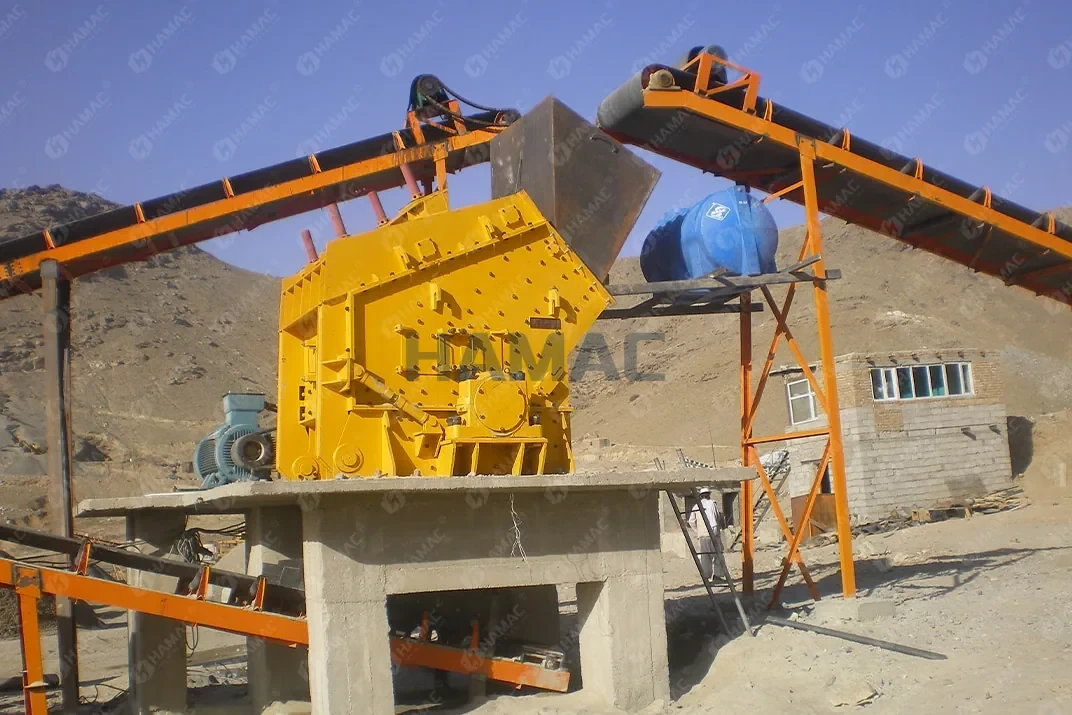
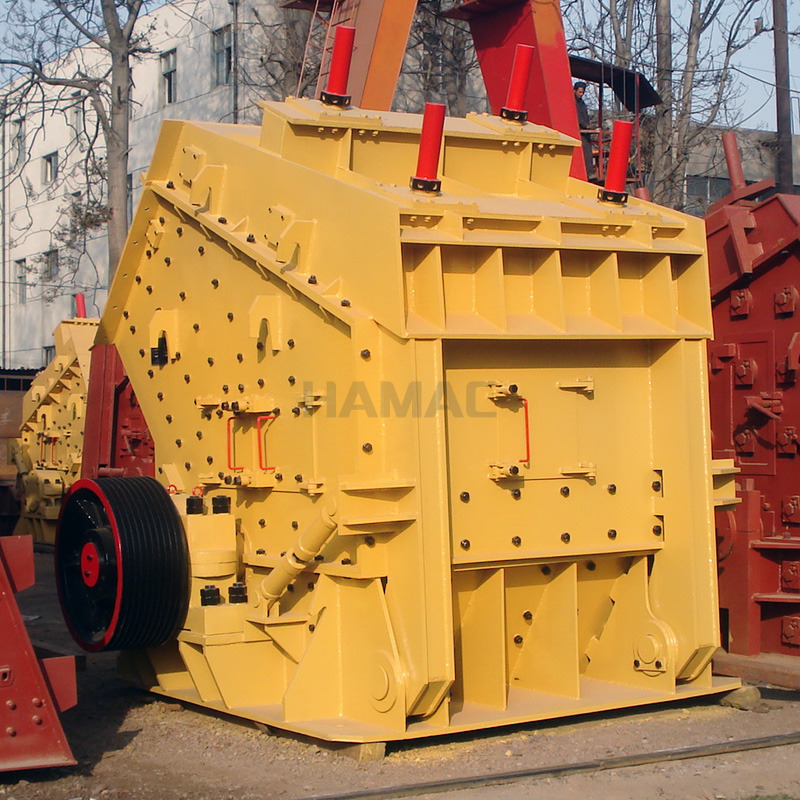
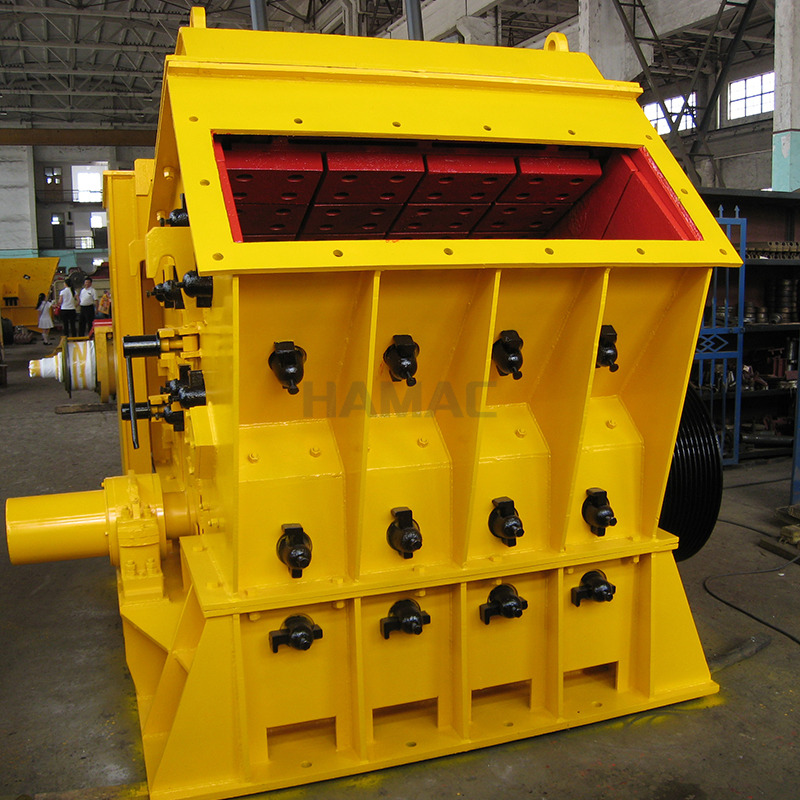
The impact crusher (impact crusher) is a new generation of impact crusher developed in combination with the specific working conditions of the sand and gravel. Read the table column by column against contract crushing on short-term sites: the model you pick is the one whose published range brackets your target tonnage, not simply the largest machine in the series. Availability, motor rating and shipping data are re-confirmed for a brownfield extension in the written HAMAC proposal.
Project profile these notes assume
| Assumption | Value |
|---|---|
| Operating duty | contract crushing on short-term sites |
| Primary objective | minimal civil works |
| Evaluation horizon | seven-year view |
| Site condition | a brownfield extension |
| Operating team | an owner-operator team |
Change any one of these assumptions and the recommended configuration for pf impact crusher may change. HAMAC re-runs the same checks against your own numbers once the enquiry data sheet is received.
From enquiry to the first saleable tonne
- Budget for water, dust extraction and spillage handling as part of the plant, not as an afterthought.
- Choose compression or impact reduction according to hardness, silica content and required particle shape.
- Include dust suppression, guarding, emergency stops and lock-out points in the layout drawing.
- Set the closed-side setting or rotor speed against the required product fractions, then verify the expected reduction ratio.
- Plan training for an owner-operator team on CSS adjustment, liner change-out and lock-out / tag-out.
- Set the maintenance stock list from the expected wear rate, not from a percentage of the equipment price.
- Verify the electrical single-line diagram, cable sizing and starter type with the local utility.
- Survey the feed: the feed material; record top size, bulk density, moisture and clay content before fixing the flow sheet.
- Record the as-built settings and give the operator a written daily, weekly and monthly schedule.
On contract crushing on short-term sites, step ordering matters: survey and sampling must precede the equipment list, or the plant is sized to a guess.
What to verify before you sign
- Whether the quoted t/h is achieved at contract crushing on short-term sites or under ideal laboratory feed.
- Local service partner, technician travel time and visa requirements for your market.
- Closed-side setting range and whether automatic setting regulation is included.
- Ambient temperature, altitude and dust load derating for motors and hydraulics.
- Product sampling points and the lab equipment needed for routine grading checks.
- Erection scope: supervision only, or full civil, mechanical and electrical installation.
- After-sales response time, technician availability and the warranty exclusions in writing.
- Saleable tonnes per hour at each product size, not gross crusher throughput, for your target tonnage.
- Guaranteed power draw and the minimal civil works trade-off it implies.
The relative weight of each item changes with the project: wear parts dominate on abrasive rock, availability dominates on remote sites.
Where the money actually goes
| Cost line | Indicative share | What moves the number |
|---|---|---|
| Equipment & drive packages | 54% | Model size, number of stages and automation level |
| Ocean freight & insurance | 8% | Destination port, container count and out-of-gauge cargo |
| Civil works & foundations | 8% | Soil conditions, dynamic loads and site preparation |
| Erection, commissioning & training | 7% | Local labour, supervision scope and schedule |
| First-year wear parts | 15% | Rock abrasiveness, liner grade and operating hours |
| Power, lubricants & consumables | 8% | kWh per tonne, local tariff and dust suppression water |
The weighting shifts with hardness and scale — a hard feed pushes the wear line up, while a larger plant pushes equipment share up.
Mistakes that cost more than the machine
- Skipping a geotechnical check and discovering settlement under the primary crusher at a brownfield extension.
- Specifying motors for the wrong voltage or frequency and rewinding them on site.
- Overlooking dust, noise and water permits in your market until erection has already started.
- Buying minimal civil works on price alone and losing it in availability.
- Letting the contract crushing on short-term sites duty be defined verbally instead of in the contract.
- Forgetting surge capacity — an intermittent loader starves the chamber and ruins particle shape.
- Assuming the manufacturer's warranty covers wear parts and consumables.
- Ignoring clay and moisture until the first wet season, when decks blind and chambers pack.
Every item on this list has cost someone a commissioning date; none of them requires new technology to avoid.
Commissioning checklist
- Record power draw, tonnage and chamber pressure at steady state.
- Measure and log the as-new CSS / setting for future wear comparison.
- Introduce feed in graded steps: 25%, 50%, 75%, then full load.
- Verify chute liners, skirt rubber and impact bars after the first hour of feed.
- Check lubrication levels, grease lines and oil cooler operation.
- Measure noise and dust at the operator position against the local limit.
- Confirm all guards, emergency stops and pull-wire switches function.
- Verify rotation direction on every motor before coupling.
For an owner-operator team, run through this list twice — once with the supervisor and once without.