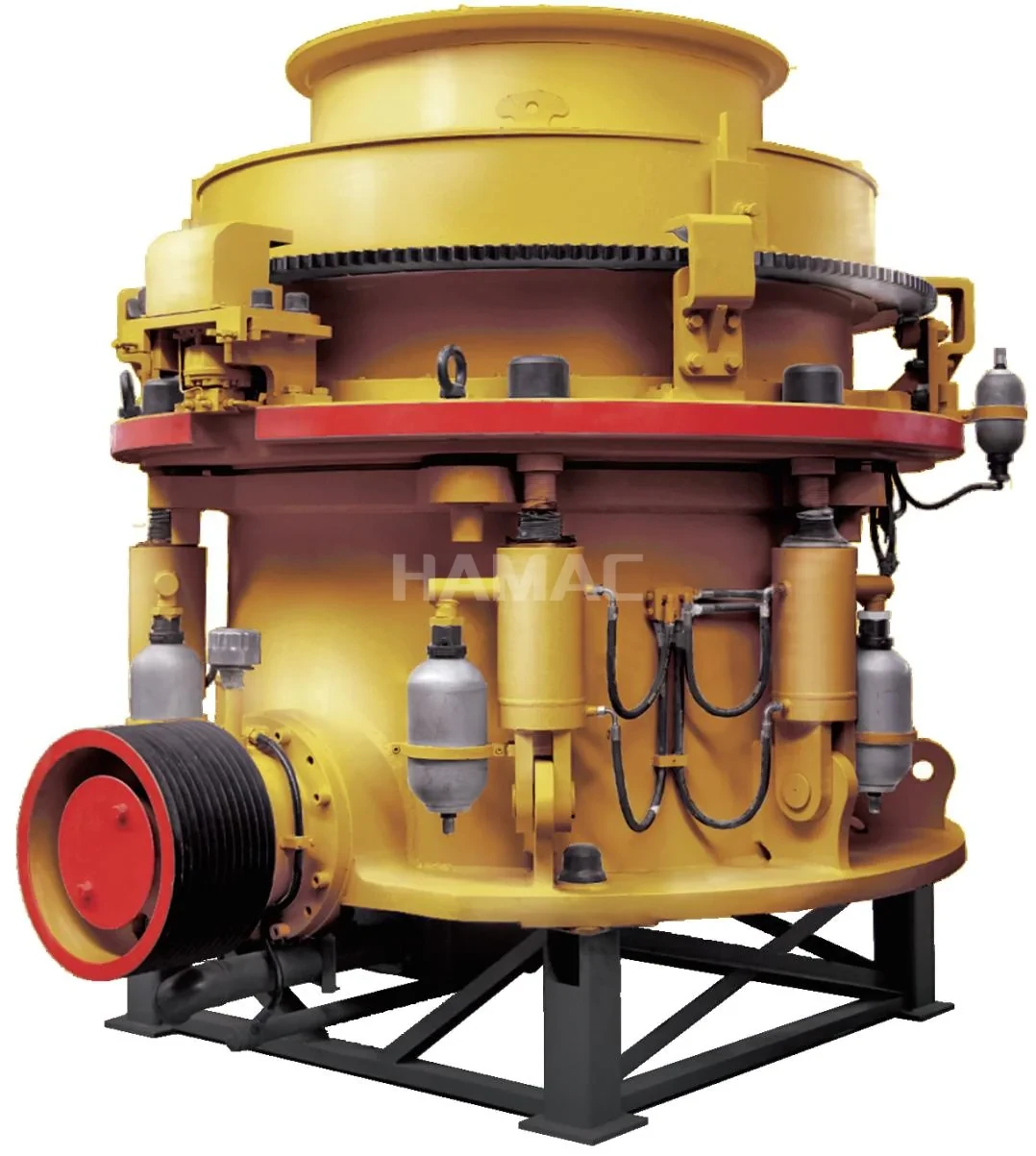
Overview
Practical, numbers-first guidance on the HPT Multi-Cylinder Hydraulic Cone Crusher — written for engineers specifying, buying and running crushing plants.
Abnormal noise / vibration
- Check for loose liner bolts or foreign metal in feed.
- Verify foundation bolts and coupling alignment.
- Listen for bearing distress; schedule replacement.
Low output
- Worn liners / blow bars reduce reduction.
- Wrong CSS / setting for target product.
- Screen blinding limits throughput.
Poor product shape
- Increase reduction in the shaping stage.
- Verify VSI rotor speed / anvil.
- Re-check screen mesh.
Reference data for this configuration
| Parameter | Reference value |
|---|---|
| Machine line | HPT Multi-Cylinder Hydraulic Cone Crusher |
| Category | Cone Crusher |
| Assumed duty | contract crushing on short-term sites |
| Evaluation horizon | ten-year view |
HAMAC engineers fill in the same fields on the project data sheet, which is why two plants of similar tonnage can still require different machines.
Published HPT Multi-Cylinder Hydraulic Cone Crusher model data
| Model | Installed power (kW) | Capacity range (t/h) | Dimensions (mm) |
|---|---|---|---|
| HPT100 | 90 | 45–140 | 1705 × 1510 × 1583 |
| HPT200 | 160 | 90–250 | 2135 × 1750 × 1927 |
| HPT300 | 220 | 110–440 | 2725 × 2110 × 2871 |
| HPT400 / HPT500 | On request | On request | On request |
Hydraulic multi-cylinder cone crusher for secondary and tertiary crushing of limestone through basalt, with 5–15% higher efficiency and 35–60% higher output than spring cone crushers. Read the table column by column against contract crushing on short-term sites: the model you pick is the one whose published range brackets your target tonnage, not simply the largest machine in the series. Availability, motor rating and shipping data are re-confirmed for a greenfield site in the written HAMAC proposal.
Project profile these notes assume
| Assumption | Value |
|---|---|
| Operating duty | contract crushing on short-term sites |
| Primary objective | simple operator maintenance |
| Evaluation horizon | ten-year view |
| Site condition | a greenfield site |
| Operating team | a rotating shift crew |
Change any one of these assumptions and the recommended configuration for hpt multi-cylinder hydraulic cone crusher may change. HAMAC re-runs the same checks against your own numbers once the enquiry data sheet is received.
From enquiry to the first saleable tonne
- Lay out conveyors, access ways, stockpile capacity and drainage before ordering steelwork.
- Set the closed-side setting or rotor speed against the required product fractions, then verify the expected reduction ratio.
- Set the maintenance stock list from the expected wear rate, not from a percentage of the equipment price.
- Commission with graded load, sample the product grading, then train operators on liner change-out and daily checks.
- Allocate screen area per deck; blinding and pegging are the most common hidden bottlenecks in a new plant.
- Review the crusher chamber profile with the liner supplier against the feed material.
- Check bearing and lubrication arrangements against the ambient temperature range at the site.
- Record the as-built settings and give the operator a written daily, weekly and monthly schedule.
- Size the primary stage for your target tonnage with a 10–20% surge allowance — never on nameplate throughput alone.
The sequence is deliberately front-loaded — decisions taken before manufacture are cheap, changes made on site are not.
What to verify before you sign
- Whether the quoted t/h is achieved at contract crushing on short-term sites or under ideal laboratory feed.
- Guaranteed power draw and the simple operator maintenance trade-off it implies.
- Dust and noise control designed to the local emission limits for your market.
- Wear-part interchangeability across machines in the same circuit.
- Written performance guarantee, sampling method and acceptance-test protocol.
- Saleable tonnes per hour at each product size, not gross crusher throughput, for your target tonnage.
- Access for liner change-out — crane radius, lifting points and clearance around the chamber.
- Choke-feed arrangement: surge bin, feeder control and level indication.
- Ambient temperature, altitude and dust load derating for motors and hydraulics.
The cheapest offer usually wins on equipment and loses on one of the last six items — freight terms, spares or the acceptance test.
Where the money actually goes
| Cost line | Indicative share | What moves the number |
|---|---|---|
| Equipment & drive packages | 54% | Model size, number of stages and automation level |
| Ocean freight & insurance | 8% | Destination port, container count and out-of-gauge cargo |
| Civil works & foundations | 8% | Soil conditions, dynamic loads and site preparation |
| Erection, commissioning & training | 7% | Local labour, supervision scope and schedule |
| First-year wear parts | 15% | Rock abrasiveness, liner grade and operating hours |
| Power, lubricants & consumables | 8% | kWh per tonne, local tariff and dust suppression water |
Freight to your market is volatile; ask for the quotation to state validity and the port basis rather than a single delivered number.
Mistakes that cost more than the machine
- Buying on nameplate t/h without converting to saleable product at the specified fractions.
- Planning the crusher but not the conveyors, transfer chutes and stockpile capacity around it.
- Assuming a mobile plant can match a stationary line on high-tonnage, multi-product duty.
- Skipping a geotechnical check and discovering settlement under the primary crusher at a greenfield site.
- Specifying motors for the wrong voltage or frequency and rewinding them on site.
- Omitting a bypass chute, so a single screen fault stops the whole line.
- Selecting the cheapest liner alloy for hard, high-silica rock and paying for it in change-outs.
- Leaving tramp-iron protection out of the scope to save a small percentage of capital.
For contract crushing on short-term sites, protect the simple operator maintenance requirement explicitly in the contract documents.
Commissioning checklist
- Check lubrication levels, grease lines and oil cooler operation.
- Sample each product fraction and compare with the specification.
- Record the baseline grading curve for each product fraction.
- Dry-run the plant empty for the specified period and record vibration.
- Confirm all guards, emergency stops and pull-wire switches function.
- Introduce feed in graded steps: 25%, 50%, 75%, then full load.
- Agree the punch list, sign the hand-over protocol and file the as-built drawings.
- Verify rotation direction on every motor before coupling.
On a greenfield site, allow extra time for the dust and noise measurements.