Overview
Practical, numbers-first guidance on the Symons Cone Crusher — written for engineers specifying, buying and running crushing plants.
Abnormal noise / vibration
- Check for loose liner bolts or foreign metal in feed.
- Verify foundation bolts and coupling alignment.
- Listen for bearing distress; schedule replacement.
Low output
- Worn liners / blow bars reduce reduction.
- Wrong CSS / setting for target product.
- Screen blinding limits throughput.
Poor product shape
- Increase reduction in the shaping stage.
- Verify VSI rotor speed / anvil.
- Re-check screen mesh.
Reference data for this configuration
| Parameter | Reference value |
|---|---|
| Machine line | Symons Cone Crusher |
| Category | Cone Crusher |
| Assumed duty | contract crushing on short-term sites |
| Evaluation horizon | single-project view |
The figures above are transcribed from published HAMAC data and from the material properties of the feed; site measurements take precedence.
Published Symons Cone Crusher model data
| Model | SCC 3’ | SCC 4 1/4’ | SCC 5 1/2’ | SCC 7’ |
|---|---|---|---|---|
| Dia. | 900 mm (3’) | 1295 mm (4 1/4’) | 1650 mm (5 1/2’) | 2134 mm (7’) |
| Fine Closing Side | 83 mm | 109 mm | 188 mm | 253 mm |
| Fine Open Side | 102 mm | 137 mm | 209 mm | 278 mm |
| Medium Closing Side | 159 mm | 188 mm | 213 mm | 303 mm |
| Medium Open Side | 175 mm | 210 mm | 241 mm | 334 mm |
| Coarse Closing Side | 159 mm | 216 mm | 241 mm | 334 mm |
| Coarse Open Side | 175 mm | 241 mm | 268 mm | 369 mm |
| Outlet Setting | 9-22 mm | 13-38 mm | 16-38 mm | 19-38 mm |
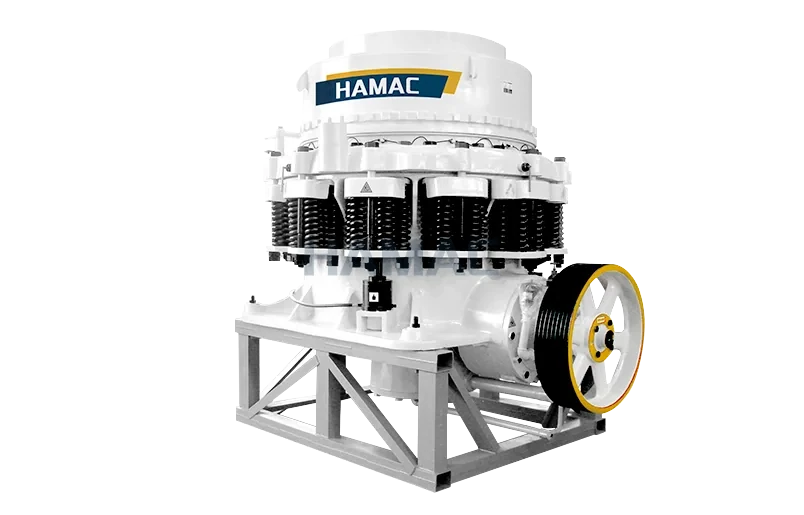
S series Symons cone crusher is a kind of high efficiency cone crusher, which integrate optimization of cavity-type and reasonable stroke and advanced technology, and the conception of. Read the table column by column against contract crushing on short-term sites: the model you pick is the one whose published range brackets your target tonnage, not simply the largest machine in the series. Availability, motor rating and shipping data are re-confirmed for a remote mine site in the written HAMAC proposal.
Project profile these notes assume
| Assumption | Value |
|---|---|
| Operating duty | contract crushing on short-term sites |
| Primary objective | strict product cubicity |
| Evaluation horizon | single-project view |
| Site condition | a remote mine site |
| Operating team | a mixed local and expatriate team |
Change any one of these assumptions and the recommended configuration for symons cone crusher may change. HAMAC re-runs the same checks against your own numbers once the enquiry data sheet is received.
From enquiry to the first saleable tonne
- Review the crusher chamber profile with the liner supplier against the feed material.
- Survey the feed: the feed material; record top size, bulk density, moisture and clay content before fixing the flow sheet.
- Log tonnes per liner set and kWh per tonne from day one so you have a real cost baseline within a quarter.
- Include dust suppression, guarding, emergency stops and lock-out points in the layout drawing.
- Check bearing and lubrication arrangements against the ambient temperature range at the site.
- Record the as-built settings and give the operator a written daily, weekly and monthly schedule.
- Budget for water, dust extraction and spillage handling as part of the plant, not as an afterthought.
- Define the acceptance test: sampling points, test duration, moisture range and who signs the protocol.
- Book shipping, prepare the packing list and confirm the container loading plan.
A realistic programme reserves time for permits, foundation curing and shipping to your market before any steel is cut.
What to verify before you sign
- Energy draw in kW and the expected kWh per tonne at the design duty.
- Whether the quoted t/h is achieved at contract crushing on short-term sites or under ideal laboratory feed.
- Availability of a mixed local and expatriate team for liner changes and the lifting equipment on site.
- Access for liner change-out — crane radius, lifting points and clearance around the chamber.
- Product sampling points and the lab equipment needed for routine grading checks.
- Wear-part interchangeability across machines in the same circuit.
- Saleable tonnes per hour at each product size, not gross crusher throughput, for your target tonnage.
- Delivery terms (FOB / CFR / CIF) with the destination port named explicitly.
- Spare-parts consignment: one full liner or blow-bar set plus meshes, belts, bearings and seals.
For contract crushing on short-term sites, give the strict product cubicity line extra weight; a generic checklist will not rank the offers correctly.
Where the money actually goes
| Cost line | Indicative share | What moves the number |
|---|---|---|
| Equipment & drive packages | 54% | Model size, number of stages and automation level |
| Ocean freight & insurance | 8% | Destination port, container count and out-of-gauge cargo |
| Civil works & foundations | 8% | Soil conditions, dynamic loads and site preparation |
| Erection, commissioning & training | 7% | Local labour, supervision scope and schedule |
| First-year wear parts | 15% | Rock abrasiveness, liner grade and operating hours |
| Power, lubricants & consumables | 8% | kWh per tonne, local tariff and dust suppression water |
Treat the percentages as a budgeting shape, not a quotation: HAMAC prices the equipment list in writing once the flow sheet is fixed.
Mistakes that cost more than the machine
- Specifying motors for the wrong voltage or frequency and rewinding them on site.
- Ordering no spares with the plant and waiting six weeks for the first liner set.
- Omitting a bypass chute, so a single screen fault stops the whole line.
- Planning the crusher but not the conveyors, transfer chutes and stockpile capacity around it.
- Buying strict product cubicity on price alone and losing it in availability.
- Comparing quotations with different port terms and calling the lower number cheaper.
- Skipping the acceptance test, so no one has a baseline to measure degradation against.
- Choosing screen apertures before the concrete or asphalt mix design is fixed.
For contract crushing on short-term sites, protect the strict product cubicity requirement explicitly in the contract documents.
Commissioning checklist
- Record power draw, tonnage and chamber pressure at steady state.
- Verify chute liners, skirt rubber and impact bars after the first hour of feed.
- Dry-run the plant empty for the specified period and record vibration.
- Hand over the spare-parts list, manuals and maintenance schedule.
- Measure and log the as-new CSS / setting for future wear comparison.
- Check lubrication levels, grease lines and oil cooler operation.
- Agree the punch list, sign the hand-over protocol and file the as-built drawings.
- Confirm the direction and tension of every belt under no load.
The commissioning record becomes the reference for every liner change in the single-project plan.