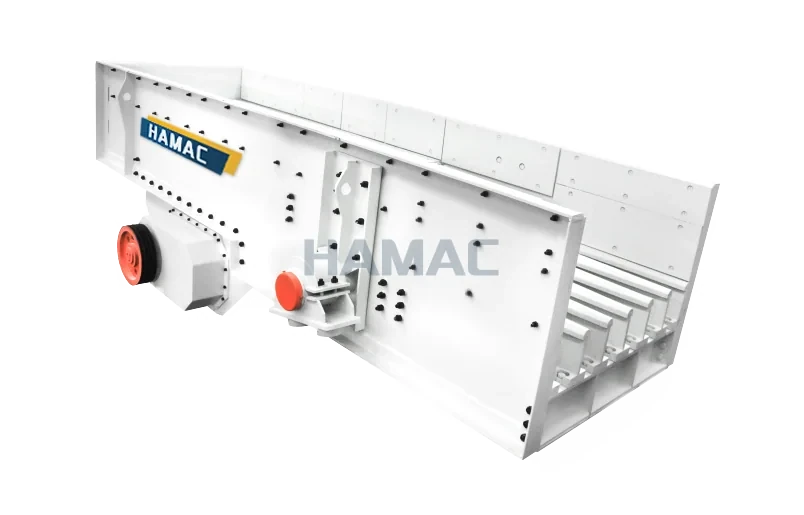
Overview
Published Vibrating Feeder specifications below are nominal values transcribed from HAMAC data. Actual performance depends on feed gradation, moisture, setting and screening efficiency.
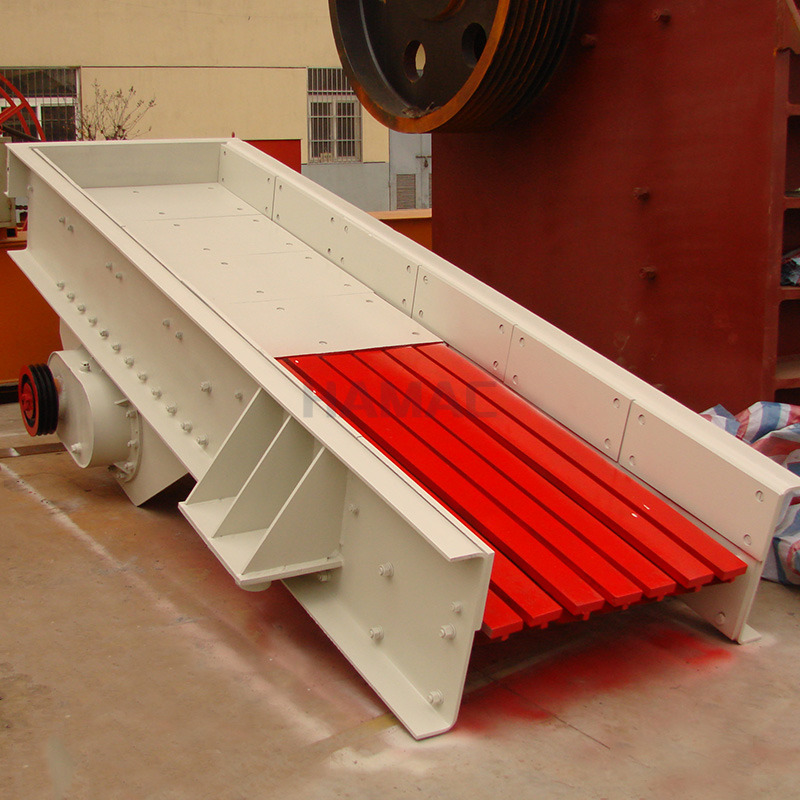
Specification table
| Parameter | Value |
|---|---|
| ZSW3090 | 900x3000 mm 400 mm |
| ZSW3896 | 960x3800 mm 500 mm |
| ZSW4211 | 1100x4200 mm 650 mm |
| ZSW4911 | 1100x4900 mm 650 mm |
| ZSW4913 | 1300x4900 mm 750 mm |
| ZSW6013 | 1300x6000 mm 750 mm |
| ZSW6015 | 1500x6000 mm 1000 mm |
How to read the data
- Rated capacity is at a specified CSS / setting and material — treat it as saleable product, not crusher throughput.
- Feed size limit protects the chamber; oversize feed causes bridging.
- Motor power scales with rotor / chamber size, not linearly with capacity.
Selecting the right model
Match the model to your target t/h at the required product size, then confirm with a HAMAC engineer before order.
Reference data for this configuration
| Parameter | Reference value |
|---|---|
| Machine line | Vibrating Feeder |
| Category | Supporting Equipments |
| Assumed duty | contract crushing on short-term sites |
| Evaluation horizon | single-project view |
Use the table as a checklist when comparing quotations for vibrating feeder — a lower price often means one of these parameters was quietly reduced.
Published Vibrating Feeder model data
| Model | Specification | Feeding size | Rotation speed | Capacity | Power | Weight |
|---|---|---|---|---|---|---|
| ZSW3090 | 900x3000 mm | 400 mm | 600~850 rpm | 90-180 t/h | 11 kw | 3450 kg |
| ZSW3896 | 960x3800 mm | 500 mm | 600~850 rpm | 120-210 t/h | 15 kw | 4450 kg |
| ZSW4211 | 1100x4200 mm | 650 mm | 600~850 rpm | 180-400 t/h | 15 kw | 4750 kg |
| ZSW4911 | 1100x4900 mm | 650 mm | 600~850 rpm | 250-480 t/h | 22 kw | 5350 kg |
| ZSW4913 | 1300x4900 mm | 750 mm | 600~850 rpm | 340-600 t/h | 22 kw | 6350 kg |
| ZSW6013 | 1300x6000 mm | 750 mm | 600~850 rpm | 340-600 t/h | 30 kw | 7800 kg |
| ZSW6015 | 1500x6000 mm | 1000 mm | 600~850 rpm | 400-800 t/h | 37 kw | 8900 kg |
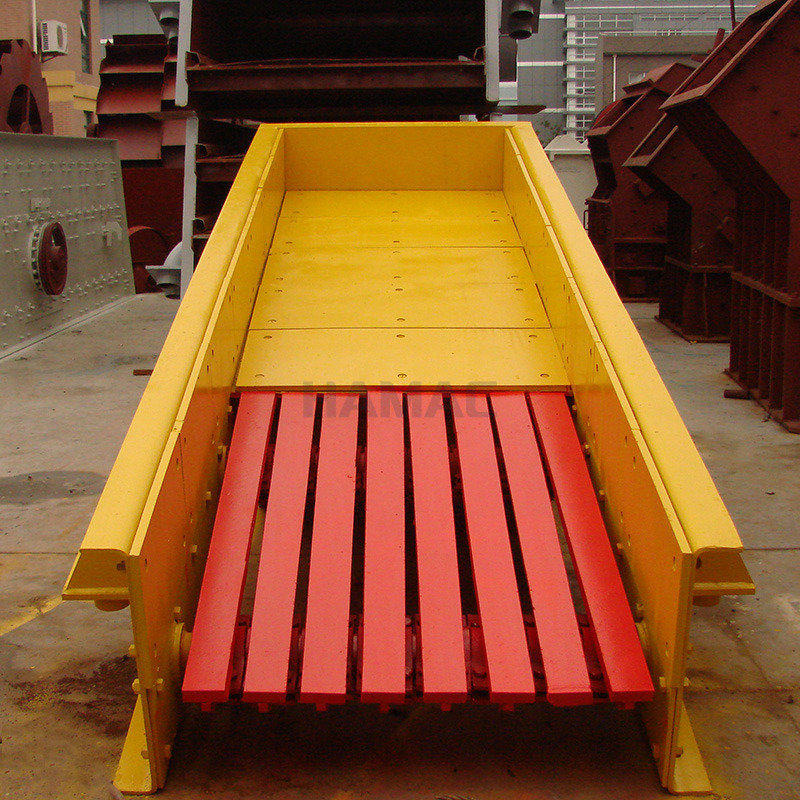
The Vibrating Feeder is an efficient feeding equipment designed to deliver materials continuously and evenly from the hopper to crushers in various industries, including mining, coal, chemical, and construction. Read the table column by column against contract crushing on short-term sites: the model you pick is the one whose published range brackets your target tonnage, not simply the largest machine in the series. Availability, motor rating and shipping data are re-confirmed for a brownfield extension in the written HAMAC proposal.
Project profile these notes assume
| Assumption | Value |
|---|---|
| Operating duty | contract crushing on short-term sites |
| Primary objective | maximum mechanical availability |
| Evaluation horizon | single-project view |
| Site condition | a brownfield extension |
| Operating team | a small contractor crew |
Change any one of these assumptions and the recommended configuration for vibrating feeder may change. HAMAC re-runs the same checks against your own numbers once the enquiry data sheet is received.
From enquiry to the first saleable tonne
- Choose compression or impact reduction according to hardness, silica content and required particle shape.
- Book shipping, prepare the packing list and confirm the container loading plan.
- Check bearing and lubrication arrangements against the ambient temperature range at the site.
- Plan training for a small contractor crew on CSS adjustment, liner change-out and lock-out / tag-out.
- Review the crusher chamber profile with the liner supplier against the feed material.
- Budget for water, dust extraction and spillage handling as part of the plant, not as an afterthought.
- Survey the feed: the feed material; record top size, bulk density, moisture and clay content before fixing the flow sheet.
- Verify the electrical single-line diagram, cable sizing and starter type with the local utility.
- Include dust suppression, guarding, emergency stops and lock-out points in the layout drawing.
Shortening this sequence is possible on a brownfield extension, but only where the feed and product specification are already fully defined.
What to verify before you sign
- Screen deck count, aperture and area; ask for the efficiency calculation, not just the mesh size.
- Saleable tonnes per hour at each product size, not gross crusher throughput, for your target tonnage.
- Closed-side setting range and whether automatic setting regulation is included.
- Liner alloy: Mn18 matched to the rock, not to the lowest purchase price.
- Product sampling points and the lab equipment needed for routine grading checks.
- Erection scope: supervision only, or full civil, mechanical and electrical installation.
- Wear-part interchangeability across machines in the same circuit.
- Spare motor, gearbox and hydraulic pump lead times from the nearest HAMAC stock point.
- Energy draw in kW and the expected kWh per tonne at the design duty.
The relative weight of each item changes with the project: wear parts dominate on abrasive rock, availability dominates on remote sites.
Where the money actually goes
| Cost line | Indicative share | What moves the number |
|---|---|---|
| Equipment & drive packages | 54% | Model size, number of stages and automation level |
| Ocean freight & insurance | 8% | Destination port, container count and out-of-gauge cargo |
| Civil works & foundations | 8% | Soil conditions, dynamic loads and site preparation |
| Erection, commissioning & training | 7% | Local labour, supervision scope and schedule |
| First-year wear parts | 15% | Rock abrasiveness, liner grade and operating hours |
| Power, lubricants & consumables | 8% | kWh per tonne, local tariff and dust suppression water |
Freight to your market is volatile; ask for the quotation to state validity and the port basis rather than a single delivered number.
Mistakes that cost more than the machine
- Forgetting surge capacity — an intermittent loader starves the chamber and ruins particle shape.
- Ignoring clay and moisture until the first wet season, when decks blind and chambers pack.
- Assuming a mobile plant can match a stationary line on high-tonnage, multi-product duty.
- Leaving tramp-iron protection out of the scope to save a small percentage of capital.
- Ordering no spares with the plant and waiting six weeks for the first liner set.
- Assuming the manufacturer's warranty covers wear parts and consumables.
- Buying on nameplate t/h without converting to saleable product at the specified fractions.
- Buying maximum mechanical availability on price alone and losing it in availability.
On a brownfield extension, the civil and logistics items deserve as much attention as the crusher itself.
Commissioning checklist
- Record the baseline grading curve for each product fraction.
- Check hydraulic pressure, accumulator pre-charge and tramp-release function.
- Calibrate the belt scale and any level probes against a known load.
- Test emergency stops, pull wires and interlock trips in sequence.
- Agree the punch list, sign the hand-over protocol and file the as-built drawings.
- Check belt tracking, chute build-up and transfer-point dust.
- Record power draw, tonnage and chamber pressure at steady state.
- Measure and log the as-new CSS / setting for future wear comparison.
The commissioning record becomes the reference for every liner change in the single-project plan.