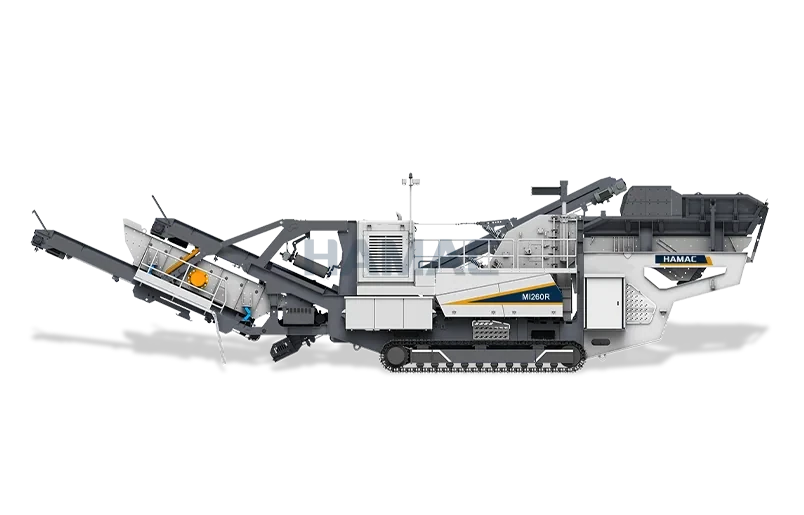
Overview
Wear parts are the largest variable cost on a Tracked Impact Crusher Plant. HAMAC supplies matched consumables and a recommended stock list with every plant.
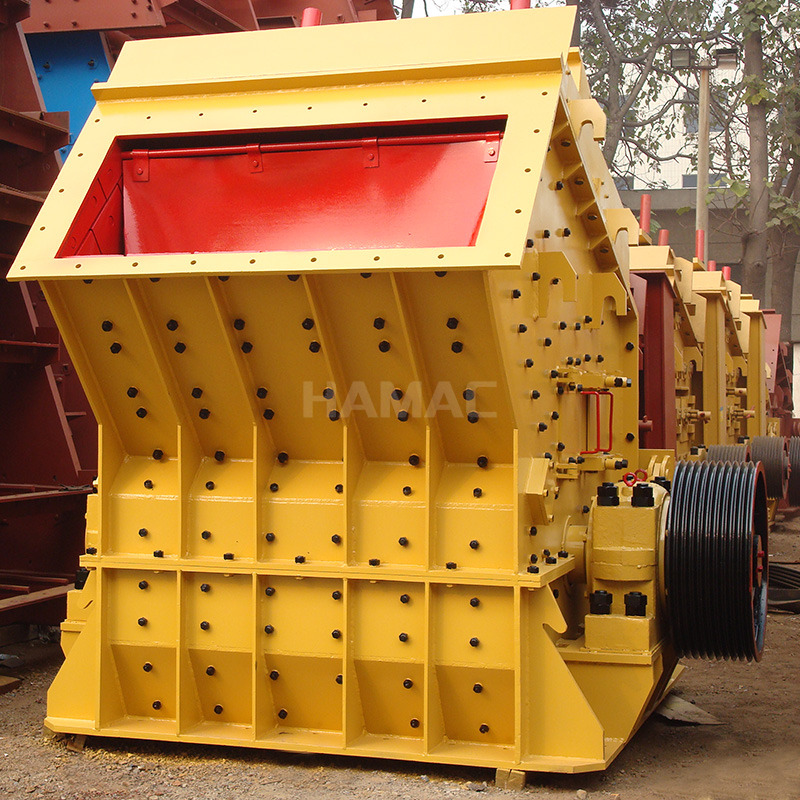
Main consumables
- Chamber liners / blow bars / Impact plates.
- Rotors, distributor plates and anvils (VSI).
- Screen meshes for every deck.
- Belts, bearings, seals and sensors.
Liner material grade
Mn13 / Mn18 / Mn22 work-harden under impact; high-chrome resists abrasion in low-impact duties. Choice follows the rock, not the price.
Recommended stock
- One full set of chamber liners or blow bars.
- Screen meshes for every deck.
- Belts, bearings and seals.
- Electrical consumables and sensors.
Reference data for this configuration
| Parameter | Reference value |
|---|---|
| Machine line | Tracked Impact Crusher Plant |
| Category | Tracked Crushing Plants |
| Assumed duty | contract crushing on short-term sites |
| Evaluation horizon | five-year view |
The figures above are transcribed from published HAMAC data and from the material properties of the feed; site measurements take precedence.
Published Tracked Impact Crusher Plant model data
| Model | MI260RE | MI350RE |
|---|---|---|
| Feeder | ||
| Volume(m³) | 7 | 7.5 |
| Feeding height(mm) | 4222 | 4124 |
| Maximum feed size(mm) | 600 | 600 |
| Feeding capacity(t/h) | 300 | 400 |
| Crusher | ||
| Host model | MIX2 | MIX3 |
| Return screen length×width(mm) | 1540x3600 | 1740x5000 |
Boost your production with the HMC series Tracked Impact Crusher Plant—track-mounted for ultimate mobility, safety, and environmental care. Read the table column by column against contract crushing on short-term sites: the model you pick is the one whose published range brackets your target tonnage, not simply the largest machine in the series. Availability, motor rating and shipping data are re-confirmed for a remote mine site in the written HAMAC proposal.
Project profile these notes assume
| Assumption | Value |
|---|---|
| Operating duty | contract crushing on short-term sites |
| Primary objective | tight grading compliance |
| Evaluation horizon | five-year view |
| Site condition | a remote mine site |
| Operating team | a full-time plant team |
Change any one of these assumptions and the recommended configuration for tracked impact crusher plant may change. HAMAC re-runs the same checks against your own numbers once the enquiry data sheet is received.
From enquiry to the first saleable tonne
- Allocate screen area per deck; blinding and pegging are the most common hidden bottlenecks in a new plant.
- Record the as-built settings and give the operator a written daily, weekly and monthly schedule.
- Choose compression or impact reduction according to hardness, silica content and required particle shape.
- Size the primary stage for your target tonnage with a 10–20% surge allowance — never on nameplate throughput alone.
- Log tonnes per liner set and kWh per tonne from day one so you have a real cost baseline within a quarter.
- Run a sieve analysis on a representative sample and attach the grading curve to the enquiry.
- Sequence delivery so foundations cure while the equipment is still in manufacture.
- Check bearing and lubrication arrangements against the ambient temperature range at the site.
- Budget for water, dust extraction and spillage handling as part of the plant, not as an afterthought.
Shortening this sequence is possible on a remote mine site, but only where the feed and product specification are already fully defined.
What to verify before you sign
- Guaranteed power draw and the tight grading compliance trade-off it implies.
- Decommissioning or relocation value at the end of a five-year horizon.
- Nameplate data for local voltage, frequency and the applicable conformity scheme.
- Wear-part interchangeability across machines in the same circuit.
- Ambient temperature, altitude and dust load derating for motors and hydraulics.
- Whether the quoted t/h is achieved at contract crushing on short-term sites or under ideal laboratory feed.
- Screen deck count, aperture and area; ask for the efficiency calculation, not just the mesh size.
- After-sales response time, technician availability and the warranty exclusions in writing.
- Control system language, telemetry and remote diagnostics availability.
The relative weight of each item changes with the project: wear parts dominate on abrasive rock, availability dominates on remote sites.
Where the money actually goes
| Cost line | Indicative share | What moves the number |
|---|---|---|
| Equipment & drive packages | 54% | Model size, number of stages and automation level |
| Ocean freight & insurance | 8% | Destination port, container count and out-of-gauge cargo |
| Civil works & foundations | 8% | Soil conditions, dynamic loads and site preparation |
| Erection, commissioning & training | 7% | Local labour, supervision scope and schedule |
| First-year wear parts | 15% | Rock abrasiveness, liner grade and operating hours |
| Power, lubricants & consumables | 8% | kWh per tonne, local tariff and dust suppression water |
Freight to your market is volatile; ask for the quotation to state validity and the port basis rather than a single delivered number.
Mistakes that cost more than the machine
- Ordering no spares with the plant and waiting six weeks for the first liner set.
- Specifying motors for the wrong voltage or frequency and rewinding them on site.
- Forgetting surge capacity — an intermittent loader starves the chamber and ruins particle shape.
- Skipping a geotechnical check and discovering settlement under the primary crusher at a remote mine site.
- Letting the contract crushing on short-term sites duty be defined verbally instead of in the contract.
- Assuming the manufacturer's warranty covers wear parts and consumables.
- Undersizing the screen, then blaming the crusher for a plant that never reaches your target tonnage.
- Skipping the acceptance test, so no one has a baseline to measure degradation against.
Every item on this list has cost someone a commissioning date; none of them requires new technology to avoid.
Commissioning checklist
- Measure and log the as-new CSS / setting for future wear comparison.
- Check hydraulic pressure, accumulator pre-charge and tramp-release function.
- Verify chute liners, skirt rubber and impact bars after the first hour of feed.
- Introduce feed in graded steps: 25%, 50%, 75%, then full load.
- Measure noise and dust at the operator position against the local limit.
- Record power draw, tonnage and chamber pressure at steady state.
- Record the baseline grading curve for each product fraction.
- Verify rotation direction on every motor before coupling.
On a remote mine site, allow extra time for the dust and noise measurements.