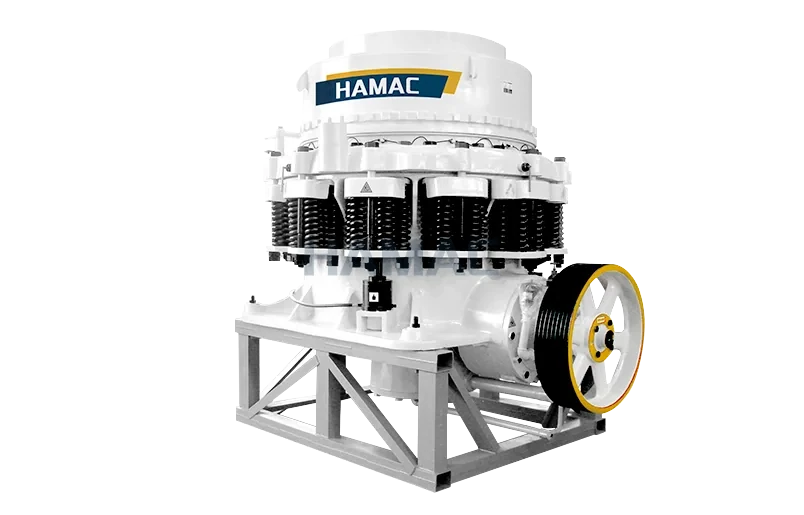
Overview
Published Symons Cone Crusher specifications below are nominal values transcribed from HAMAC data. Actual performance depends on feed gradation, moisture, setting and screening efficiency.
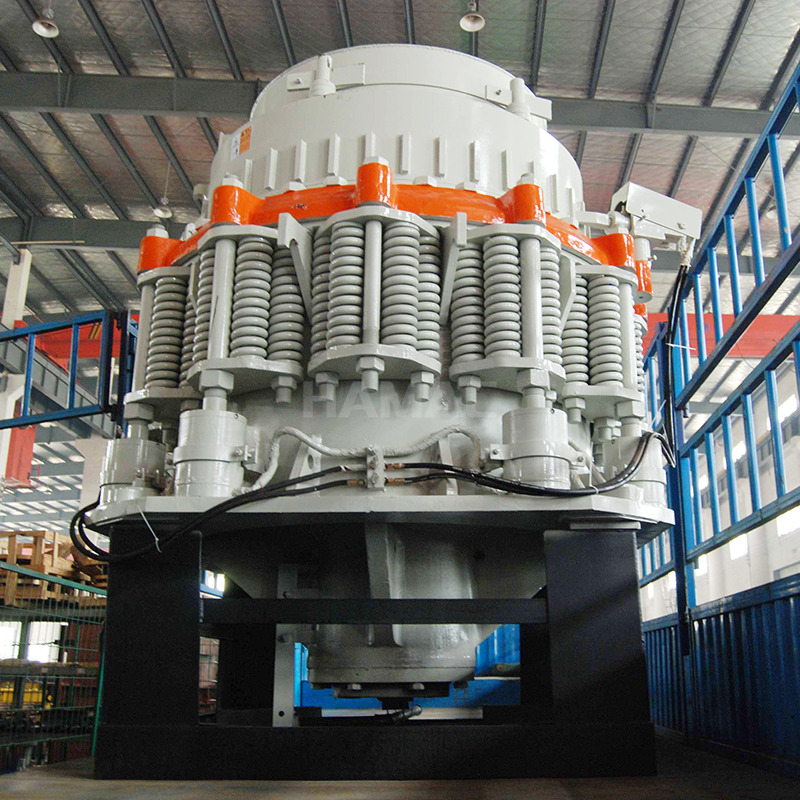
Specification table
| Parameter | Value |
|---|---|
| Dia. | 900 mm (3’) 1295 mm (4 1/4’) |
| Fine Closing Side | 83 mm 109 mm |
| Fine Open Side | 102 mm 137 mm |
| Medium Closing Side | 159 mm 188 mm |
| Medium Open Side | 175 mm 210 mm |
| Coarse Closing Side | 159 mm 216 mm |
| Coarse Open Side | 175 mm 241 mm |
How to read the data
- Rated capacity is at a specified CSS / setting and material — treat it as saleable product, not crusher throughput.
- Feed size limit protects the chamber; oversize feed causes bridging.
- Motor power scales with rotor / chamber size, not linearly with capacity.
Selecting the right model
Match the model to your target t/h at the required product size, then confirm with a HAMAC engineer before order.
Reference data for this configuration
| Parameter | Reference value |
|---|---|
| Machine line | Symons Cone Crusher |
| Category | Cone Crusher |
| Assumed duty | high-tonnage aggregate supply |
| Evaluation horizon | five-year view |
Use the table as a checklist when comparing quotations for symons cone crusher — a lower price often means one of these parameters was quietly reduced.
Published Symons Cone Crusher model data
| Model | SCC 3’ | SCC 4 1/4’ | SCC 5 1/2’ | SCC 7’ |
|---|---|---|---|---|
| Dia. | 900 mm (3’) | 1295 mm (4 1/4’) | 1650 mm (5 1/2’) | 2134 mm (7’) |
| Fine Closing Side | 83 mm | 109 mm | 188 mm | 253 mm |
| Fine Open Side | 102 mm | 137 mm | 209 mm | 278 mm |
| Medium Closing Side | 159 mm | 188 mm | 213 mm | 303 mm |
| Medium Open Side | 175 mm | 210 mm | 241 mm | 334 mm |
| Coarse Closing Side | 159 mm | 216 mm | 241 mm | 334 mm |
| Coarse Open Side | 175 mm | 241 mm | 268 mm | 369 mm |
| Outlet Setting | 9-22 mm | 13-38 mm | 16-38 mm | 19-38 mm |
S series Symons cone crusher is a kind of high efficiency cone crusher, which integrate optimization of cavity-type and reasonable stroke and advanced technology, and the conception of. Read the table column by column against high-tonnage aggregate supply: the model you pick is the one whose published range brackets your target tonnage, not simply the largest machine in the series. Availability, motor rating and shipping data are re-confirmed for a brownfield extension in the written HAMAC proposal.
Project profile these notes assume
| Assumption | Value |
|---|---|
| Operating duty | high-tonnage aggregate supply |
| Primary objective | lowest energy per tonne |
| Evaluation horizon | five-year view |
| Site condition | a brownfield extension |
| Operating team | a full-time plant team |
Change any one of these assumptions and the recommended configuration for symons cone crusher may change. HAMAC re-runs the same checks against your own numbers once the enquiry data sheet is received.
From enquiry to the first saleable tonne
- Budget for water, dust extraction and spillage handling as part of the plant, not as an afterthought.
- Size the primary stage for your target tonnage with a 10–20% surge allowance — never on nameplate throughput alone.
- Set the closed-side setting or rotor speed against the required product fractions, then verify the expected reduction ratio.
- Plan training for a full-time plant team on CSS adjustment, liner change-out and lock-out / tag-out.
- Confirm the haul-road and stockpile plan with a brownfield extension in mind before fixing conveyor lengths.
- Check bearing and lubrication arrangements against the ambient temperature range at the site.
- Include dust suppression, guarding, emergency stops and lock-out points in the layout drawing.
- Record the as-built settings and give the operator a written daily, weekly and monthly schedule.
- Lay out conveyors, access ways, stockpile capacity and drainage before ordering steelwork.
On high-tonnage aggregate supply, step ordering matters: survey and sampling must precede the equipment list, or the plant is sized to a guess.
What to verify before you sign
- Dust and noise control designed to the local emission limits for your market.
- Choke-feed arrangement: surge bin, feeder control and level indication.
- Whether the quoted t/h is achieved at high-tonnage aggregate supply or under ideal laboratory feed.
- Closed-side setting range and whether automatic setting regulation is included.
- Nameplate data for local voltage, frequency and the applicable conformity scheme.
- Delivery terms (FOB / CFR / CIF) with the destination port named explicitly.
- Access for liner change-out — crane radius, lifting points and clearance around the chamber.
- Spare motor, gearbox and hydraulic pump lead times from the nearest HAMAC stock point.
- Ambient temperature, altitude and dust load derating for motors and hydraulics.
Bring this list to the design review — it is cheaper to resolve an omission on paper than during commissioning.
Where the money actually goes
| Cost line | Indicative share | What moves the number |
|---|---|---|
| Equipment & drive packages | 54% | Model size, number of stages and automation level |
| Ocean freight & insurance | 8% | Destination port, container count and out-of-gauge cargo |
| Civil works & foundations | 8% | Soil conditions, dynamic loads and site preparation |
| Erection, commissioning & training | 7% | Local labour, supervision scope and schedule |
| First-year wear parts | 15% | Rock abrasiveness, liner grade and operating hours |
| Power, lubricants & consumables | 8% | kWh per tonne, local tariff and dust suppression water |
Model a low, base and high case for tonnes per liner set. The spread tells you more than a single optimistic estimate.
Mistakes that cost more than the machine
- Skipping a geotechnical check and discovering settlement under the primary crusher at a brownfield extension.
- Leaving tramp-iron protection out of the scope to save a small percentage of capital.
- Forgetting surge capacity — an intermittent loader starves the chamber and ruins particle shape.
- Letting the high-tonnage aggregate supply duty be defined verbally instead of in the contract.
- Assuming the manufacturer's warranty covers wear parts and consumables.
- Using one liner profile for both secondary and tertiary stages.
- Undersizing the screen, then blaming the crusher for a plant that never reaches your target tonnage.
- Choosing screen apertures before the concrete or asphalt mix design is fixed.
On a brownfield extension, the civil and logistics items deserve as much attention as the crusher itself.
Commissioning checklist
- Check hydraulic pressure, accumulator pre-charge and tramp-release function.
- Verify rotation direction on every motor before coupling.
- Measure and log the as-new CSS / setting for future wear comparison.
- Calibrate the belt scale and any level probes against a known load.
- Check lubrication levels, grease lines and oil cooler operation.
- Verify chute liners, skirt rubber and impact bars after the first hour of feed.
- Confirm the direction and tension of every belt under no load.
- Agree the punch list, sign the hand-over protocol and file the as-built drawings.
The commissioning record becomes the reference for every liner change in the five-year plan.