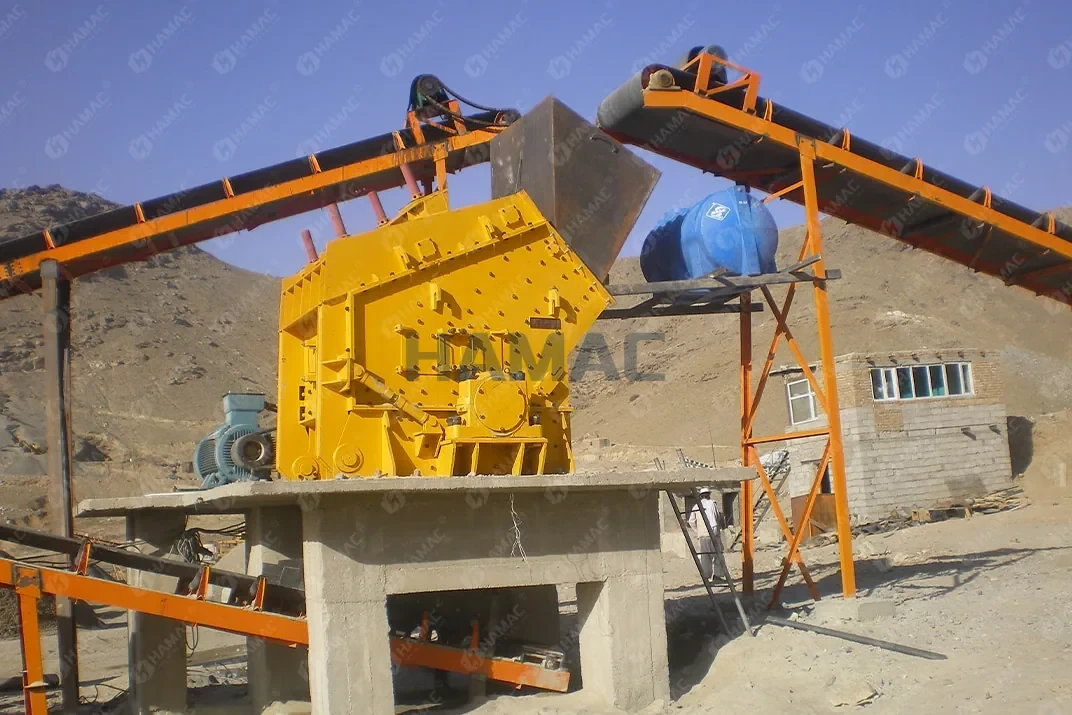
Overview
Wear parts are the largest variable cost on a PF Impact Crusher. HAMAC supplies matched consumables and a recommended stock list with every plant.
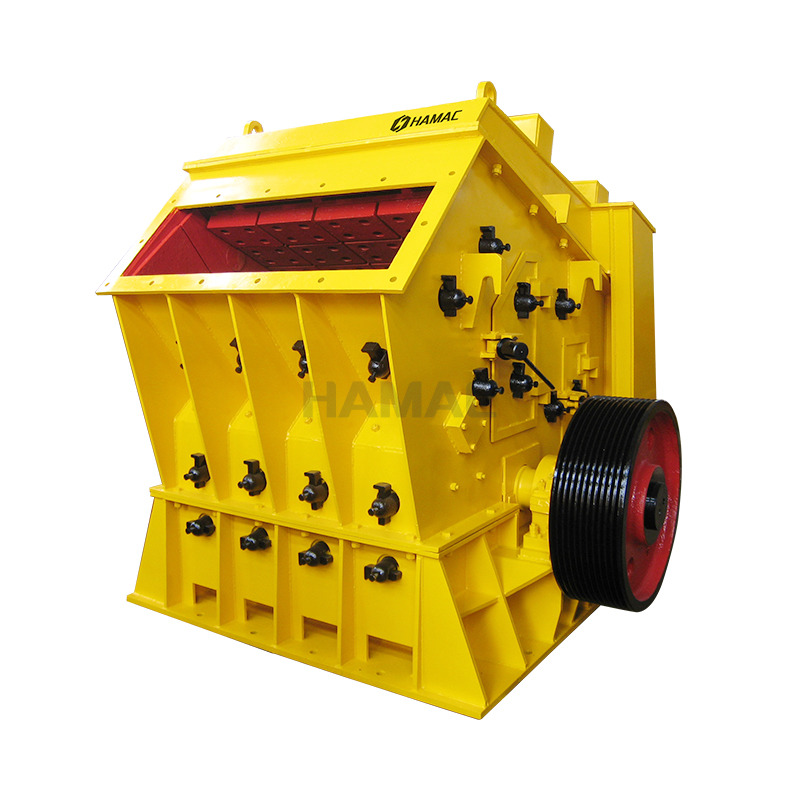
Main consumables
- Chamber liners / blow bars / Impact plates.
- Rotors, distributor plates and anvils (VSI).
- Screen meshes for every deck.
- Belts, bearings, seals and sensors.
Liner material grade
Mn13 / Mn18 / Mn22 work-harden under impact; high-chrome resists abrasion in low-impact duties. Choice follows the rock, not the price.
Recommended stock
- One full set of chamber liners or blow bars.
- Screen meshes for every deck.
- Belts, bearings and seals.
- Electrical consumables and sensors.
Reference data for this configuration
| Parameter | Reference value |
|---|---|
| Machine line | PF Impact Crusher |
| Category | Impact Crusher |
| Assumed duty | seasonal road-project supply |
| Evaluation horizon | ten-year view |
Where a value is shown as nominal, the written proposal states the guaranteed figure for your material, feed grading and ten-year operating plan.
Published PF Impact Crusher model data
| Model | Rotor size | Feed opening | Max. Feeding size | Capacity | Motor Power | Weight | Overall dimension |
|---|---|---|---|---|---|---|---|
| PF-1007 | Φ1000×700 mm | 400×730 mm | 300 mm | 30-70 t/h | 37-45 kW | 12 t | 2330×1660×2300 mm |
| PF-1010 | Φ1000×1050 mm | 400×1080 mm | 350 mm | 50-90 t/h | 45-55 kW | 15 t | 2370×1700×2390 mm |
| PF-1210 | Φ1250×1050 mm | 400×1080 mm | 350 mm | 70-130 t/h | 110 kW | 17.7 t | 2680×2160×2800 mm |
| PF-1214 | Φ1250×1400 mm | 400×1430 mm | 350 mm | 100-180 t/h | 132 kW | 22.4 t | 2650×2460×2800 mm |
| PF-1315 | Φ1320×1500 mm | 860×1520 mm | 500 mm | 130-250 t/h | 220 kW | 27 t | 3180×2720×2620 mm |
| PF-1520 | Φ1500×2000 mm | 830×2040 mm | 700 mm | 300-550 t/h | 315-400 kW | 50.6 t | 3959×3564×3330 mm |
| PF-1620 | Φ1600×2000 mm | 2000×1600 mm | 500 mm | 400-700 t/h | 400-500 kW | 58 t | 4259×3660×3450 mm |
| PF-1820 | Φ1800×2000 mm | 1260×2040 mm | 800 mm | 600-800 t/h | 630-710 kW | 83.21 t | 4400×3866×4009 mm |
The impact crusher (impact crusher) is a new generation of impact crusher developed in combination with the specific working conditions of the sand and gravel. Read the table column by column against seasonal road-project supply: the model you pick is the one whose published range brackets your target tonnage, not simply the largest machine in the series. Availability, motor rating and shipping data are re-confirmed for a confined urban yard in the written HAMAC proposal.
Project profile these notes assume
| Assumption | Value |
|---|---|
| Operating duty | seasonal road-project supply |
| Primary objective | lowest cost per tonne |
| Evaluation horizon | ten-year view |
| Site condition | a confined urban yard |
| Operating team | an owner-operator team |
Change any one of these assumptions and the recommended configuration for pf impact crusher may change. HAMAC re-runs the same checks against your own numbers once the enquiry data sheet is received.
From enquiry to the first saleable tonne
- Set the maintenance stock list from the expected wear rate, not from a percentage of the equipment price.
- Lay out conveyors, access ways, stockpile capacity and drainage before ordering steelwork.
- Log tonnes per liner set and kWh per tonne from day one so you have a real cost baseline within a quarter.
- Record the as-built settings and give the operator a written daily, weekly and monthly schedule.
- Set the closed-side setting or rotor speed against the required product fractions, then verify the expected reduction ratio.
- Review the crusher chamber profile with the liner supplier against the feed material.
- Choose compression or impact reduction according to hardness, silica content and required particle shape.
- Book shipping, prepare the packing list and confirm the container loading plan.
- Plan training for an owner-operator team on CSS adjustment, liner change-out and lock-out / tag-out.
A HAMAC project manager stays with the order from the first data sheet through hand-over in your market.
What to verify before you sign
- Erection scope: supervision only, or full civil, mechanical and electrical installation.
- Tramp-iron protection — hydraulic release, magnet and metal detection on the feed belt.
- Local service partner, technician travel time and visa requirements for your market.
- Ambient temperature, altitude and dust load derating for motors and hydraulics.
- Choke-feed arrangement: surge bin, feeder control and level indication.
- Decommissioning or relocation value at the end of a ten-year horizon.
- Saleable tonnes per hour at each product size, not gross crusher throughput, for your target tonnage.
- Wear-part interchangeability across machines in the same circuit.
- Delivery terms (FOB / CFR / CIF) with the destination port named explicitly.
Share this list with an owner-operator team as well as procurement; operators are the ones who live with the omissions.
Where the money actually goes
| Cost line | Indicative share | What moves the number |
|---|---|---|
| Equipment & drive packages | 54% | Model size, number of stages and automation level |
| Ocean freight & insurance | 8% | Destination port, container count and out-of-gauge cargo |
| Civil works & foundations | 8% | Soil conditions, dynamic loads and site preparation |
| Erection, commissioning & training | 7% | Local labour, supervision scope and schedule |
| First-year wear parts | 15% | Rock abrasiveness, liner grade and operating hours |
| Power, lubricants & consumables | 8% | kWh per tonne, local tariff and dust suppression water |
Freight to your market is volatile; ask for the quotation to state validity and the port basis rather than a single delivered number.
Mistakes that cost more than the machine
- Skipping a geotechnical check and discovering settlement under the primary crusher at a confined urban yard.
- Ordering no spares with the plant and waiting six weeks for the first liner set.
- Forgetting surge capacity — an intermittent loader starves the chamber and ruins particle shape.
- Letting the seasonal road-project supply duty be defined verbally instead of in the contract.
- Undersizing the screen, then blaming the crusher for a plant that never reaches your target tonnage.
- Omitting a bypass chute, so a single screen fault stops the whole line.
- Ignoring clay and moisture until the first wet season, when decks blind and chambers pack.
- Planning the crusher but not the conveyors, transfer chutes and stockpile capacity around it.
On a confined urban yard, the civil and logistics items deserve as much attention as the crusher itself.
Commissioning checklist
- Hand over the spare-parts list, manuals and maintenance schedule.
- Calibrate the belt scale and any level probes against a known load.
- Agree the punch list, sign the hand-over protocol and file the as-built drawings.
- Introduce feed in graded steps: 25%, 50%, 75%, then full load.
- Verify chute liners, skirt rubber and impact bars after the first hour of feed.
- Measure noise and dust at the operator position against the local limit.
- Check belt tracking, chute build-up and transfer-point dust.
- Record power draw, tonnage and chamber pressure at steady state.
The commissioning record becomes the reference for every liner change in the ten-year plan.