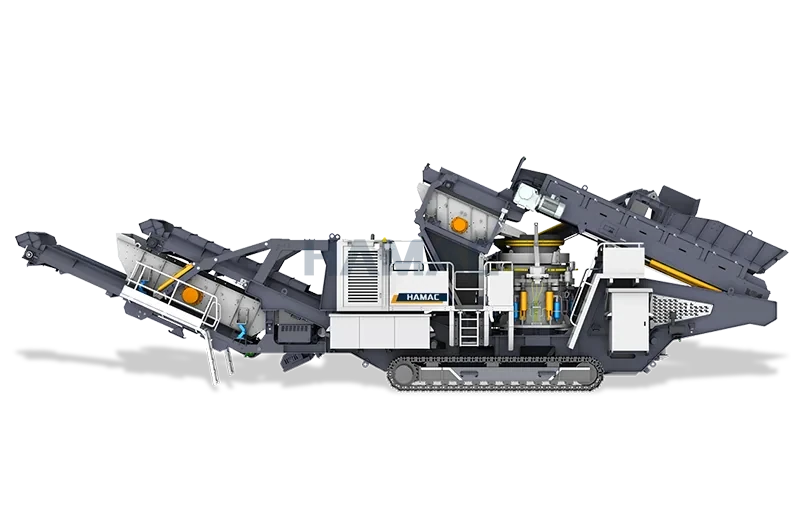
Overview
Published Tracked Cone Crusher Plant specifications below are nominal values transcribed from HAMAC data. Actual performance depends on feed gradation, moisture, setting and screening efficiency.
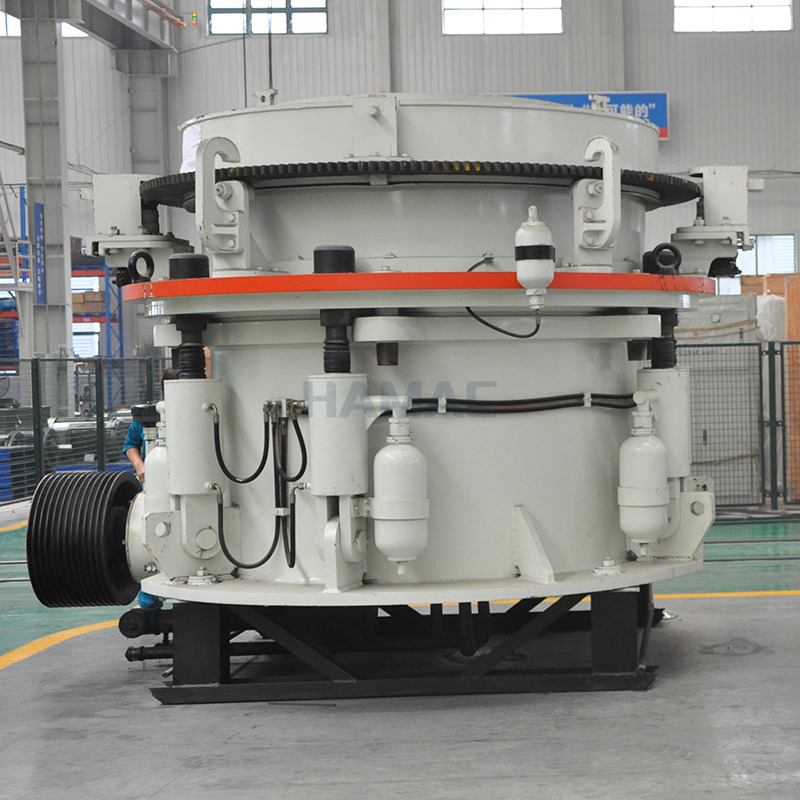
Specification table
| Parameter | Value |
|---|---|
| Feeder | |
| Volume(m³) | 6.5 6.5 |
| Feeding height(mm) | 2900 2870 |
| Maximum feed size(mm) | 185 225 |
| Feeding capacity(t/h) | 400 500 |
| Crusher | |
| Host model | HPC200 HPC300 |
How to read the data
- Rated capacity is at a specified CSS / setting and material — treat it as saleable product, not crusher throughput.
- Feed size limit protects the chamber; oversize feed causes bridging.
- Motor power scales with rotor / chamber size, not linearly with capacity.
Selecting the right model
Match the model to your target t/h at the required product size, then confirm with a HAMAC engineer before order.
Reference data for this configuration
| Parameter | Reference value |
|---|---|
| Machine line | Tracked Cone Crusher Plant |
| Category | Tracked Crushing Plants |
| Assumed duty | manufactured-sand production |
| Evaluation horizon | three-year view |
At manufactured-sand production, the ranking of these parameters changes: maximum mechanical availability usually becomes the deciding constraint rather than the headline tonnage.
Published Tracked Cone Crusher Plant model data
| Model | MC200HRSE | MC300HRE | MC300HRSE | MC400HRSE |
|---|---|---|---|---|
| Feeder | ||||
| Volume(m³) | 6.5 | 6.5 | 6.5 | 6.5 |
| Feeding height(mm) | 2900 | 2870 | 2900 | 2560 |
| Maximum feed size(mm) | 185 | 225 | 225 | 275 |
| Feeding capacity(t/h) | 400 | 500 | 500 | 700 |
| Crusher | ||||
| Host model | HPC200 | HPC300 | HPC300 | HPC400 |
| Return screen length×width(mm) | 1740x5000 | 1740x5000 | 1740x5000 | 1800x5000 |
Maximize your productivity with the versatile Tracked Cone Crusher Plant! Read the table column by column against manufactured-sand production: the model you pick is the one whose published range brackets your target tonnage, not simply the largest machine in the series. Availability, motor rating and shipping data are re-confirmed for a confined urban yard in the written HAMAC proposal.
Project profile these notes assume
| Assumption | Value |
|---|---|
| Operating duty | manufactured-sand production |
| Primary objective | maximum mechanical availability |
| Evaluation horizon | three-year view |
| Site condition | a confined urban yard |
| Operating team | a full-time plant team |
Change any one of these assumptions and the recommended configuration for tracked cone crusher plant may change. HAMAC re-runs the same checks against your own numbers once the enquiry data sheet is received.
From enquiry to the first saleable tonne
- Include dust suppression, guarding, emergency stops and lock-out points in the layout drawing.
- Set the maintenance stock list from the expected wear rate, not from a percentage of the equipment price.
- Verify the electrical single-line diagram, cable sizing and starter type with the local utility.
- Define the acceptance test: sampling points, test duration, moisture range and who signs the protocol.
- Confirm the haul-road and stockpile plan with a confined urban yard in mind before fixing conveyor lengths.
- Lay out conveyors, access ways, stockpile capacity and drainage before ordering steelwork.
- Budget for water, dust extraction and spillage handling as part of the plant, not as an afterthought.
- Confirm site voltage, frequency and applicable conformity standards before manufacture.
- Book shipping, prepare the packing list and confirm the container loading plan.
Shortening this sequence is possible on a confined urban yard, but only where the feed and product specification are already fully defined.
What to verify before you sign
- Spare motor, gearbox and hydraulic pump lead times from the nearest HAMAC stock point.
- Tramp-iron protection — hydraulic release, magnet and metal detection on the feed belt.
- Energy draw in kW and the expected kWh per tonne at the design duty.
- Whether the quoted t/h is achieved at manufactured-sand production or under ideal laboratory feed.
- Screen deck count, aperture and area; ask for the efficiency calculation, not just the mesh size.
- Guaranteed power draw and the maximum mechanical availability trade-off it implies.
- Wear-part interchangeability across machines in the same circuit.
- Liner alloy: Mn22 matched to the rock, not to the lowest purchase price.
- Closed-side setting range and whether automatic setting regulation is included.
Bring this list to the design review — it is cheaper to resolve an omission on paper than during commissioning.
Where the money actually goes
| Cost line | Indicative share | What moves the number |
|---|---|---|
| Equipment & drive packages | 54% | Model size, number of stages and automation level |
| Ocean freight & insurance | 8% | Destination port, container count and out-of-gauge cargo |
| Civil works & foundations | 8% | Soil conditions, dynamic loads and site preparation |
| Erection, commissioning & training | 7% | Local labour, supervision scope and schedule |
| First-year wear parts | 15% | Rock abrasiveness, liner grade and operating hours |
| Power, lubricants & consumables | 8% | kWh per tonne, local tariff and dust suppression water |
Model a low, base and high case for tonnes per liner set. The spread tells you more than a single optimistic estimate.
Mistakes that cost more than the machine
- Specifying motors for the wrong voltage or frequency and rewinding them on site.
- Omitting a bypass chute, so a single screen fault stops the whole line.
- Buying on nameplate t/h without converting to saleable product at the specified fractions.
- Buying maximum mechanical availability on price alone and losing it in availability.
- Ignoring clay and moisture until the first wet season, when decks blind and chambers pack.
- Overlooking dust, noise and water permits in your market until erection has already started.
- Undersizing the screen, then blaming the crusher for a plant that never reaches your target tonnage.
- Skipping the acceptance test, so no one has a baseline to measure degradation against.
On a confined urban yard, the civil and logistics items deserve as much attention as the crusher itself.
Commissioning checklist
- Hand over the spare-parts list, manuals and maintenance schedule.
- Record power draw, tonnage and chamber pressure at steady state.
- Record the baseline grading curve for each product fraction.
- Confirm the direction and tension of every belt under no load.
- Dry-run the plant empty for the specified period and record vibration.
- Calibrate the belt scale and any level probes against a known load.
- Verify chute liners, skirt rubber and impact bars after the first hour of feed.
- Sample each product fraction and compare with the specification.
On a confined urban yard, allow extra time for the dust and noise measurements.