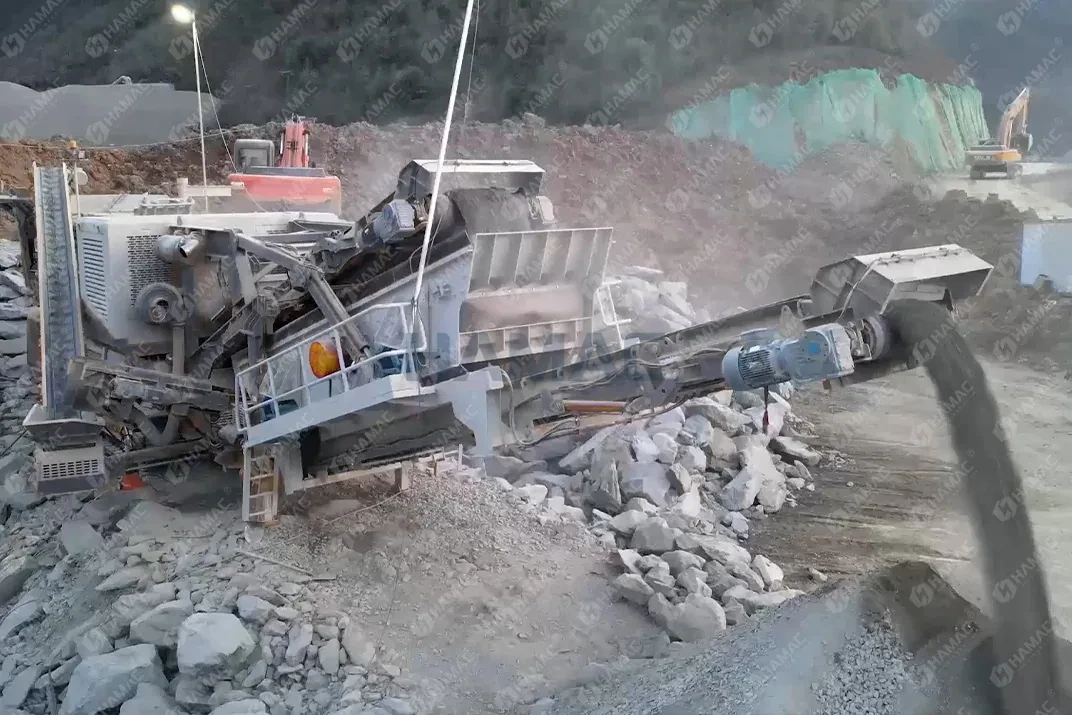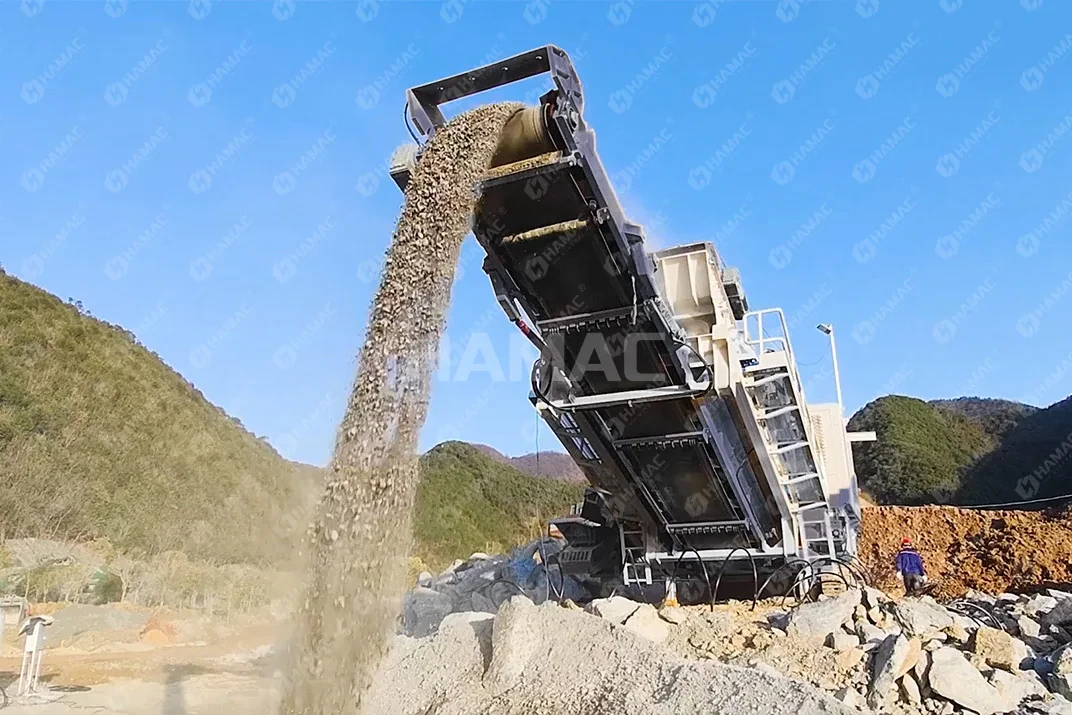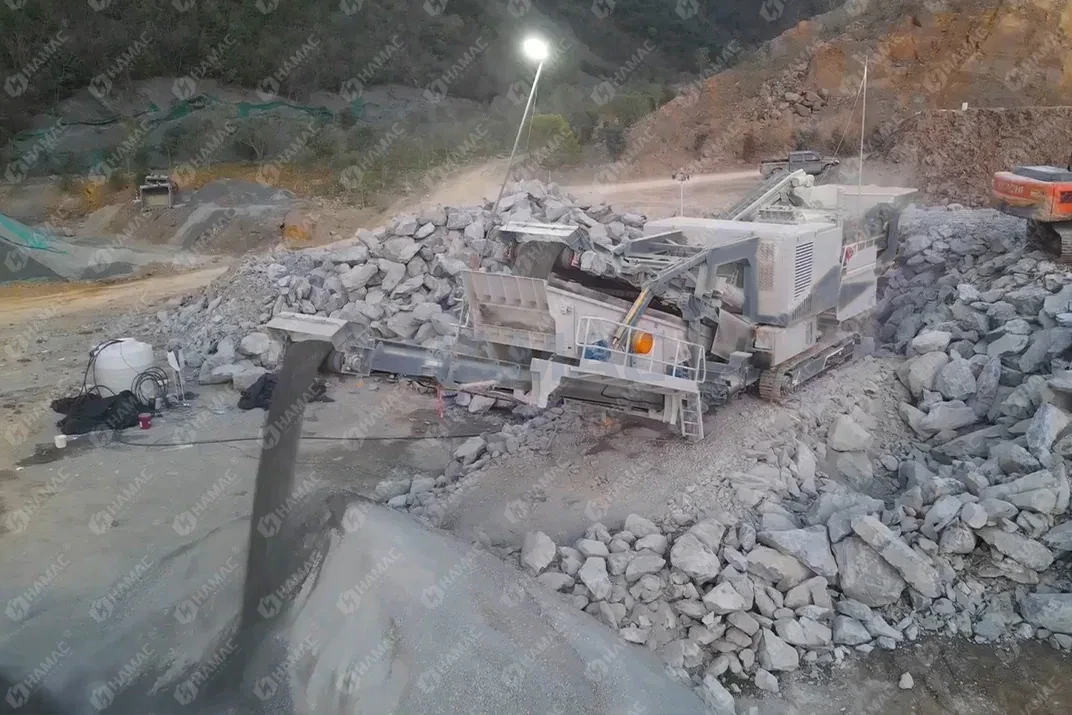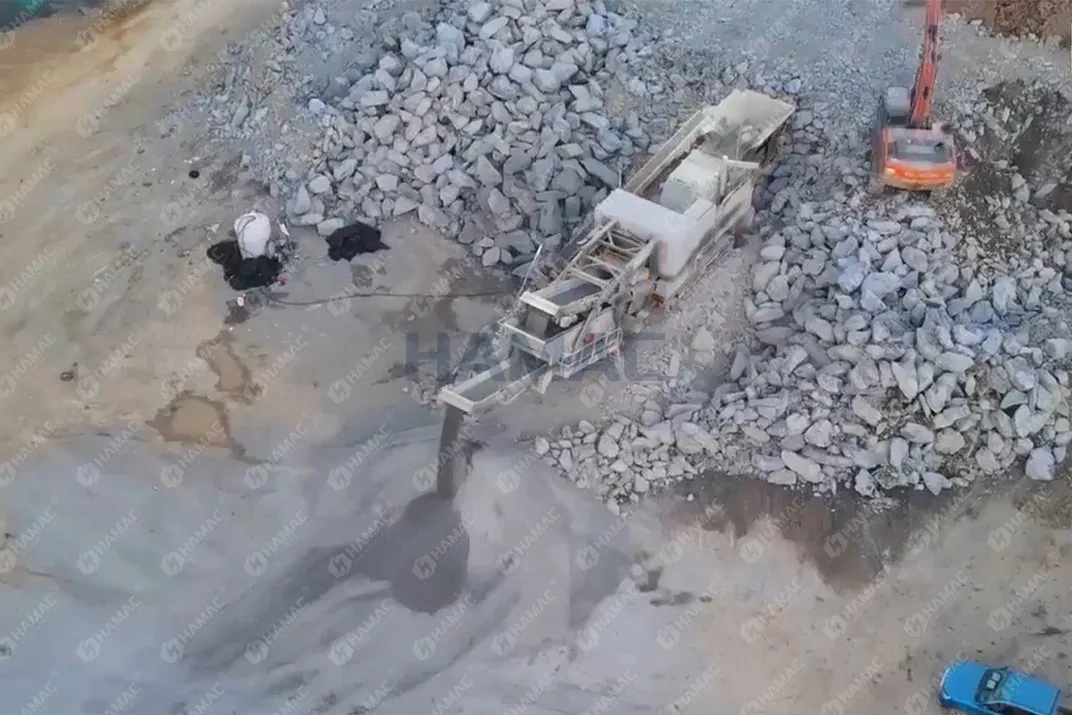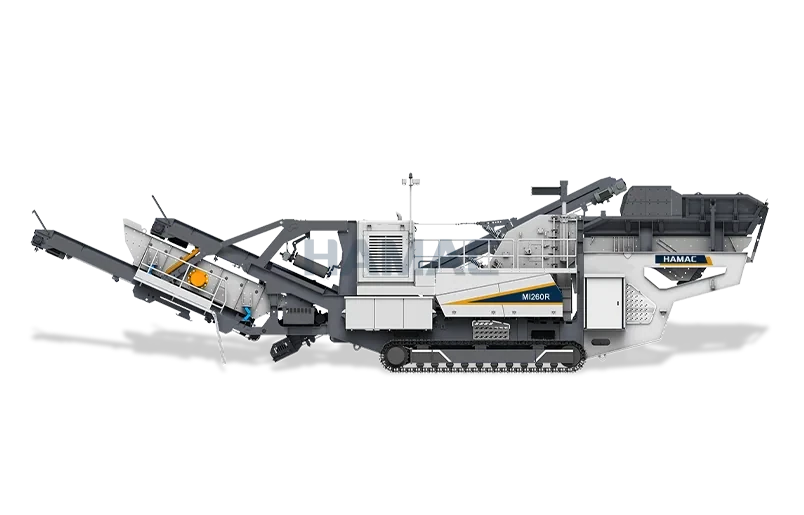
What is a Tracked Impact Crusher Plant?
Tracked Impact Crusher Plant is a tracked crushing plants built by HAMAC for mobile and semi-mobile crushing and screening. Boost your production with the HMC series Tracked Impact Crusher Plant—track-mounted for ultimate mobility, safety, and environmental care. The published range covers 27 standard models, with engineering support for flow-sheet design, installation and spare parts worldwide.
The HMC tracked impact crusher plant is a crawler-mounted unit for high-mobility, safe and low-emission crushing in aggregates and recycling. Models MI260RE (7 m3 hopper) and MI350RE (7.5 m3 hopper) pair impact crushing with on-board screening.
HAMAC supplies the Tracked Impact Crusher Plant as a standalone machine or as part of a complete crushing, screening and conveying circuit. Every quotation is built from five inputs: raw material and its compressive strength / abrasiveness, maximum feed size, required capacity in tonnes per hour, required product sizes, and site conditions (grid power, space, mobility, environmental limits).
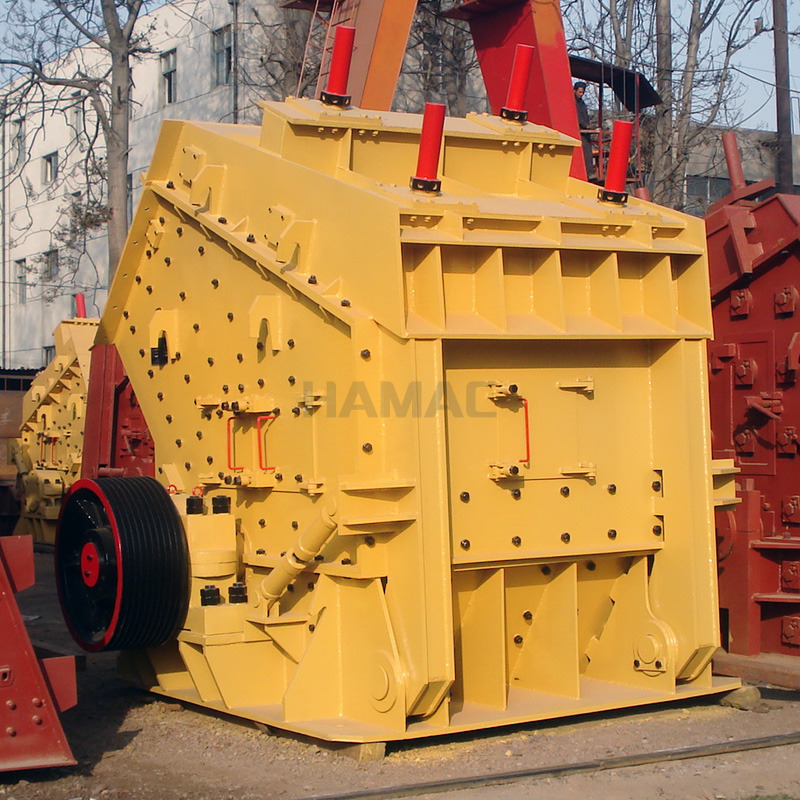
How does a Tracked Impact Crusher Plant work?
A tracked feeder feeds the impact crusher; the rotor-and-blow-bar stage produces a cubical product, which the return screen grades in closed circuit.
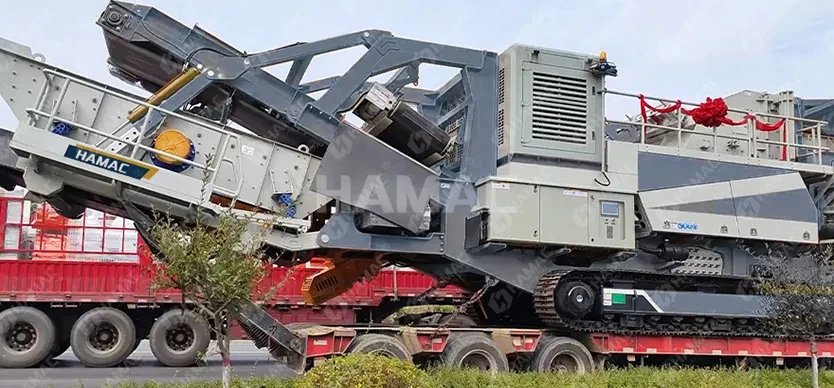
In a typical closed circuit, vibrating feeders meter the material, the crusher reduces it, vibrating screens separate the sizes and belt conveyors recirculate oversize. This loop is what stabilises product gradation — the crusher alone does not determine the final particle size distribution.
Tracked Impact Crusher Plant technical specifications
The table below reproduces the published HAMAC technical data for the Tracked Impact Crusher Plant. Values are nominal; actual throughput depends on feed gradation, bulk density, moisture, crusher setting and screen efficiency. All dimensions are in millimetres unless stated otherwise.
| Model | MI260RE | MI350RE |
|---|---|---|
| Feeder | ||
| Volume(m³) | 7 | 7.5 |
| Feeding height(mm) | 4222 | 4124 |
| Maximum feed size(mm) | 600 | 600 |
| Feeding capacity(t/h) | 300 | 400 |
| Crusher | ||
| Host model | MIX2 | MIX3 |
| Return screen length×width(mm) | 1540x3600 | 1740x5000 |
| Number of layers | 1 | 1 |
| Closed side setting(mm) | 25-100 | 25-100 |
| Conveyor | ||
| Main conveyor belt width (mm) | 1200 | 1200 |
| Transfer conveyor belt width (mm) | 500 | 500 |
| Re-circulation conveyor belt width (mm) | 500 | 500 |
| Under screen conveyor belt width (mm) | 1200 | 1000 |
| Stack height (mm) | 3471 | 3042 |
| Power Unit | ||
| Generator power (kW) | 400KW | 500KW |
| Diesel tank capacity | 1000L | 1000L |
| Hydraulic tank capacity | 300L | 300L |
| Technical Data | ||
| Total power(kw) | 262.6 | 347.2 |
| Host power(kw) | 200 | 280 |
| Processing capacity(t/h) | 160-350 | 250-500 |
| Track speed(km/h) | 0.6-1 | 0.6-1 |
| Total weight(t) | 57 | 65 |
| Transport dimension(mm) | 18127×3626×3872 | 18882x3505x3872 |
Need imperial units or a specific model? Ask for the full datasheet with motor voltages (380 V / 415 V / 440 V, 50 or 60 Hz), shipping dimensions, container loading plan and recommended spare-parts list via the enquiry form.
Suitable materials and plant position
Choosing a crusher by material is more reliable than choosing by horsepower. Hard, abrasive and high-silica rocks wear impact parts quickly and are normally handled by compression crushers; softer, non-abrasive rock can be reduced in a single impact pass with better particle shape.
| Material / duty | Typical circuit | Engineering note |
|---|---|---|
| Granite / basalt (hard, abrasive) | Jaw crusher → hydraulic cone crusher → VSI (optional) | Compression crushing; avoid impact crushers as wear cost rises sharply above ~150 MPa |
| Limestone / marble (soft–medium) | Jaw crusher → impact crusher → vibrating screen | Impact crushing gives excellent cubical shape and a high reduction ratio in one pass |
| River pebble / cobble | Jaw crusher → cone crusher → VSI sand maker | High silica content makes wear-part selection the main operating cost driver |
| Iron / copper / gold / manganese ore | Jaw crusher → cone crusher → screening → grinding mill | Feed size to the mill is usually controlled below 15–25 mm |
| Construction & demolition waste | Mobile impact crusher + screen + magnetic separator | Tracked or wheel mobile units avoid hauling waste off site |
| Coal / gypsum / calcite / barite | Crusher → YGM or MTW grinding mill → classifier | Product fineness is normally specified in mesh or microns, not millimetres |
For capacity planning, use the plant-by-capacity matrix, then confirm the crusher setting (CSS), screening area and conveyor widths with a HAMAC engineer before ordering.
Key features and operating benefits
- Track-mounted mobility across soft or steep ground
- Cubical product from single-pass impact crushing
- On-board return screen for closed-circuit operation
- Eco-friendly engine and dust-control options
- Radio remote for safe operation
These design choices mainly affect three running costs: energy per tonne, wear-part consumption per tonne, and unplanned downtime. When comparing quotations, ask suppliers to state all three for your material rather than comparing only the purchase price. See how to calculate crusher operating cost per tonne.
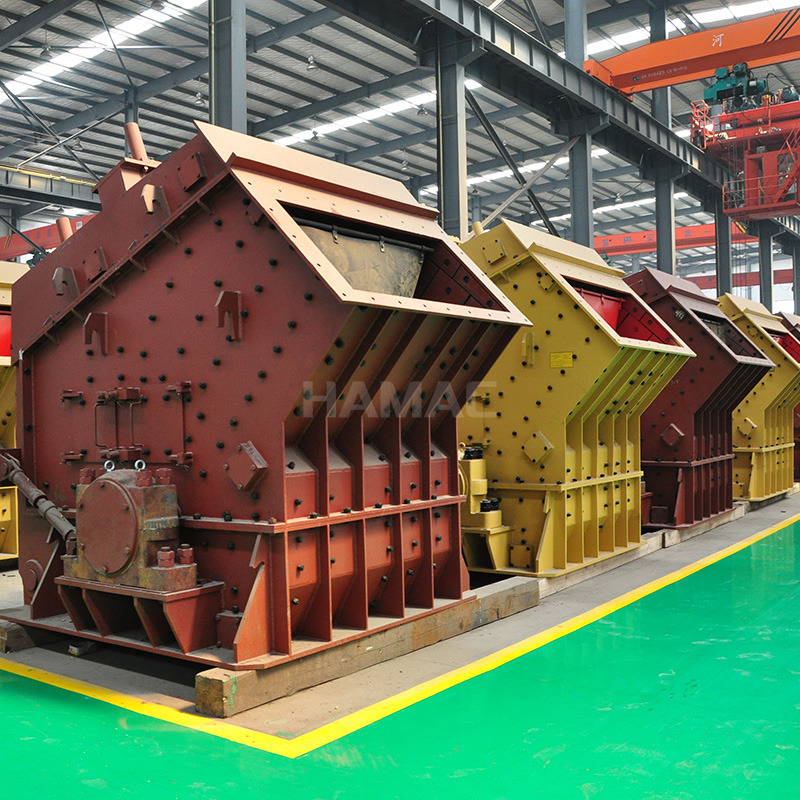
How to select the right Tracked Impact Crusher Plant model
Use the following sequence — it is the same method HAMAC engineers apply when preparing a quotation:
- Define the feed. Maximum block size, compressive strength (MPa), silica / abrasiveness index, moisture and clay content.
- Define the product. Required fractions in mm, the share of manufactured sand, and the shape / flakiness requirement.
- Set the capacity. Rated t/h at a defined closed-side setting, plus peak / surge allowance (usually 10–20%).
- Choose the circuit. Stationary, wheel mobile, tracked, or modular — based on project duration and relocation frequency.
- Check utilities and logistics. Available power, foundation work, container / road transport limits and local dust and noise rules.
| Plant capacity | Typical main machines | Circuit note |
|---|---|---|
| 50–100 t/h | PE500×750 / PE600×900 jaw + PF1010 impact or small cone | 1–2 screen decks, 1 mobile unit or a compact stationary line |
| 100–200 t/h | PE750×1060 jaw + HPT200 / PF1214 + 3YK1860 screen | The most common range for quarry and contractor projects |
| 200–300 t/h | PE900×1200 jaw + HPT300 / HP300 + 3YK2160 screen | Two-stage crushing with closed-circuit screening |
| 300–500 t/h | PE1000×1200 / C110 jaw + two cone crushers + 3YK2460 screens | Requires a proper stockpile, conveyor and dust-control design |
| 500–1000+ t/h | Multiple parallel crushing lines + modular screening towers | Engineered as a full plant with power, civil and automation design |
Tracked Impact Crusher Plant photographs