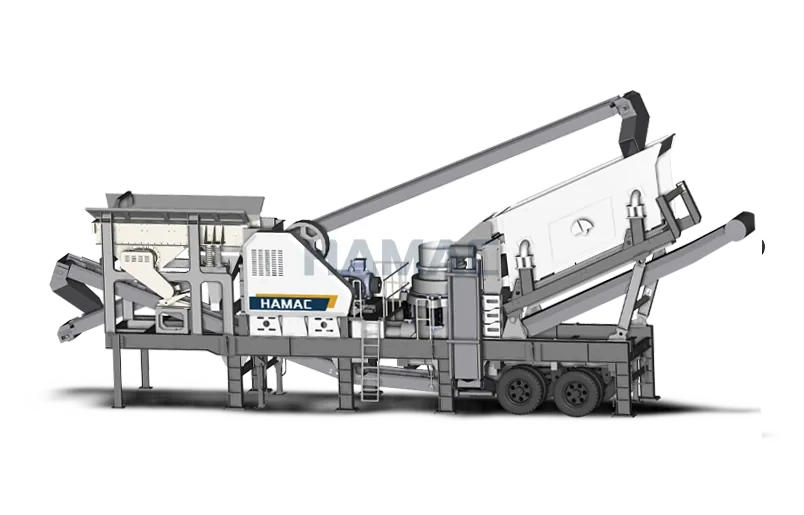
Overview
The Mobile 3 In 1 Crushing & Screening Plant is offered across several model sizes. Price depends on capacity, wear-package grade, mobility (stationary, wheel or tracked) and the level of automation, not on a single list price.
What drives the price
- Model size and rated capacity — larger rotors / chambers cost more.
- Mobility: stationary < wheel-mounted < tracked (tracked adds hydraulic & engine cost).
- Motor specification and starter (soft-start / VFD) and local voltage.
- Wear-parts grade (Mn13 / Mn18 / Mn22 / high-chrome) and spare-parts package.
- Control system: relay panel vs PLC with remote monitoring.
Typical price brackets
Entry models for contractor use start in the low five-figure USD range; mid-size export configurations are typically six-figure; large tracked or fully automated lines are higher. Exact numbers depend on the technical specification — request a written quotation rather than a ballpark.
How to get an accurate quote
Send material, feed size, target t/h and product sizes. HAMAC returns a flow sheet, equipment list and FOB / CFR / CIF price within 24 hours.
Reference data for this configuration
| Parameter | Reference value |
|---|---|
| Machine line | Mobile 3 In 1 Crushing & Screening Plant |
| Category | Wheel Type Mobile Crushers |
| Assumed duty | high-tonnage aggregate supply |
| Evaluation horizon | ten-year view |
The figures above are transcribed from published HAMAC data and from the material properties of the feed; site measurements take precedence.
Published Mobile 3 In 1 Crushing & Screening Plant model data
| Model | Vibrating feeder | Impact crusher | Vibrating screen | Main belt | Capacity (t/h) |
|---|---|---|---|---|---|
| K3-PF1214-3C | GZD1142 | PFV1214 | 3YK1848 | B1000 | 100–200 |
| K3-LF150-3C | GZD9638 | LF150 | 3YK1548 | B800 | 80–150 |
| K3-LF250-3C | GZD1142 | LF250 | 3YK1848 | B1000 | 150–300 |
Feeding, crushing and screening on one wheel chassis — 80–300 t/h — for contractors who need a complete plant with minimal setup. Read the table column by column against high-tonnage aggregate supply: the model you pick is the one whose published range brackets your target tonnage, not simply the largest machine in the series. Availability, motor rating and shipping data are re-confirmed for a brownfield extension in the written HAMAC proposal.
Project profile these notes assume
| Assumption | Value |
|---|---|
| Operating duty | high-tonnage aggregate supply |
| Primary objective | simple operator maintenance |
| Evaluation horizon | ten-year view |
| Site condition | a brownfield extension |
| Operating team | a full-time plant team |
Change any one of these assumptions and the recommended configuration for mobile 3 in 1 crushing & screening plant may change. HAMAC re-runs the same checks against your own numbers once the enquiry data sheet is received.
From enquiry to the first saleable tonne
- Confirm site voltage, frequency and applicable conformity standards before manufacture.
- Review the crusher chamber profile with the liner supplier against the feed material.
- Log tonnes per liner set and kWh per tonne from day one so you have a real cost baseline within a quarter.
- Allocate screen area per deck; blinding and pegging are the most common hidden bottlenecks in a new plant.
- Run a sieve analysis on a representative sample and attach the grading curve to the enquiry.
- Size the primary stage for your target tonnage with a 10–20% surge allowance — never on nameplate throughput alone.
- Commission with graded load, sample the product grading, then train operators on liner change-out and daily checks.
- Check bearing and lubrication arrangements against the ambient temperature range at the site.
- Lay out conveyors, access ways, stockpile capacity and drainage before ordering steelwork.
On high-tonnage aggregate supply, step ordering matters: survey and sampling must precede the equipment list, or the plant is sized to a guess.
What to verify before you sign
- Liner alloy: Mn13 matched to the rock, not to the lowest purchase price.
- Spare-parts consignment: one full liner or blow-bar set plus meshes, belts, bearings and seals.
- Spare motor, gearbox and hydraulic pump lead times from the nearest HAMAC stock point.
- Tramp-iron protection — hydraulic release, magnet and metal detection on the feed belt.
- Wear-part interchangeability across machines in the same circuit.
- Control system language, telemetry and remote diagnostics availability.
- Energy draw in kW and the expected kWh per tonne at the design duty.
- Ambient temperature, altitude and dust load derating for motors and hydraulics.
- Saleable tonnes per hour at each product size, not gross crusher throughput, for your target tonnage.
These are the items HAMAC puts in the technical proposal; if another offer is silent on them, ask why.
Where the money actually goes
| Cost line | Indicative share | What moves the number |
|---|---|---|
| Equipment & drive packages | 54% | Model size, number of stages and automation level |
| Ocean freight & insurance | 8% | Destination port, container count and out-of-gauge cargo |
| Civil works & foundations | 8% | Soil conditions, dynamic loads and site preparation |
| Erection, commissioning & training | 7% | Local labour, supervision scope and schedule |
| First-year wear parts | 15% | Rock abrasiveness, liner grade and operating hours |
| Power, lubricants & consumables | 8% | kWh per tonne, local tariff and dust suppression water |
Freight to your market is volatile; ask for the quotation to state validity and the port basis rather than a single delivered number.
Mistakes that cost more than the machine
- Skipping the acceptance test, so no one has a baseline to measure degradation against.
- Undersizing the screen, then blaming the crusher for a plant that never reaches your target tonnage.
- Choosing screen apertures before the concrete or asphalt mix design is fixed.
- Overlooking dust, noise and water permits in your market until erection has already started.
- Comparing quotations with different port terms and calling the lower number cheaper.
- Assuming the manufacturer's warranty covers wear parts and consumables.
- Selecting the cheapest liner alloy for hard, high-silica rock and paying for it in change-outs.
- Using one liner profile for both secondary and tertiary stages.
Review the list with a full-time plant team before the order is placed — they will recognise most of them.
Commissioning checklist
- Confirm the direction and tension of every belt under no load.
- Check hydraulic pressure, accumulator pre-charge and tramp-release function.
- Measure and log the as-new CSS / setting for future wear comparison.
- Record power draw, tonnage and chamber pressure at steady state.
- Test emergency stops, pull wires and interlock trips in sequence.
- Verify rotation direction on every motor before coupling.
- Hand over the spare-parts list, manuals and maintenance schedule.
- Measure noise and dust at the operator position against the local limit.
Keep the signed record; it is the only defensible baseline for later performance disputes.