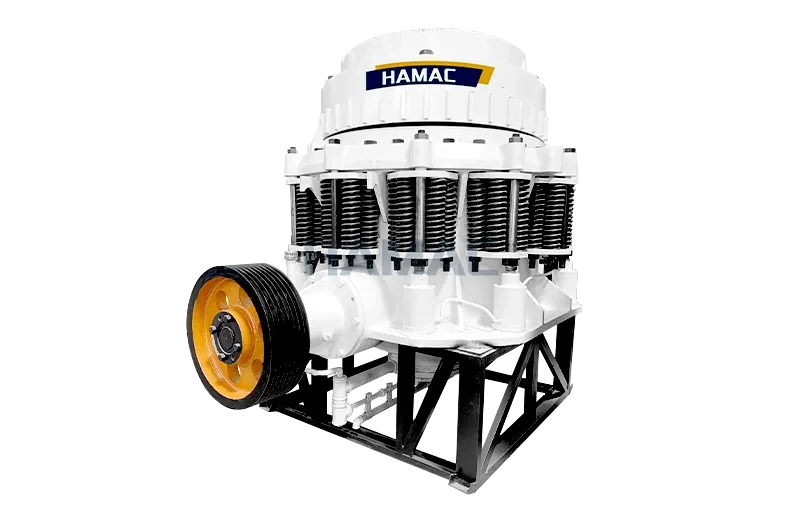
Overview
The Compound Cone Crusher is offered across several model sizes. Price depends on capacity, wear-package grade, mobility (stationary, wheel or tracked) and the level of automation, not on a single list price.
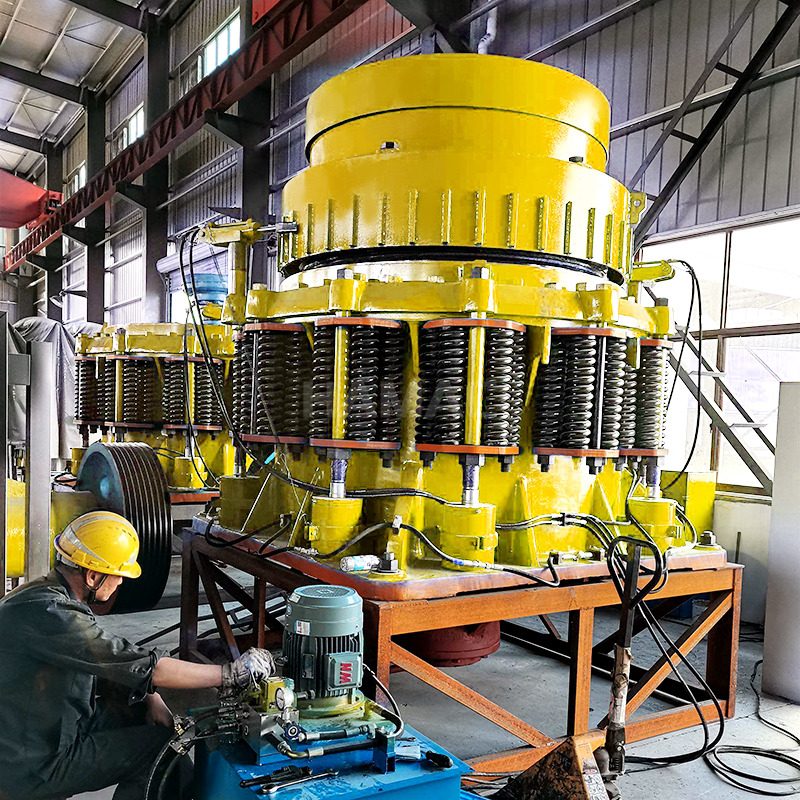
What drives the price
- Model size and rated capacity — larger rotors / chambers cost more.
- Mobility: stationary < wheel-mounted < tracked (tracked adds hydraulic & engine cost).
- Motor specification and starter (soft-start / VFD) and local voltage.
- Wear-parts grade (Mn13 / Mn18 / Mn22 / high-chrome) and spare-parts package.
- Control system: relay panel vs PLC with remote monitoring.
Typical price brackets
Entry models for contractor use start in the low five-figure USD range; mid-size export configurations are typically six-figure; large tracked or fully automated lines are higher. Exact numbers depend on the technical specification — request a written quotation rather than a ballpark.
How to get an accurate quote
Send material, feed size, target t/h and product sizes. HAMAC returns a flow sheet, equipment list and FOB / CFR / CIF price within 24 hours.
Reference data for this configuration
| Parameter | Reference value |
|---|---|
| Machine line | Compound Cone Crusher |
| Category | Cone Crusher |
| Assumed duty | mine pre-beneficiation feed |
| Evaluation horizon | single-project view |
The figures above are transcribed from published HAMAC data and from the material properties of the feed; site measurements take precedence.
Published Compound Cone Crusher model data
| Model | Cavity Type | Stroke | Feed Limit | Exit Aperture | Capacity | Motor Power | Weight |
|---|---|---|---|---|---|---|---|
| HMC1650C2-D | Coarse | 34 mm | 300 mm | 35-65 mm | 280-610 t/h | 250 kw | 35 t |
| HMC1650C-D | Coarse | 34 mm | 260 mm | 30-60 mm | 265-580 t/h | 250 kw | 35 t |
| HMC1650Z-D | Medium Coarse | 34 mm | 240 mm | 25-60 mm | 240-550 t/h | 250 kw | 35 t |
| HMC1650S-X | Fine | 28 mm | 130 mm | 20-45 mm | 180-350 t/h | 250 kw | 35 t |
| HMC1400C-D | Coarse | 30 mm | 235 mm | 30-60 mm | 210-530 t/h | 220 kw | 25 t |
| HMC1400Z-D | Medium Coarse | 30 mm | 215 mm | 25-50 mm | 200-500 t/h | 220 kw | 25 t |
| HMC1400Z-X | Medium Coarse | 25 mm | 180 mm | 22-45 mm | 180-475 t/h | 220 kw | 25 t |
| HMC1400S-X | Fine | 25 mm | 100 mm | 19-40 mm | 130-260 t/h | 220 kw | 25 t |
HMC series compound spring cone crusher is a more convenient cone crusher which is researched on the base of traditional spring cone crusher. Read the table column by column against mine pre-beneficiation feed: the model you pick is the one whose published range brackets your target tonnage, not simply the largest machine in the series. Availability, motor rating and shipping data are re-confirmed for an existing quarry bench in the written HAMAC proposal.
Project profile these notes assume
| Assumption | Value |
|---|---|
| Operating duty | mine pre-beneficiation feed |
| Primary objective | lowest energy per tonne |
| Evaluation horizon | single-project view |
| Site condition | an existing quarry bench |
| Operating team | a full-time plant team |
Change any one of these assumptions and the recommended configuration for compound cone crusher may change. HAMAC re-runs the same checks against your own numbers once the enquiry data sheet is received.
From enquiry to the first saleable tonne
- Check bearing and lubrication arrangements against the ambient temperature range at the site.
- Define the acceptance test: sampling points, test duration, moisture range and who signs the protocol.
- Review the crusher chamber profile with the liner supplier against the feed material.
- Run a sieve analysis on a representative sample and attach the grading curve to the enquiry.
- Sequence delivery so foundations cure while the equipment is still in manufacture.
- Lay out conveyors, access ways, stockpile capacity and drainage before ordering steelwork.
- Commission with graded load, sample the product grading, then train operators on liner change-out and daily checks.
- Budget for water, dust extraction and spillage handling as part of the plant, not as an afterthought.
- Survey the feed: the feed material; record top size, bulk density, moisture and clay content before fixing the flow sheet.
The sequence is deliberately front-loaded — decisions taken before manufacture are cheap, changes made on site are not.
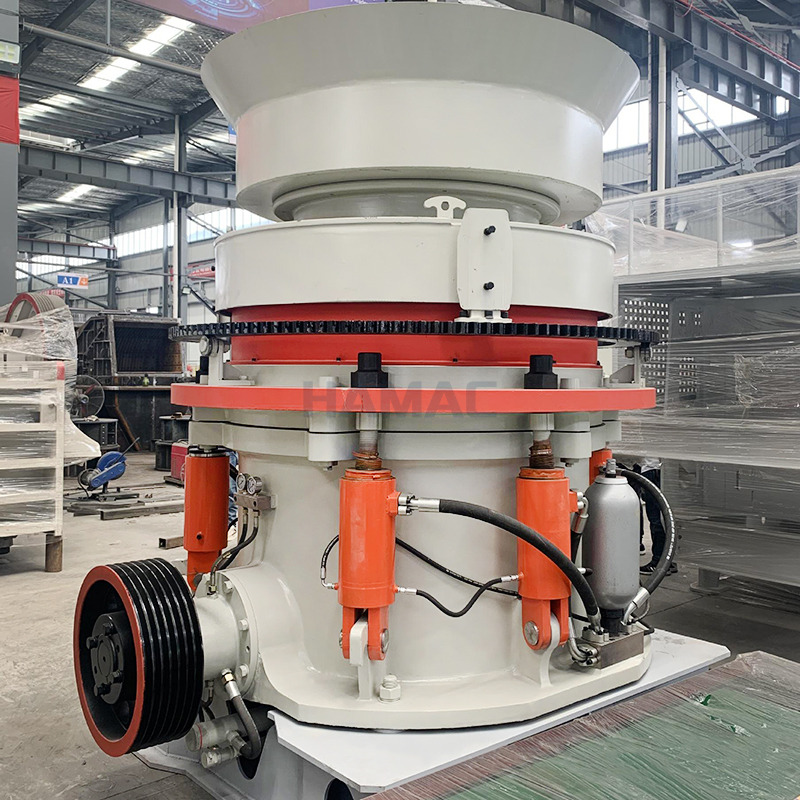
What to verify before you sign
- Availability of a full-time plant team for liner changes and the lifting equipment on site.
- Wear-part interchangeability across machines in the same circuit.
- Saleable tonnes per hour at each product size, not gross crusher throughput, for your target tonnage.
- Maximum feed lump and gradation — a chamber that cannot accept the top size will bridge on day one.
- Spare motor, gearbox and hydraulic pump lead times from the nearest HAMAC stock point.
- Delivery terms (FOB / CFR / CIF) with the destination port named explicitly.
- Nameplate data for local voltage, frequency and the applicable conformity scheme.
- Whether the quoted t/h is achieved at mine pre-beneficiation feed or under ideal laboratory feed.
- Ambient temperature, altitude and dust load derating for motors and hydraulics.
The relative weight of each item changes with the project: wear parts dominate on abrasive rock, availability dominates on remote sites.
Where the money actually goes
| Cost line | Indicative share | What moves the number |
|---|---|---|
| Equipment & drive packages | 54% | Model size, number of stages and automation level |
| Ocean freight & insurance | 8% | Destination port, container count and out-of-gauge cargo |
| Civil works & foundations | 8% | Soil conditions, dynamic loads and site preparation |
| Erection, commissioning & training | 7% | Local labour, supervision scope and schedule |
| First-year wear parts | 15% | Rock abrasiveness, liner grade and operating hours |
| Power, lubricants & consumables | 8% | kWh per tonne, local tariff and dust suppression water |
For compound cone crusher at your target tonnage, wear parts and energy usually outweigh the difference between two purchase prices within three to five years.
Mistakes that cost more than the machine
- Skipping the acceptance test, so no one has a baseline to measure degradation against.
- Omitting a bypass chute, so a single screen fault stops the whole line.
- Leaving tramp-iron protection out of the scope to save a small percentage of capital.
- Ignoring clay and moisture until the first wet season, when decks blind and chambers pack.
- Assuming a mobile plant can match a stationary line on high-tonnage, multi-product duty.
- Ordering no spares with the plant and waiting six weeks for the first liner set.
- Specifying motors for the wrong voltage or frequency and rewinding them on site.
- Comparing quotations with different port terms and calling the lower number cheaper.
For mine pre-beneficiation feed, protect the lowest energy per tonne requirement explicitly in the contract documents.
Commissioning checklist
- Record power draw, tonnage and chamber pressure at steady state.
- Verify rotation direction on every motor before coupling.
- Check lubrication levels, grease lines and oil cooler operation.
- Introduce feed in graded steps: 25%, 50%, 75%, then full load.
- Measure and log the as-new CSS / setting for future wear comparison.
- Hand over the spare-parts list, manuals and maintenance schedule.
- Check belt tracking, chute build-up and transfer-point dust.
- Measure noise and dust at the operator position against the local limit.
Keep the signed record; it is the only defensible baseline for later performance disputes.