Overview
Gypsum (Mohs 1.5, ~30 MPa, low abrasion): processing steps, equipment and cost notes for plant buyers.
Processing steps
- Primary crushing — jaw.
- Secondary / tertiary — jaw + impact.
- Screening for graded products.
- Dewatering / handling.
Recommended equipment
- PE Series Jaw Crusher
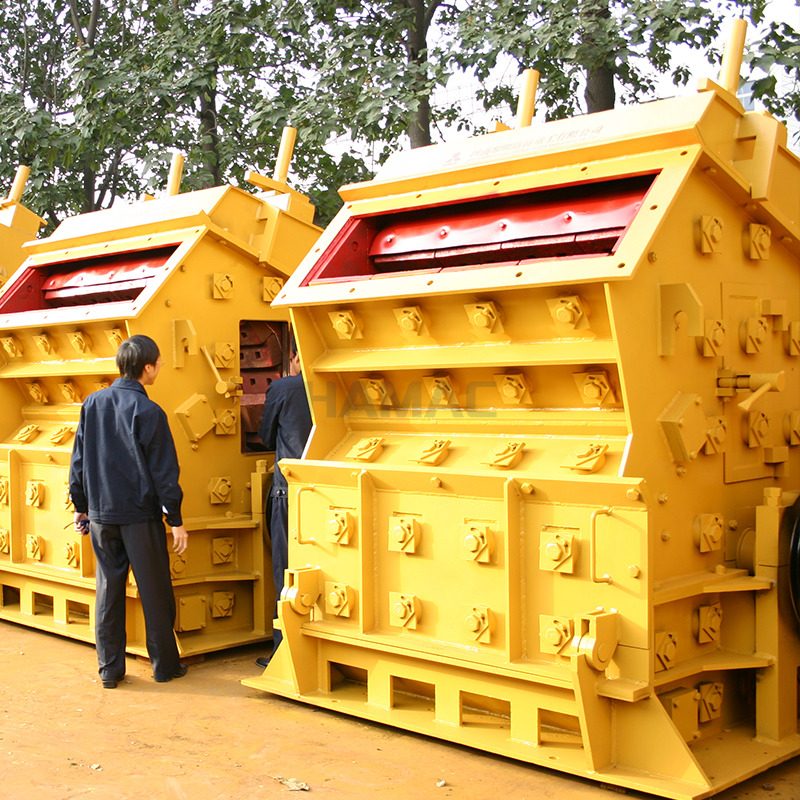
- PF Impact Crusher
- Vibrating Feeder
Cost notes
Operating cost is dominated by wear parts on low-abrasion material; choose liner grade by rock, not price.
Reference data for this configuration
| Parameter | Reference value |
|---|---|
| Feed material | Gypsum |
| Mohs hardness | 1.5 |
| Compressive strength | ~30 MPa |
| Abrasiveness | Low |
| Recommended circuit | jaw + impact |
| Assumed duty | continuous quarry production |
| Evaluation horizon | five-year view |
Ask for the same table from any competing supplier; without it, an offer for gypsum crushing cannot be compared on scope.
Project profile these notes assume
| Assumption | Value |
|---|---|
| Operating duty | continuous quarry production |
| Primary objective | maximum mechanical availability |
| Evaluation horizon | five-year view |
| Site condition | a confined urban yard |
| Operating team | a rotating shift crew |
Change any one of these assumptions and the recommended configuration for gypsum crushing may change. HAMAC re-runs the same checks against your own numbers once the enquiry data sheet is received.
From enquiry to the first saleable tonne
- Lay out conveyors, access ways, stockpile capacity and drainage before ordering steelwork.
- Budget for water, dust extraction and spillage handling as part of the plant, not as an afterthought.
- Apply jaw + impact; the reduction mechanism must suit low abrasion and a compressive strength near 30 MPa.
- Plan training for a rotating shift crew on CSS adjustment, liner change-out and lock-out / tag-out.
- Log tonnes per liner set and kWh per tonne from day one so you have a real cost baseline within a quarter.
- Confirm site voltage, frequency and applicable conformity standards before manufacture.
- Book shipping, prepare the packing list and confirm the container loading plan.
- Run a sieve analysis on a representative sample and attach the grading curve to the enquiry.
- Review the crusher chamber profile with the liner supplier against Gypsum (Mohs 1.5, ~30 MPa, low abrasion).
On continuous quarry production, step ordering matters: survey and sampling must precede the equipment list, or the plant is sized to a guess.
What to verify before you sign
- Maximum feed lump and gradation — a chamber that cannot accept the top size will bridge on day one.
- Local service partner, technician travel time and visa requirements for your market.
- Nameplate data for local voltage, frequency and the applicable conformity scheme.
- After-sales response time, technician availability and the warranty exclusions in writing.
- Spare motor, gearbox and hydraulic pump lead times from the nearest HAMAC stock point.
- Erection scope: supervision only, or full civil, mechanical and electrical installation.
- Screen deck count, aperture and area; ask for the efficiency calculation, not just the mesh size.
- Spare-parts consignment: one full liner or blow-bar set plus meshes, belts, bearings and seals.
- Whether the quoted t/h is achieved at continuous quarry production or under ideal laboratory feed.
Ask each supplier to price the same list. Quotations for gypsum crushing only become comparable when the scope is identical.
Where the money actually goes
| Cost line | Indicative share | What moves the number |
|---|---|---|
| Equipment & drive packages | 55% | Model size, number of stages and automation level |
| Ocean freight & insurance | 9% | Destination port, container count and out-of-gauge cargo |
| Civil works & foundations | 9% | Soil conditions, dynamic loads and site preparation |
| Erection, commissioning & training | 7% | Local labour, supervision scope and schedule |
| First-year wear parts | 13% | Rock abrasiveness, liner grade and operating hours |
| Power, lubricants & consumables | 7% | kWh per tonne, local tariff and dust suppression water |
A five-year view normally reverses the ranking of two otherwise similar offers once wear and energy are included.
Mistakes that cost more than the machine
- Letting the continuous quarry production duty be defined verbally instead of in the contract.
- Skipping the acceptance test, so no one has a baseline to measure degradation against.
- Ordering no spares with the plant and waiting six weeks for the first liner set.
- Using one liner profile for both secondary and tertiary stages.
- Planning the crusher but not the conveyors, transfer chutes and stockpile capacity around it.
- Comparing quotations with different port terms and calling the lower number cheaper.
- Ignoring clay and moisture until the first wet season, when decks blind and chambers pack.
- Omitting a bypass chute, so a single screen fault stops the whole line.
On a confined urban yard, the civil and logistics items deserve as much attention as the crusher itself.
Commissioning checklist
- Hand over the spare-parts list, manuals and maintenance schedule.
- Record power draw, tonnage and chamber pressure at steady state.
- Check lubrication levels, grease lines and oil cooler operation.
- Measure noise and dust at the operator position against the local limit.
- Introduce feed in graded steps: 25%, 50%, 75%, then full load.
- Agree the punch list, sign the hand-over protocol and file the as-built drawings.
- Check belt tracking, chute build-up and transfer-point dust.
- Measure and log the as-new CSS / setting for future wear comparison.
Keep the signed record; it is the only defensible baseline for later performance disputes.