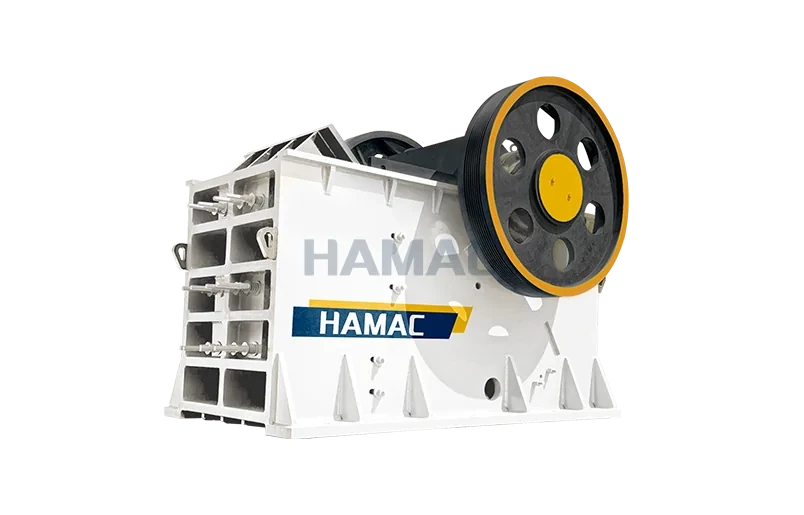
Overview
This page brings together the published PE Series Jaw Crusher model data and the practical details of importing it into Nepal — power supply, standards, shipping and commissioning. Popular feed materials in the market include Aggregates, River pebble.
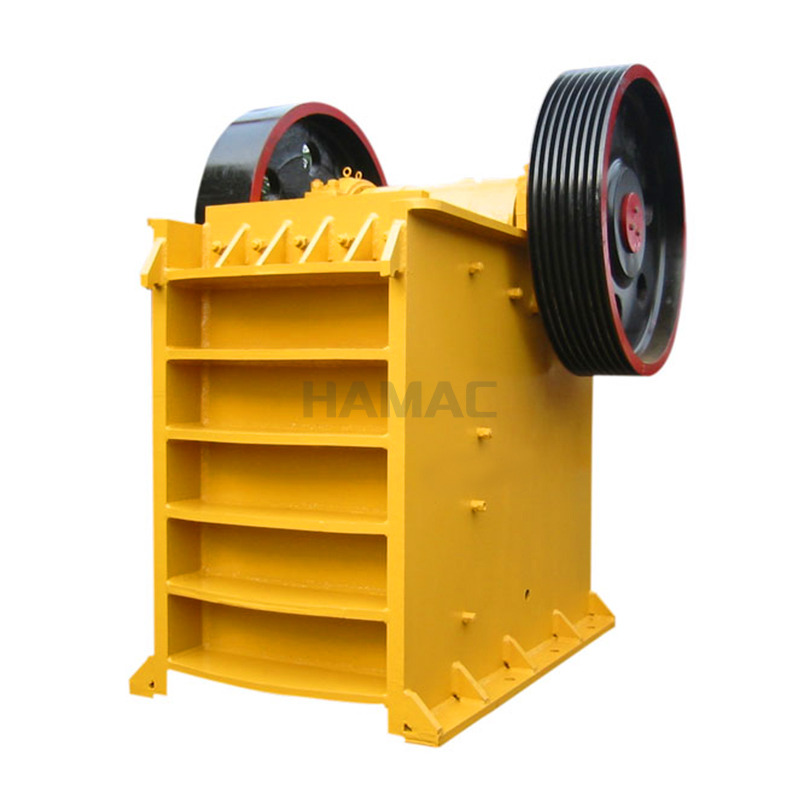
Published PE Series Jaw Crusher data
| Published parameter | Nominal value |
|---|---|
| PEX250x750 | 250x750 mm 210 mm |
| PEX250x1000 | 250x1000 mm 210 mm |
| PEX250x1200 | 250x1200 mm 210 mm |
| PEX300x1300 | 300x1300 mm 250 mm |
| PE400×600 | 400×600 mm 340 mm |
| PE500×750 | 500×750 mm 425 mm |
Local conditions in Nepal
- Destination port: Kolkata.
- Site supply: 400V 50Hz.
- Standards: NS.
- Common materials: Aggregates, River pebble.
- Region: Asia.
Delivery scope
HAMAC quotes FOB, CFR or CIF to Kolkata, sets motors and starters to 400V 50Hz, and supplies the certificate set applicable to NS. Workshop assembly, test, container loading plan and installation supervision are included in a turnkey scope.
Reference data for this configuration
| Parameter | Reference value |
|---|---|
| Destination port | Kolkata |
| Site supply | 400V 50Hz |
| Local standards | NS |
| Region | Asia |
| Machine line | PE Series Jaw Crusher |
| Category | Jaw Crusher |
| Assumed duty | continuous quarry production |
| Evaluation horizon | three-year view |
Treat this as a living sheet. Every revision of the flow sheet for Nepal should update the same fields so the equipment list stays traceable.
Published PE Series Jaw Crusher model data
| Model | Input Size | Max Feeding Size | Output Range | Capacity | Engine Power | Weight |
|---|---|---|---|---|---|---|
| PEX250x750 | 250x750 mm | 210 mm | 25-60 mm | 13-35 T/H | 30 KW | 5.5 T |
| PEX250x1000 | 250x1000 mm | 210 mm | 25-60 mm | 16-52 T/H | 37 KW | 7 T |
| PEX250x1200 | 250x1200 mm | 210 mm | 25-60 mm | 20-61 T/H | 55 KW | 9.5 T |
| PEX300x1300 | 300x1300 mm | 250 mm | 20-90 mm | 16-105 T/H | 75 KW | 15.6 T |
| PE400×600 | 400×600 mm | 340 mm | 40-100 mm | 16-60 T/H | 30 KW | 6.7 T |
| PE500×750 | 500×750 mm | 425 mm | 50-100 mm | 40-110 T/H | 55 KW | 11.7 T |
| PE600×900 | 600×900 mm | 500 mm | 65-180 mm | 80-180 T/H | 55-75 KW | 16.1 T |
| PE750×1060 | 750×1060 mm | 630 mm | 80-180 mm | 110-320 T/H | 90-110 KW | 30.1 T |
Jaw crushers are often used for primary crushing in mine material crushing. Read the table column by column against continuous quarry production: the model you pick is the one whose published range brackets your target tonnage, not simply the largest machine in the series. Availability, motor rating and shipping data are re-confirmed for a brownfield extension in the written HAMAC proposal.
Project profile these notes assume
| Assumption | Value |
|---|---|
| Operating duty | continuous quarry production |
| Primary objective | maximum mechanical availability |
| Evaluation horizon | three-year view |
| Site condition | a brownfield extension |
| Operating team | a rotating shift crew |
Change any one of these assumptions and the recommended configuration for pe series jaw crusher may change. HAMAC re-runs the same checks against your own numbers once the enquiry data sheet is received.
From enquiry to the first saleable tonne
- Define the acceptance test: sampling points, test duration, moisture range and who signs the protocol.
- Lay out conveyors, access ways, stockpile capacity and drainage before ordering steelwork.
- Survey the feed: the feed material; record top size, bulk density, moisture and clay content before fixing the flow sheet.
- Include dust suppression, guarding, emergency stops and lock-out points in the layout drawing.
- Book container or flat-rack space to Kolkata and prepare the customs document set in advance.
- Allocate screen area per deck; blinding and pegging are the most common hidden bottlenecks in a new plant.
- Choose compression or impact reduction according to hardness, silica content and required particle shape.
- Run a sieve analysis on a representative sample and attach the grading curve to the enquiry.
- Confirm the haul-road and stockpile plan with a brownfield extension in mind before fixing conveyor lengths.
Most delays at this stage come from missing feed data rather than from manufacturing capacity.
What to verify before you sign
- Liner alloy: Mn18 with ceramic inserts matched to the rock, not to the lowest purchase price.
- Decommissioning or relocation value at the end of a three-year horizon.
- Closed-side setting range and whether automatic setting regulation is included.
- Control system language, telemetry and remote diagnostics availability.
- Dust and noise control designed to the local emission limits for Nepal.
- Screen deck count, aperture and area; ask for the efficiency calculation, not just the mesh size.
- Access for liner change-out — crane radius, lifting points and clearance around the chamber.
- Product sampling points and the lab equipment needed for routine grading checks.
- Tramp-iron protection — hydraulic release, magnet and metal detection on the feed belt.
The relative weight of each item changes with the project: wear parts dominate on abrasive rock, availability dominates on remote sites.
Where the money actually goes
| Cost line | Indicative share | What moves the number |
|---|---|---|
| Equipment & drive packages | 53% | Model size, number of stages and automation level |
| Ocean freight & insurance | 11% | Destination port, container count and out-of-gauge cargo |
| Civil works & foundations | 8% | Soil conditions, dynamic loads and site preparation |
| Erection, commissioning & training | 7% | Local labour, supervision scope and schedule |
| First-year wear parts | 14% | Rock abrasiveness, liner grade and operating hours |
| Power, lubricants & consumables | 7% | kWh per tonne, local tariff and dust suppression water |
Freight to Nepal is volatile; ask for the quotation to state validity and the port basis rather than a single delivered number.
Mistakes that cost more than the machine
- Selecting the cheapest liner alloy for hard, high-silica rock and paying for it in change-outs.
- Skipping a geotechnical check and discovering settlement under the primary crusher at a brownfield extension.
- Ordering no spares with the plant and waiting six weeks for the first liner set.
- Leaving tramp-iron protection out of the scope to save a small percentage of capital.
- Using one liner profile for both secondary and tertiary stages.
- Buying on nameplate t/h without converting to saleable product at the specified fractions.
- Assuming a mobile plant can match a stationary line on high-tonnage, multi-product duty.
- Skipping the acceptance test, so no one has a baseline to measure degradation against.
Every item on this list has cost someone a commissioning date; none of them requires new technology to avoid.
Commissioning checklist
- Record power draw, tonnage and chamber pressure at steady state.
- Calibrate the belt scale and any level probes against a known load.
- Verify chute liners, skirt rubber and impact bars after the first hour of feed.
- Check lubrication levels, grease lines and oil cooler operation.
- Measure noise and dust at the operator position against the local limit.
- Introduce feed in graded steps: 25%, 50%, 75%, then full load.
- Check belt tracking, chute build-up and transfer-point dust.
- Sample each product fraction and compare with the specification.
On a brownfield extension, allow extra time for the dust and noise measurements.