Overview
This page brings together the published Mobile Jaw Crusher Plant model data and the practical details of importing it into Egypt — power supply, standards, shipping and commissioning. Popular feed materials in the market include Limestone, Granite.
Published Mobile Jaw Crusher Plant data
| Published parameter | Nominal value |
|---|---|
| MJ69 | 95-165 mm 30-85 m³/h |
| MJC96 | 60-175 mm 60-200 m³/h |
| MJ750 | 80-180 mm 72-150 m³/h |
| MJC106 | 70-200 mm 100-300 m³/h |
Local conditions in Egypt
- Destination port: Alexandria.
- Site supply: 380V 50Hz.
- Standards: EOS.
- Common materials: Limestone, Granite.
- Region: Africa.
Delivery scope
HAMAC quotes FOB, CFR or CIF to Alexandria, sets motors and starters to 380V 50Hz, and supplies the certificate set applicable to EOS. Workshop assembly, test, container loading plan and installation supervision are included in a turnkey scope.
Reference data for this configuration
| Parameter | Reference value |
|---|---|
| Destination port | Alexandria |
| Site supply | 380V 50Hz |
| Local standards | EOS |
| Region | Africa |
| Machine line | Mobile Jaw Crusher Plant |
| Category | Wheel Type Mobile Crushers |
| Assumed duty | seasonal road-project supply |
| Evaluation horizon | five-year view |
Treat this as a living sheet. Every revision of the flow sheet for Egypt should update the same fields so the equipment list stays traceable.
Published Mobile Jaw Crusher Plant model data
| Model | Discharge Adjustment | Nominal Capacity | Dimension | Magnetic Separator | Axles |
|---|---|---|---|---|---|
| MJ69 | 95-165 mm | 30-85 m³/h | 11097×3759×3500 mm | RCYD800 | Double |
| MJC96 | 60-175 mm | 60-200 m³/h | 11097×3759×3500 mm | RCYD800 | Double |
| MJ750 | 80-180 mm | 72-150 m³/h | 13300×2900×4440 mm | RCYD1000 | Three |
| MJC106 | 70-200 mm | 100-300 m³/h | 13300×2900×4440 mm | RCYD1000 | Three |
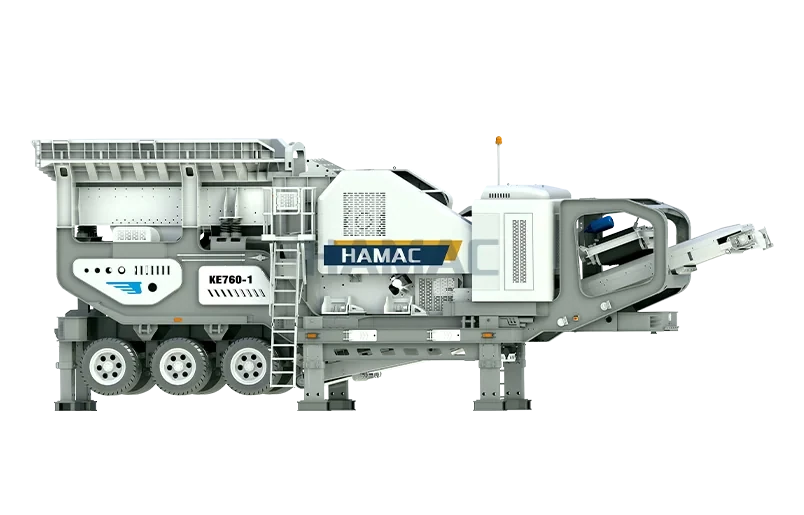
The tire-type mobilejaw crusher mobile is a mobile primary crushing equipment composed of vibratingfeeder, jaw crusher, conveyor belt and other components. Read the table column by column against seasonal road-project supply: the model you pick is the one whose published range brackets your target tonnage, not simply the largest machine in the series. Availability, motor rating and shipping data are re-confirmed for a confined urban yard in the written HAMAC proposal.
Project profile these notes assume
| Assumption | Value |
|---|---|
| Operating duty | seasonal road-project supply |
| Primary objective | lowest energy per tonne |
| Evaluation horizon | five-year view |
| Site condition | a confined urban yard |
| Operating team | a mixed local and expatriate team |
Change any one of these assumptions and the recommended configuration for mobile jaw crusher plant may change. HAMAC re-runs the same checks against your own numbers once the enquiry data sheet is received.
From enquiry to the first saleable tonne
- Plan training for a mixed local and expatriate team on CSS adjustment, liner change-out and lock-out / tag-out.
- Record the as-built settings and give the operator a written daily, weekly and monthly schedule.
- Choose compression or impact reduction according to hardness, silica content and required particle shape.
- Run a sieve analysis on a representative sample and attach the grading curve to the enquiry.
- Budget for water, dust extraction and spillage handling as part of the plant, not as an afterthought.
- Size the primary stage for your target tonnage with a 10–20% surge allowance — never on nameplate throughput alone.
- Survey the feed: the feed material; record top size, bulk density, moisture and clay content before fixing the flow sheet.
- Confirm the haul-road and stockpile plan with a confined urban yard in mind before fixing conveyor lengths.
- Commission with graded load, sample the product grading, then train operators on liner change-out and daily checks.
Each step has an owner and a document: flow sheet, general arrangement, foundation reference, packing list and acceptance protocol.
What to verify before you sign
- Tramp-iron protection — hydraulic release, magnet and metal detection on the feed belt.
- Dust and noise control designed to the local emission limits for Egypt.
- After-sales response time, technician availability and the warranty exclusions in writing.
- Maximum feed lump and gradation — a chamber that cannot accept the top size will bridge on day one.
- Erection scope: supervision only, or full civil, mechanical and electrical installation.
- Energy draw in kW and the expected kWh per tonne at the design duty.
- Screen deck count, aperture and area; ask for the efficiency calculation, not just the mesh size.
- Wear-part interchangeability across machines in the same circuit.
- Availability of a mixed local and expatriate team for liner changes and the lifting equipment on site.
For seasonal road-project supply, give the lowest energy per tonne line extra weight; a generic checklist will not rank the offers correctly.
Where the money actually goes
| Cost line | Indicative share | What moves the number |
|---|---|---|
| Equipment & drive packages | 53% | Model size, number of stages and automation level |
| Ocean freight & insurance | 11% | Destination port, container count and out-of-gauge cargo |
| Civil works & foundations | 8% | Soil conditions, dynamic loads and site preparation |
| Erection, commissioning & training | 7% | Local labour, supervision scope and schedule |
| First-year wear parts | 14% | Rock abrasiveness, liner grade and operating hours |
| Power, lubricants & consumables | 7% | kWh per tonne, local tariff and dust suppression water |
Include downtime in the model. An unplanned liner change on a remote site costs far more than the casting itself.
Mistakes that cost more than the machine
- Assuming a mobile plant can match a stationary line on high-tonnage, multi-product duty.
- Undersizing the screen, then blaming the crusher for a plant that never reaches your target tonnage.
- Ignoring clay and moisture until the first wet season, when decks blind and chambers pack.
- Overlooking dust, noise and water permits in Egypt until erection has already started.
- Specifying motors for the wrong voltage or frequency and rewinding them on site.
- Using one liner profile for both secondary and tertiary stages.
- Buying lowest energy per tonne on price alone and losing it in availability.
- Choosing screen apertures before the concrete or asphalt mix design is fixed.
For seasonal road-project supply, protect the lowest energy per tonne requirement explicitly in the contract documents.
Commissioning checklist
- Test emergency stops, pull wires and interlock trips in sequence.
- Check hydraulic pressure, accumulator pre-charge and tramp-release function.
- Confirm all guards, emergency stops and pull-wire switches function.
- Verify rotation direction on every motor before coupling.
- Record the baseline grading curve for each product fraction.
- Sample each product fraction and compare with the specification.
- Agree the punch list, sign the hand-over protocol and file the as-built drawings.
- Verify chute liners, skirt rubber and impact bars after the first hour of feed.
The commissioning record becomes the reference for every liner change in the five-year plan.