Overview
Buying a Mobile 4 In 1 Crushing & Screening Plant direct from HAMAC removes the trading margin and gives you engineering support from enquiry to commissioning.
Why buy direct
- One project manager for the whole order.
- Workshop assembly, test and container loading plan.
- Flow-sheet design, layout and foundation reference.
- Installation supervision, training and 24h technical response.
Export & documentation
Quoted FOB / CFR / CIF. Documentation applicable to your market (CE where required), Spanish manuals for LatAm, motors set to local voltage.
How to order
Send project data → receive design + budget in 24h → refine drawings → manufacture → install.
Reference data for this configuration
| Parameter | Reference value |
|---|---|
| Machine line | Mobile 4 In 1 Crushing & Screening Plant |
| Category | Wheel Type Mobile Crushers |
| Assumed duty | high-tonnage aggregate supply |
| Evaluation horizon | ten-year view |
These values are the starting point for a written proposal on mobile 4 in 1 crushing & screening plant; they are nominal and should be confirmed against a sample test before manufacture.
Published Mobile 4 In 1 Crushing & Screening Plant model data
| Model | Vibrating Feeder | Jaw Crusher | Cone Crusher / Impact Crusher | Vibrating Screen |
|---|---|---|---|---|
| Y3SY9E46 | GZD850×3000 | PE400×600 | PYB900 | 3YZS1237 |
| Y3SC75E57 | GZD850×3000 | PE500×700 | 3FT | 3YZS1548 |
| Y3SF1210E57 | GZD850×3000 | PE500×700 | PF1210 | 3YZS1548 |
| Y2SY9E57 | GZD850×3000 | PE500×700 | PYB900 | 2YZS1237 |
| Y3SF1010E46 | GZD850×3000 | PE400×600 | PF1010 | 3YZS1237 |
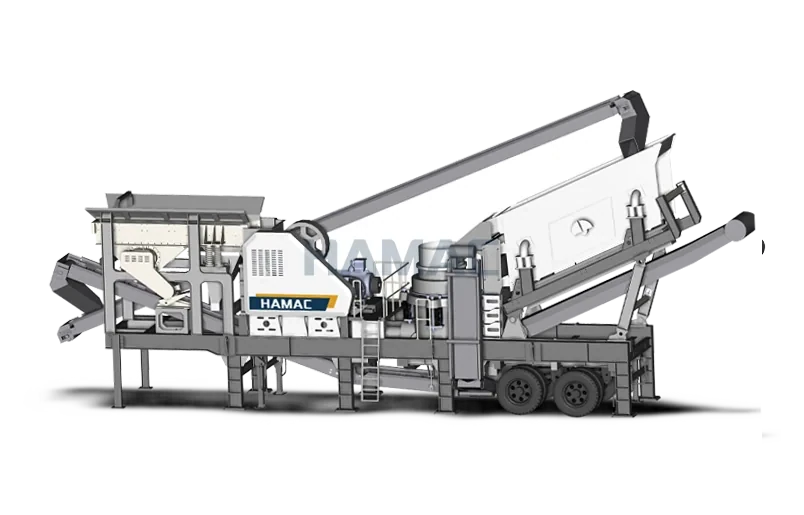
The 4-in-1 Mobile Crushing Plant combines a vibrating feeder, jaw crusher, cone or impact crusher, and vibrating screen in a single frame, offering an economical solution for mobile crushing. Read the table column by column against high-tonnage aggregate supply: the model you pick is the one whose published range brackets your target tonnage, not simply the largest machine in the series. Availability, motor rating and shipping data are re-confirmed for a confined urban yard in the written HAMAC proposal.
Project profile these notes assume
| Assumption | Value |
|---|---|
| Operating duty | high-tonnage aggregate supply |
| Primary objective | strict product cubicity |
| Evaluation horizon | ten-year view |
| Site condition | a confined urban yard |
| Operating team | an owner-operator team |
Change any one of these assumptions and the recommended configuration for mobile 4 in 1 crushing & screening plant may change. HAMAC re-runs the same checks against your own numbers once the enquiry data sheet is received.
From enquiry to the first saleable tonne
- Record the as-built settings and give the operator a written daily, weekly and monthly schedule.
- Survey the feed: the feed material; record top size, bulk density, moisture and clay content before fixing the flow sheet.
- Lay out conveyors, access ways, stockpile capacity and drainage before ordering steelwork.
- Verify the electrical single-line diagram, cable sizing and starter type with the local utility.
- Run a sieve analysis on a representative sample and attach the grading curve to the enquiry.
- Log tonnes per liner set and kWh per tonne from day one so you have a real cost baseline within a quarter.
- Book shipping, prepare the packing list and confirm the container loading plan.
- Set the closed-side setting or rotor speed against the required product fractions, then verify the expected reduction ratio.
- Include dust suppression, guarding, emergency stops and lock-out points in the layout drawing.
A HAMAC project manager stays with the order from the first data sheet through hand-over in your market.
What to verify before you sign
- Choke-feed arrangement: surge bin, feeder control and level indication.
- Decommissioning or relocation value at the end of a ten-year horizon.
- Screen deck count, aperture and area; ask for the efficiency calculation, not just the mesh size.
- Closed-side setting range and whether automatic setting regulation is included.
- Product sampling points and the lab equipment needed for routine grading checks.
- After-sales response time, technician availability and the warranty exclusions in writing.
- Availability of an owner-operator team for liner changes and the lifting equipment on site.
- Guaranteed power draw and the strict product cubicity trade-off it implies.
- Control system language, telemetry and remote diagnostics availability.
Bring this list to the design review — it is cheaper to resolve an omission on paper than during commissioning.
Where the money actually goes
| Cost line | Indicative share | What moves the number |
|---|---|---|
| Equipment & drive packages | 54% | Model size, number of stages and automation level |
| Ocean freight & insurance | 8% | Destination port, container count and out-of-gauge cargo |
| Civil works & foundations | 8% | Soil conditions, dynamic loads and site preparation |
| Erection, commissioning & training | 7% | Local labour, supervision scope and schedule |
| First-year wear parts | 15% | Rock abrasiveness, liner grade and operating hours |
| Power, lubricants & consumables | 8% | kWh per tonne, local tariff and dust suppression water |
Freight to your market is volatile; ask for the quotation to state validity and the port basis rather than a single delivered number.
Mistakes that cost more than the machine
- Ignoring clay and moisture until the first wet season, when decks blind and chambers pack.
- Buying on nameplate t/h without converting to saleable product at the specified fractions.
- Overlooking dust, noise and water permits in your market until erection has already started.
- Buying strict product cubicity on price alone and losing it in availability.
- Skipping a geotechnical check and discovering settlement under the primary crusher at a confined urban yard.
- Skipping the acceptance test, so no one has a baseline to measure degradation against.
- Leaving tramp-iron protection out of the scope to save a small percentage of capital.
- Letting the high-tonnage aggregate supply duty be defined verbally instead of in the contract.
Review the list with an owner-operator team before the order is placed — they will recognise most of them.
Commissioning checklist
- Record power draw, tonnage and chamber pressure at steady state.
- Verify chute liners, skirt rubber and impact bars after the first hour of feed.
- Verify rotation direction on every motor before coupling.
- Check hydraulic pressure, accumulator pre-charge and tramp-release function.
- Check lubrication levels, grease lines and oil cooler operation.
- Hand over the spare-parts list, manuals and maintenance schedule.
- Test emergency stops, pull wires and interlock trips in sequence.
- Dry-run the plant empty for the specified period and record vibration.
The commissioning record becomes the reference for every liner change in the ten-year plan.