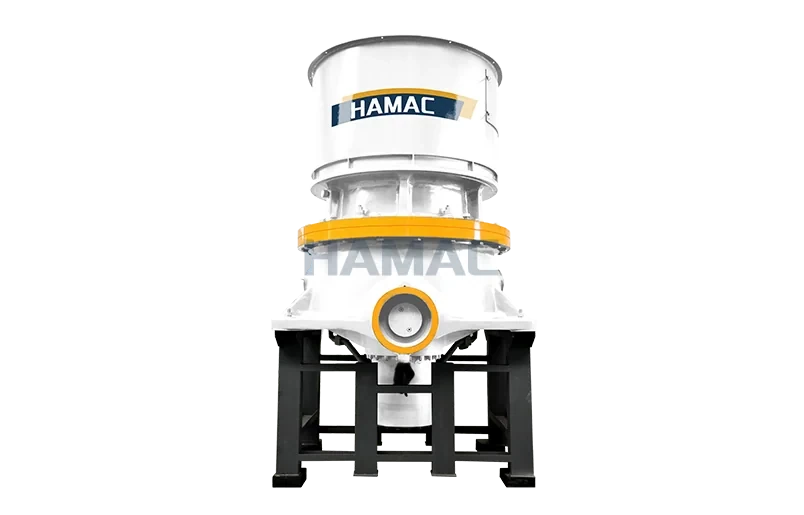
Overview
Published HCS Hydraulic Cone Crusher specifications below are nominal values transcribed from HAMAC data. Actual performance depends on feed gradation, moisture, setting and screening efficiency.
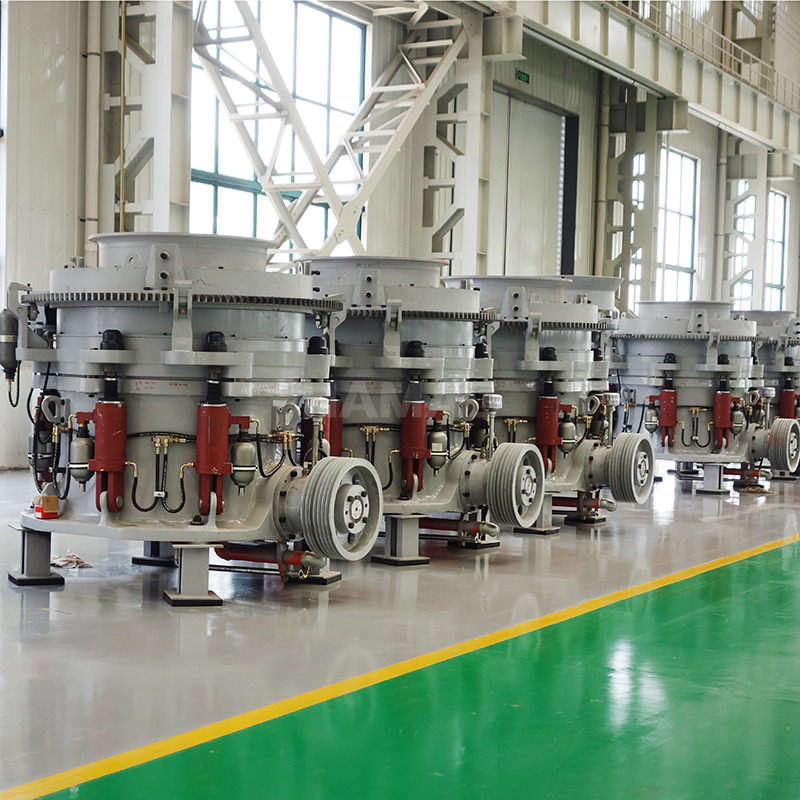
Specification table
| Parameter | Value |
|---|---|
| HST100 | S1(EC) 240 mm |
| S2(MC) | 200 mm 19 mm |
| H1(F) | 135 mm 10 mm |
| H2(MF) | 65 mm 8 mm |
| H3(UF) | 35 mm 4 mm |
| HST160 | S1(EC) 360 mm |
| S2(MC) | 300 mm 22 mm |
How to read the data
- Rated capacity is at a specified CSS / setting and material — treat it as saleable product, not crusher throughput.
- Feed size limit protects the chamber; oversize feed causes bridging.
- Motor power scales with rotor / chamber size, not linearly with capacity.
Selecting the right model
Match the model to your target t/h at the required product size, then confirm with a HAMAC engineer before order.
Reference data for this configuration
| Parameter | Reference value |
|---|---|
| Machine line | HCS Hydraulic Cone Crusher |
| Category | Cone Crusher |
| Assumed duty | high-tonnage aggregate supply |
| Evaluation horizon | five-year view |
At high-tonnage aggregate supply, the ranking of these parameters changes: fast mobilisation usually becomes the deciding constraint rather than the headline tonnage.
Published HCS Hydraulic Cone Crusher model data
| Model | Cavity | Feed opening | Min opening | Capacity | Maximum Power |
|---|---|---|---|---|---|
| HST100 | S1(EC) | 240 mm | 22 mm | 85-170 t/h | 90 kW |
| S2(MC) | 200 mm | 19 mm | 70-130 t/h | ||
| H1(F) | 135 mm | 10 mm | 45-115 t/h | ||
| H2(MF) | 65 mm | 8 mm | 35-80 t/h | ||
| H3(UF) | 35 mm | 4 mm | 27-60 t/h | ||
| HST160 | S1(EC) | 360 mm | 25 mm | 120-345 t/h | 160 kW |
| S2(MC) | 300 mm | 22 mm | 105-305 t/h | ||
| S3(C) | 235 mm | 19 mm | 90-275 t/h |
HST single cylinder hydraulic cone crusher integrates mechanical, hydraulic, electrical, automation, intelligent control and other technologies, and can be widely used in medium, fine and. Read the table column by column against high-tonnage aggregate supply: the model you pick is the one whose published range brackets your target tonnage, not simply the largest machine in the series. Availability, motor rating and shipping data are re-confirmed for a remote mine site in the written HAMAC proposal.
Project profile these notes assume
| Assumption | Value |
|---|---|
| Operating duty | high-tonnage aggregate supply |
| Primary objective | fast mobilisation |
| Evaluation horizon | five-year view |
| Site condition | a remote mine site |
| Operating team | a mixed local and expatriate team |
Change any one of these assumptions and the recommended configuration for hcs hydraulic cone crusher may change. HAMAC re-runs the same checks against your own numbers once the enquiry data sheet is received.
From enquiry to the first saleable tonne
- Include dust suppression, guarding, emergency stops and lock-out points in the layout drawing.
- Confirm the haul-road and stockpile plan with a remote mine site in mind before fixing conveyor lengths.
- Choose compression or impact reduction according to hardness, silica content and required particle shape.
- Plan training for a mixed local and expatriate team on CSS adjustment, liner change-out and lock-out / tag-out.
- Check bearing and lubrication arrangements against the ambient temperature range at the site.
- Define the acceptance test: sampling points, test duration, moisture range and who signs the protocol.
- Record the as-built settings and give the operator a written daily, weekly and monthly schedule.
- Book shipping, prepare the packing list and confirm the container loading plan.
- Survey the feed: the feed material; record top size, bulk density, moisture and clay content before fixing the flow sheet.
A realistic programme reserves time for permits, foundation curing and shipping to your market before any steel is cut.
What to verify before you sign
- Maximum feed lump and gradation — a chamber that cannot accept the top size will bridge on day one.
- Whether the quoted t/h is achieved at high-tonnage aggregate supply or under ideal laboratory feed.
- Control system language, telemetry and remote diagnostics availability.
- Closed-side setting range and whether automatic setting regulation is included.
- Wear-part interchangeability across machines in the same circuit.
- Nameplate data for local voltage, frequency and the applicable conformity scheme.
- Energy draw in kW and the expected kWh per tonne at the design duty.
- Local service partner, technician travel time and visa requirements for your market.
- Liner alloy: Mn22 matched to the rock, not to the lowest purchase price.
Ask each supplier to price the same list. Quotations for hcs hydraulic cone crusher only become comparable when the scope is identical.
Where the money actually goes
| Cost line | Indicative share | What moves the number |
|---|---|---|
| Equipment & drive packages | 54% | Model size, number of stages and automation level |
| Ocean freight & insurance | 8% | Destination port, container count and out-of-gauge cargo |
| Civil works & foundations | 8% | Soil conditions, dynamic loads and site preparation |
| Erection, commissioning & training | 7% | Local labour, supervision scope and schedule |
| First-year wear parts | 15% | Rock abrasiveness, liner grade and operating hours |
| Power, lubricants & consumables | 8% | kWh per tonne, local tariff and dust suppression water |
On high-tonnage aggregate supply, the fast mobilisation objective changes which line deserves the most attention during value engineering.
Mistakes that cost more than the machine
- Ignoring clay and moisture until the first wet season, when decks blind and chambers pack.
- Planning the crusher but not the conveyors, transfer chutes and stockpile capacity around it.
- Omitting a bypass chute, so a single screen fault stops the whole line.
- Specifying motors for the wrong voltage or frequency and rewinding them on site.
- Overlooking dust, noise and water permits in your market until erection has already started.
- Letting the high-tonnage aggregate supply duty be defined verbally instead of in the contract.
- Choosing screen apertures before the concrete or asphalt mix design is fixed.
- Forgetting surge capacity — an intermittent loader starves the chamber and ruins particle shape.
On a remote mine site, the civil and logistics items deserve as much attention as the crusher itself.
Commissioning checklist
- Confirm all guards, emergency stops and pull-wire switches function.
- Measure and log the as-new CSS / setting for future wear comparison.
- Sample each product fraction and compare with the specification.
- Hand over the spare-parts list, manuals and maintenance schedule.
- Measure noise and dust at the operator position against the local limit.
- Dry-run the plant empty for the specified period and record vibration.
- Test emergency stops, pull wires and interlock trips in sequence.
- Verify chute liners, skirt rubber and impact bars after the first hour of feed.
For a mixed local and expatriate team, run through this list twice — once with the supervisor and once without.