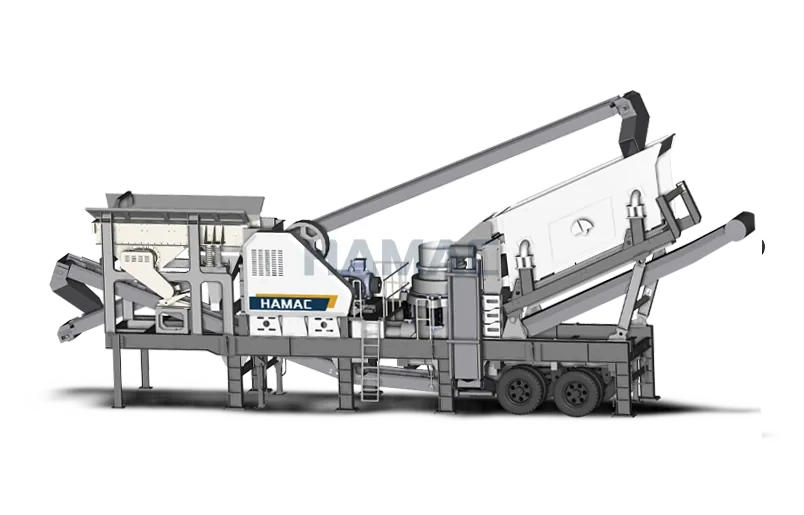
Overview
Published Mobile 3 In 1 Crushing & Screening Plant specifications below are nominal values transcribed from HAMAC data. Actual performance depends on feed gradation, moisture, setting and screening efficiency.
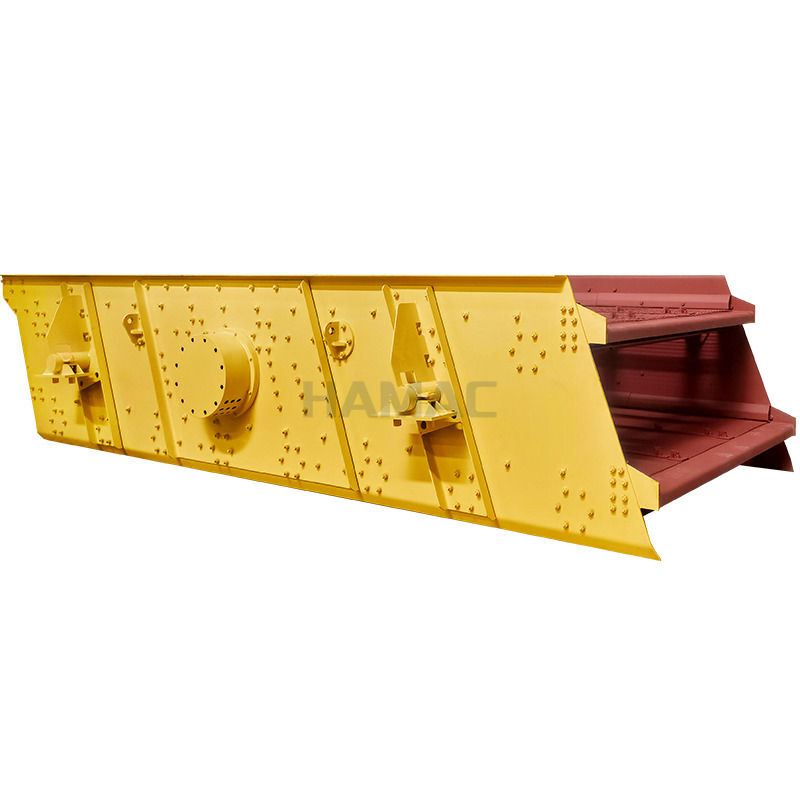
Specification table
| Parameter | Value |
|---|---|
| K3-PF1214-3C | GZD1142 PFV1214 |
| K3-LF150-3C | GZD9638 LF150 |
| K3-LF250-3C | GZD1142 LF250 |
How to read the data
- Rated capacity is at a specified CSS / setting and material — treat it as saleable product, not crusher throughput.
- Feed size limit protects the chamber; oversize feed causes bridging.
- Motor power scales with rotor / chamber size, not linearly with capacity.
Selecting the right model
Match the model to your target t/h at the required product size, then confirm with a HAMAC engineer before order.
Reference data for this configuration
| Parameter | Reference value |
|---|---|
| Machine line | Mobile 3 In 1 Crushing & Screening Plant |
| Category | Wheel Type Mobile Crushers |
| Assumed duty | cement raw-meal preparation |
| Evaluation horizon | ten-year view |
Use the table as a checklist when comparing quotations for mobile 3 in 1 crushing & screening plant — a lower price often means one of these parameters was quietly reduced.
Published Mobile 3 In 1 Crushing & Screening Plant model data
| Model | Vibrating feeder | Impact crusher | Vibrating screen | Main belt | Capacity (t/h) |
|---|---|---|---|---|---|
| K3-PF1214-3C | GZD1142 | PFV1214 | 3YK1848 | B1000 | 100–200 |
| K3-LF150-3C | GZD9638 | LF150 | 3YK1548 | B800 | 80–150 |
| K3-LF250-3C | GZD1142 | LF250 | 3YK1848 | B1000 | 150–300 |
Feeding, crushing and screening on one wheel chassis — 80–300 t/h — for contractors who need a complete plant with minimal setup. Read the table column by column against cement raw-meal preparation: the model you pick is the one whose published range brackets your target tonnage, not simply the largest machine in the series. Availability, motor rating and shipping data are re-confirmed for a remote mine site in the written HAMAC proposal.
Project profile these notes assume
| Assumption | Value |
|---|---|
| Operating duty | cement raw-meal preparation |
| Primary objective | simple operator maintenance |
| Evaluation horizon | ten-year view |
| Site condition | a remote mine site |
| Operating team | an owner-operator team |
Change any one of these assumptions and the recommended configuration for mobile 3 in 1 crushing & screening plant may change. HAMAC re-runs the same checks against your own numbers once the enquiry data sheet is received.
From enquiry to the first saleable tonne
- Commission with graded load, sample the product grading, then train operators on liner change-out and daily checks.
- Confirm site voltage, frequency and applicable conformity standards before manufacture.
- Choose compression or impact reduction according to hardness, silica content and required particle shape.
- Review the crusher chamber profile with the liner supplier against the feed material.
- Survey the feed: the feed material; record top size, bulk density, moisture and clay content before fixing the flow sheet.
- Lay out conveyors, access ways, stockpile capacity and drainage before ordering steelwork.
- Sequence delivery so foundations cure while the equipment is still in manufacture.
- Set the closed-side setting or rotor speed against the required product fractions, then verify the expected reduction ratio.
- Check bearing and lubrication arrangements against the ambient temperature range at the site.
A realistic programme reserves time for permits, foundation curing and shipping to your market before any steel is cut.
What to verify before you sign
- Availability of an owner-operator team for liner changes and the lifting equipment on site.
- Energy draw in kW and the expected kWh per tonne at the design duty.
- Ambient temperature, altitude and dust load derating for motors and hydraulics.
- Nameplate data for local voltage, frequency and the applicable conformity scheme.
- Closed-side setting range and whether automatic setting regulation is included.
- Saleable tonnes per hour at each product size, not gross crusher throughput, for your target tonnage.
- Decommissioning or relocation value at the end of a ten-year horizon.
- Choke-feed arrangement: surge bin, feeder control and level indication.
- Screen deck count, aperture and area; ask for the efficiency calculation, not just the mesh size.
Bring this list to the design review — it is cheaper to resolve an omission on paper than during commissioning.
Where the money actually goes
| Cost line | Indicative share | What moves the number |
|---|---|---|
| Equipment & drive packages | 54% | Model size, number of stages and automation level |
| Ocean freight & insurance | 8% | Destination port, container count and out-of-gauge cargo |
| Civil works & foundations | 8% | Soil conditions, dynamic loads and site preparation |
| Erection, commissioning & training | 7% | Local labour, supervision scope and schedule |
| First-year wear parts | 15% | Rock abrasiveness, liner grade and operating hours |
| Power, lubricants & consumables | 8% | kWh per tonne, local tariff and dust suppression water |
On cement raw-meal preparation, the simple operator maintenance objective changes which line deserves the most attention during value engineering.
Mistakes that cost more than the machine
- Omitting a bypass chute, so a single screen fault stops the whole line.
- Assuming a mobile plant can match a stationary line on high-tonnage, multi-product duty.
- Buying on nameplate t/h without converting to saleable product at the specified fractions.
- Skipping a geotechnical check and discovering settlement under the primary crusher at a remote mine site.
- Skipping the acceptance test, so no one has a baseline to measure degradation against.
- Forgetting surge capacity — an intermittent loader starves the chamber and ruins particle shape.
- Undersizing the screen, then blaming the crusher for a plant that never reaches your target tonnage.
- Overlooking dust, noise and water permits in your market until erection has already started.
On a remote mine site, the civil and logistics items deserve as much attention as the crusher itself.
Commissioning checklist
- Measure and log the as-new CSS / setting for future wear comparison.
- Introduce feed in graded steps: 25%, 50%, 75%, then full load.
- Calibrate the belt scale and any level probes against a known load.
- Measure noise and dust at the operator position against the local limit.
- Dry-run the plant empty for the specified period and record vibration.
- Record the baseline grading curve for each product fraction.
- Check belt tracking, chute build-up and transfer-point dust.
- Confirm all guards, emergency stops and pull-wire switches function.
For an owner-operator team, run through this list twice — once with the supervisor and once without.