Overview
Practical, numbers-first guidance on the Vibrating Feeder — written for engineers specifying, buying and running crushing plants.
Abnormal noise / vibration
- Check for loose liner bolts or foreign metal in feed.
- Verify foundation bolts and coupling alignment.
- Listen for bearing distress; schedule replacement.
Low output
- Worn liners / blow bars reduce reduction.
- Wrong CSS / setting for target product.
- Screen blinding limits throughput.
Poor product shape
- Increase reduction in the shaping stage.
- Verify VSI rotor speed / anvil.
- Re-check screen mesh.
Reference data for this configuration
| Parameter | Reference value |
|---|---|
| Machine line | Vibrating Feeder |
| Category | Supporting Equipments |
| Assumed duty | contract crushing on short-term sites |
| Evaluation horizon | single-project view |
Treat this as a living sheet. Every revision of the flow sheet for your market should update the same fields so the equipment list stays traceable.
Published Vibrating Feeder model data
| Model | Specification | Feeding size | Rotation speed | Capacity | Power | Weight |
|---|---|---|---|---|---|---|
| ZSW3090 | 900x3000 mm | 400 mm | 600~850 rpm | 90-180 t/h | 11 kw | 3450 kg |
| ZSW3896 | 960x3800 mm | 500 mm | 600~850 rpm | 120-210 t/h | 15 kw | 4450 kg |
| ZSW4211 | 1100x4200 mm | 650 mm | 600~850 rpm | 180-400 t/h | 15 kw | 4750 kg |
| ZSW4911 | 1100x4900 mm | 650 mm | 600~850 rpm | 250-480 t/h | 22 kw | 5350 kg |
| ZSW4913 | 1300x4900 mm | 750 mm | 600~850 rpm | 340-600 t/h | 22 kw | 6350 kg |
| ZSW6013 | 1300x6000 mm | 750 mm | 600~850 rpm | 340-600 t/h | 30 kw | 7800 kg |
| ZSW6015 | 1500x6000 mm | 1000 mm | 600~850 rpm | 400-800 t/h | 37 kw | 8900 kg |
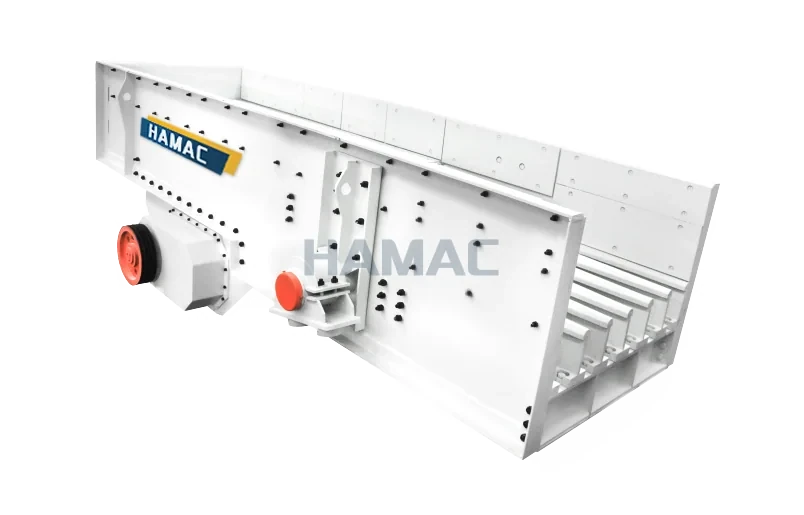
The Vibrating Feeder is an efficient feeding equipment designed to deliver materials continuously and evenly from the hopper to crushers in various industries, including mining, coal, chemical, and construction. Read the table column by column against contract crushing on short-term sites: the model you pick is the one whose published range brackets your target tonnage, not simply the largest machine in the series. Availability, motor rating and shipping data are re-confirmed for a greenfield site in the written HAMAC proposal.
Project profile these notes assume
| Assumption | Value |
|---|---|
| Operating duty | contract crushing on short-term sites |
| Primary objective | lowest energy per tonne |
| Evaluation horizon | single-project view |
| Site condition | a greenfield site |
| Operating team | a rotating shift crew |
Change any one of these assumptions and the recommended configuration for vibrating feeder may change. HAMAC re-runs the same checks against your own numbers once the enquiry data sheet is received.
From enquiry to the first saleable tonne
- Include dust suppression, guarding, emergency stops and lock-out points in the layout drawing.
- Run a sieve analysis on a representative sample and attach the grading curve to the enquiry.
- Lay out conveyors, access ways, stockpile capacity and drainage before ordering steelwork.
- Set the closed-side setting or rotor speed against the required product fractions, then verify the expected reduction ratio.
- Plan training for a rotating shift crew on CSS adjustment, liner change-out and lock-out / tag-out.
- Size the primary stage for your target tonnage with a 10–20% surge allowance — never on nameplate throughput alone.
- Check bearing and lubrication arrangements against the ambient temperature range at the site.
- Book shipping, prepare the packing list and confirm the container loading plan.
- Commission with graded load, sample the product grading, then train operators on liner change-out and daily checks.
For a rotating shift crew, the commissioning and training steps need more calendar time than the mechanical erection itself.
What to verify before you sign
- Ambient temperature, altitude and dust load derating for motors and hydraulics.
- Maximum feed lump and gradation — a chamber that cannot accept the top size will bridge on day one.
- Control system language, telemetry and remote diagnostics availability.
- Local service partner, technician travel time and visa requirements for your market.
- Product sampling points and the lab equipment needed for routine grading checks.
- Screen deck count, aperture and area; ask for the efficiency calculation, not just the mesh size.
- Decommissioning or relocation value at the end of a single-project horizon.
- Choke-feed arrangement: surge bin, feeder control and level indication.
- Energy draw in kW and the expected kWh per tonne at the design duty.
For contract crushing on short-term sites, give the lowest energy per tonne line extra weight; a generic checklist will not rank the offers correctly.
Where the money actually goes
| Cost line | Indicative share | What moves the number |
|---|---|---|
| Equipment & drive packages | 54% | Model size, number of stages and automation level |
| Ocean freight & insurance | 8% | Destination port, container count and out-of-gauge cargo |
| Civil works & foundations | 8% | Soil conditions, dynamic loads and site preparation |
| Erection, commissioning & training | 7% | Local labour, supervision scope and schedule |
| First-year wear parts | 15% | Rock abrasiveness, liner grade and operating hours |
| Power, lubricants & consumables | 8% | kWh per tonne, local tariff and dust suppression water |
Treat the percentages as a budgeting shape, not a quotation: HAMAC prices the equipment list in writing once the flow sheet is fixed.
Mistakes that cost more than the machine
- Forgetting surge capacity — an intermittent loader starves the chamber and ruins particle shape.
- Assuming the manufacturer's warranty covers wear parts and consumables.
- Omitting a bypass chute, so a single screen fault stops the whole line.
- Using one liner profile for both secondary and tertiary stages.
- Overlooking dust, noise and water permits in your market until erection has already started.
- Undersizing the screen, then blaming the crusher for a plant that never reaches your target tonnage.
- Buying on nameplate t/h without converting to saleable product at the specified fractions.
- Leaving tramp-iron protection out of the scope to save a small percentage of capital.
Every item on this list has cost someone a commissioning date; none of them requires new technology to avoid.
Commissioning checklist
- Verify rotation direction on every motor before coupling.
- Check belt tracking, chute build-up and transfer-point dust.
- Introduce feed in graded steps: 25%, 50%, 75%, then full load.
- Measure and log the as-new CSS / setting for future wear comparison.
- Measure noise and dust at the operator position against the local limit.
- Check hydraulic pressure, accumulator pre-charge and tramp-release function.
- Calibrate the belt scale and any level probes against a known load.
- Hand over the spare-parts list, manuals and maintenance schedule.
Keep the signed record; it is the only defensible baseline for later performance disputes.