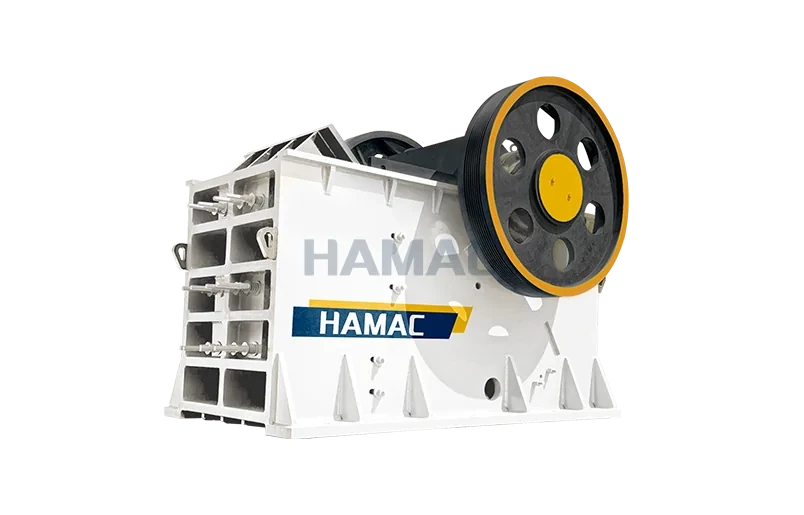
Overview
This page brings together the published PE Series Jaw Crusher model data and the practical details of importing it into United States — power supply, standards, shipping and commissioning. Popular feed materials in the market include Granite, Basalt, Limestone.
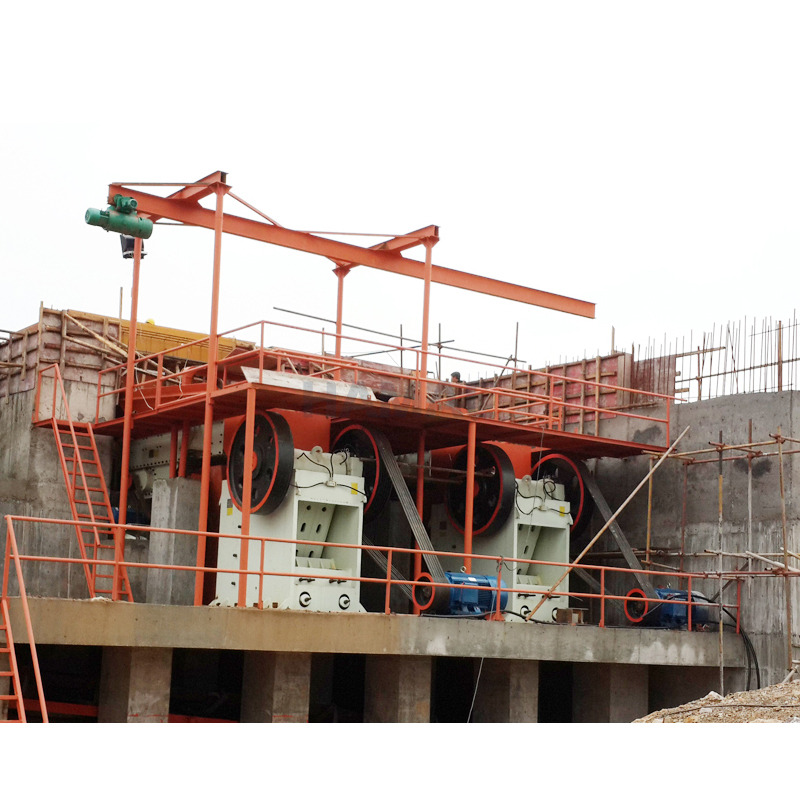
Published PE Series Jaw Crusher data
| Published parameter | Nominal value |
|---|---|
| PEX250x750 | 250x750 mm 210 mm |
| PEX250x1000 | 250x1000 mm 210 mm |
| PEX250x1200 | 250x1200 mm 210 mm |
| PEX300x1300 | 300x1300 mm 250 mm |
| PE400×600 | 400×600 mm 340 mm |
| PE500×750 | 500×750 mm 425 mm |
Local conditions in United States
- Destination port: Los Angeles / Houston.
- Site supply: 460V 60Hz.
- Standards: ASTM / OSHA.
- Common materials: Granite, Basalt, Limestone.
- Region: North America.
Delivery scope
HAMAC quotes FOB, CFR or CIF to Los Angeles / Houston, sets motors and starters to 460V 60Hz, and supplies the certificate set applicable to ASTM / OSHA. Workshop assembly, test, container loading plan and installation supervision are included in a turnkey scope.
Reference data for this configuration
| Parameter | Reference value |
|---|---|
| Destination port | Los Angeles / Houston |
| Site supply | 460V 60Hz |
| Local standards | ASTM / OSHA |
| Region | North America |
| Machine line | PE Series Jaw Crusher |
| Category | Jaw Crusher |
| Assumed duty | contract crushing on short-term sites |
| Evaluation horizon | three-year view |
Ask for the same table from any competing supplier; without it, an offer for pe series jaw crusher cannot be compared on scope.
Published PE Series Jaw Crusher model data
| Model | Input Size | Max Feeding Size | Output Range | Capacity | Engine Power | Weight |
|---|---|---|---|---|---|---|
| PEX250x750 | 250x750 mm | 210 mm | 25-60 mm | 13-35 T/H | 30 KW | 5.5 T |
| PEX250x1000 | 250x1000 mm | 210 mm | 25-60 mm | 16-52 T/H | 37 KW | 7 T |
| PEX250x1200 | 250x1200 mm | 210 mm | 25-60 mm | 20-61 T/H | 55 KW | 9.5 T |
| PEX300x1300 | 300x1300 mm | 250 mm | 20-90 mm | 16-105 T/H | 75 KW | 15.6 T |
| PE400×600 | 400×600 mm | 340 mm | 40-100 mm | 16-60 T/H | 30 KW | 6.7 T |
| PE500×750 | 500×750 mm | 425 mm | 50-100 mm | 40-110 T/H | 55 KW | 11.7 T |
| PE600×900 | 600×900 mm | 500 mm | 65-180 mm | 80-180 T/H | 55-75 KW | 16.1 T |
| PE750×1060 | 750×1060 mm | 630 mm | 80-180 mm | 110-320 T/H | 90-110 KW | 30.1 T |
Jaw crushers are often used for primary crushing in mine material crushing. Read the table column by column against contract crushing on short-term sites: the model you pick is the one whose published range brackets your target tonnage, not simply the largest machine in the series. Availability, motor rating and shipping data are re-confirmed for a confined urban yard in the written HAMAC proposal.
Project profile these notes assume
| Assumption | Value |
|---|---|
| Operating duty | contract crushing on short-term sites |
| Primary objective | lowest energy per tonne |
| Evaluation horizon | three-year view |
| Site condition | a confined urban yard |
| Operating team | an owner-operator team |
Change any one of these assumptions and the recommended configuration for pe series jaw crusher may change. HAMAC re-runs the same checks against your own numbers once the enquiry data sheet is received.
From enquiry to the first saleable tonne
- Survey the feed: the feed material; record top size, bulk density, moisture and clay content before fixing the flow sheet.
- Run a sieve analysis on a representative sample and attach the grading curve to the enquiry.
- Sequence delivery so foundations cure while the equipment is still in manufacture.
- Book container or flat-rack space to Los Angeles / Houston and prepare the customs document set in advance.
- Include dust suppression, guarding, emergency stops and lock-out points in the layout drawing.
- Choose compression or impact reduction according to hardness, silica content and required particle shape.
- Size the primary stage for your target tonnage with a 10–20% surge allowance — never on nameplate throughput alone.
- Verify the electrical single-line diagram, cable sizing and starter type with the local utility.
- Check bearing and lubrication arrangements against the ambient temperature range at the site.
Shortening this sequence is possible on a confined urban yard, but only where the feed and product specification are already fully defined.
What to verify before you sign
- Tramp-iron protection — hydraulic release, magnet and metal detection on the feed belt.
- Whether the quoted t/h is achieved at contract crushing on short-term sites or under ideal laboratory feed.
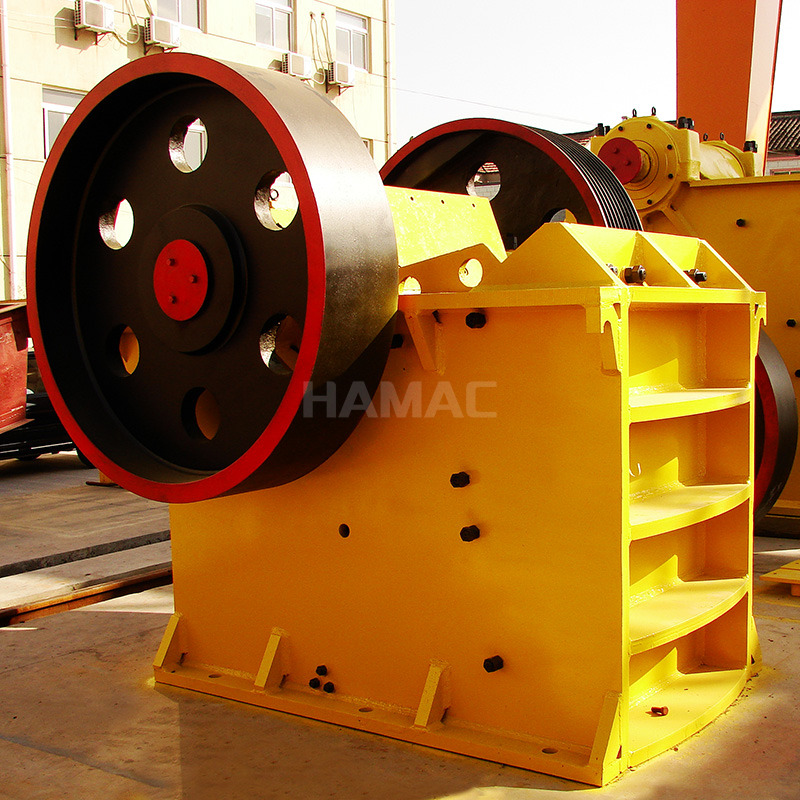
- Access for liner change-out — crane radius, lifting points and clearance around the chamber.
- Screen deck count, aperture and area; ask for the efficiency calculation, not just the mesh size.
- Product sampling points and the lab equipment needed for routine grading checks.
- Availability of an owner-operator team for liner changes and the lifting equipment on site.
- Wear-part interchangeability across machines in the same circuit.
- Nameplate data for 460V 60Hz and the ASTM / OSHA certificate set.
- After-sales response time, technician availability and the warranty exclusions in writing.
For contract crushing on short-term sites, give the lowest energy per tonne line extra weight; a generic checklist will not rank the offers correctly.
Where the money actually goes
| Cost line | Indicative share | What moves the number |
|---|---|---|
| Equipment & drive packages | 53% | Model size, number of stages and automation level |
| Ocean freight & insurance | 11% | Destination port, container count and out-of-gauge cargo |
| Civil works & foundations | 8% | Soil conditions, dynamic loads and site preparation |
| Erection, commissioning & training | 7% | Local labour, supervision scope and schedule |
| First-year wear parts | 14% | Rock abrasiveness, liner grade and operating hours |
| Power, lubricants & consumables | 7% | kWh per tonne, local tariff and dust suppression water |
The weighting shifts with hardness and scale — a hard feed pushes the wear line up, while a larger plant pushes equipment share up.
Mistakes that cost more than the machine
- Buying on nameplate t/h without converting to saleable product at the specified fractions.
- Skipping a geotechnical check and discovering settlement under the primary crusher at a confined urban yard.
- Comparing quotations with different port terms and calling the lower number cheaper.
- Specifying motors for the wrong voltage or frequency and rewinding them on site.
- Using one liner profile for both secondary and tertiary stages.
- Letting the contract crushing on short-term sites duty be defined verbally instead of in the contract.
- Assuming the manufacturer's warranty covers wear parts and consumables.
- Choosing screen apertures before the concrete or asphalt mix design is fixed.
Every item on this list has cost someone a commissioning date; none of them requires new technology to avoid.
Commissioning checklist
- Agree the punch list, sign the hand-over protocol and file the as-built drawings.
- Calibrate the belt scale and any level probes against a known load.
- Measure and log the as-new CSS / setting for future wear comparison.
- Record power draw, tonnage and chamber pressure at steady state.
- Dry-run the plant empty for the specified period and record vibration.
- Record the baseline grading curve for each product fraction.
- Measure noise and dust at the operator position against the local limit.
- Check lubrication levels, grease lines and oil cooler operation.
The commissioning record becomes the reference for every liner change in the three-year plan.