Overview
This page brings together the published Mobile Jaw Crusher Plant model data and the practical details of importing it into Mexico — power supply, standards, shipping and commissioning. Popular feed materials in the market include Basalt, Limestone.
Published Mobile Jaw Crusher Plant data
| Published parameter | Nominal value |
|---|---|
| MJ69 | 95-165 mm 30-85 m³/h |
| MJC96 | 60-175 mm 60-200 m³/h |
| MJ750 | 80-180 mm 72-150 m³/h |
| MJC106 | 70-200 mm 100-300 m³/h |
Local conditions in Mexico
- Destination port: Manzanillo.
- Site supply: 460V 60Hz.
- Standards: NOM.
- Common materials: Basalt, Limestone.
- Region: North America.
Delivery scope
HAMAC quotes FOB, CFR or CIF to Manzanillo, sets motors and starters to 460V 60Hz, and supplies the certificate set applicable to NOM. Workshop assembly, test, container loading plan and installation supervision are included in a turnkey scope.
Reference data for this configuration
| Parameter | Reference value |
|---|---|
| Destination port | Manzanillo |
| Site supply | 460V 60Hz |
| Local standards | NOM |
| Region | North America |
| Machine line | Mobile Jaw Crusher Plant |
| Category | Wheel Type Mobile Crushers |
| Assumed duty | seasonal road-project supply |
| Evaluation horizon | five-year view |
Treat this as a living sheet. Every revision of the flow sheet for Mexico should update the same fields so the equipment list stays traceable.
Published Mobile Jaw Crusher Plant model data
| Model | Discharge Adjustment | Nominal Capacity | Dimension | Magnetic Separator | Axles |
|---|---|---|---|---|---|
| MJ69 | 95-165 mm | 30-85 m³/h | 11097×3759×3500 mm | RCYD800 | Double |
| MJC96 | 60-175 mm | 60-200 m³/h | 11097×3759×3500 mm | RCYD800 | Double |
| MJ750 | 80-180 mm | 72-150 m³/h | 13300×2900×4440 mm | RCYD1000 | Three |
| MJC106 | 70-200 mm | 100-300 m³/h | 13300×2900×4440 mm | RCYD1000 | Three |
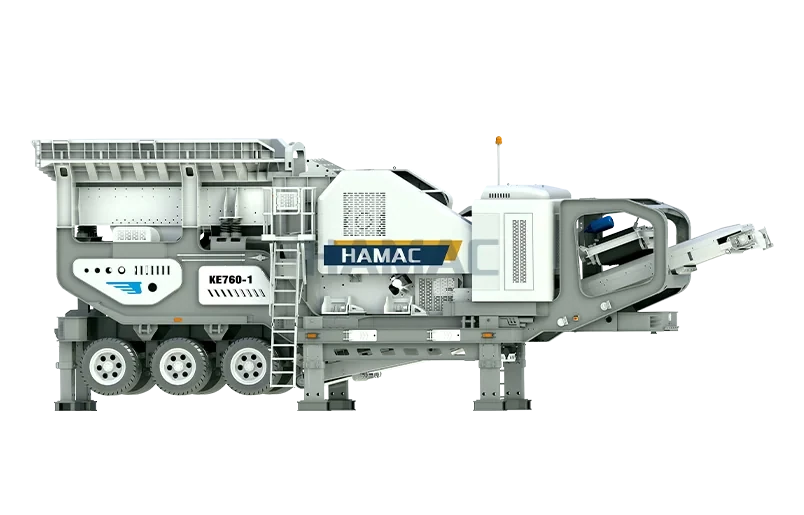
The tire-type mobilejaw crusher mobile is a mobile primary crushing equipment composed of vibratingfeeder, jaw crusher, conveyor belt and other components. Read the table column by column against seasonal road-project supply: the model you pick is the one whose published range brackets your target tonnage, not simply the largest machine in the series. Availability, motor rating and shipping data are re-confirmed for a coastal export terminal in the written HAMAC proposal.
Project profile these notes assume
| Assumption | Value |
|---|---|
| Operating duty | seasonal road-project supply |
| Primary objective | maximum mechanical availability |
| Evaluation horizon | five-year view |
| Site condition | a coastal export terminal |
| Operating team | a rotating shift crew |
Change any one of these assumptions and the recommended configuration for mobile jaw crusher plant may change. HAMAC re-runs the same checks against your own numbers once the enquiry data sheet is received.
From enquiry to the first saleable tonne
- Log tonnes per liner set and kWh per tonne from day one so you have a real cost baseline within a quarter.
- Lay out conveyors, access ways, stockpile capacity and drainage before ordering steelwork.
- Survey the feed: the feed material; record top size, bulk density, moisture and clay content before fixing the flow sheet.
- Choose compression or impact reduction according to hardness, silica content and required particle shape.
- Set the closed-side setting or rotor speed against the required product fractions, then verify the expected reduction ratio.
- Commission with graded load, sample the product grading, then train operators on liner change-out and daily checks.
- Review the crusher chamber profile with the liner supplier against the feed material.
- Size the primary stage for your target tonnage with a 10–20% surge allowance — never on nameplate throughput alone.
- Plan training for a rotating shift crew on CSS adjustment, liner change-out and lock-out / tag-out.
Shortening this sequence is possible on a coastal export terminal, but only where the feed and product specification are already fully defined.
What to verify before you sign
- Guaranteed power draw and the maximum mechanical availability trade-off it implies.
- Whether the quoted t/h is achieved at seasonal road-project supply or under ideal laboratory feed.
- Maximum feed lump and gradation — a chamber that cannot accept the top size will bridge on day one.
- Access for liner change-out — crane radius, lifting points and clearance around the chamber.
- Energy draw in kW and the expected kWh per tonne at the design duty.
- Screen deck count, aperture and area; ask for the efficiency calculation, not just the mesh size.
- Liner alloy: Mn18 with ceramic inserts matched to the rock, not to the lowest purchase price.
- Wear-part interchangeability across machines in the same circuit.
- Local service partner, technician travel time and visa requirements for Mexico.
Score each supplier against the same ten items and keep the score sheet with the purchase file for the five-year review.
Where the money actually goes
| Cost line | Indicative share | What moves the number |
|---|---|---|
| Equipment & drive packages | 53% | Model size, number of stages and automation level |
| Ocean freight & insurance | 11% | Destination port, container count and out-of-gauge cargo |
| Civil works & foundations | 8% | Soil conditions, dynamic loads and site preparation |
| Erection, commissioning & training | 7% | Local labour, supervision scope and schedule |
| First-year wear parts | 14% | Rock abrasiveness, liner grade and operating hours |
| Power, lubricants & consumables | 7% | kWh per tonne, local tariff and dust suppression water |
For mobile jaw crusher plant at your target tonnage, wear parts and energy usually outweigh the difference between two purchase prices within three to five years.
Mistakes that cost more than the machine
- Overlooking dust, noise and water permits in Mexico until erection has already started.
- Selecting the cheapest liner alloy for hard, high-silica rock and paying for it in change-outs.
- Comparing quotations with different port terms and calling the lower number cheaper.
- Specifying motors for the wrong voltage or frequency and rewinding them on site.
- Letting the seasonal road-project supply duty be defined verbally instead of in the contract.
- Assuming a mobile plant can match a stationary line on high-tonnage, multi-product duty.
- Planning the crusher but not the conveyors, transfer chutes and stockpile capacity around it.
- Undersizing the screen, then blaming the crusher for a plant that never reaches your target tonnage.
Every item on this list has cost someone a commissioning date; none of them requires new technology to avoid.
Commissioning checklist
- Record power draw, tonnage and chamber pressure at steady state.
- Record the baseline grading curve for each product fraction.
- Confirm all guards, emergency stops and pull-wire switches function.
- Measure noise and dust at the operator position against the local limit.
- Calibrate the belt scale and any level probes against a known load.
- Test emergency stops, pull wires and interlock trips in sequence.
- Confirm the direction and tension of every belt under no load.
- Verify rotation direction on every motor before coupling.
For a rotating shift crew, run through this list twice — once with the supervisor and once without.