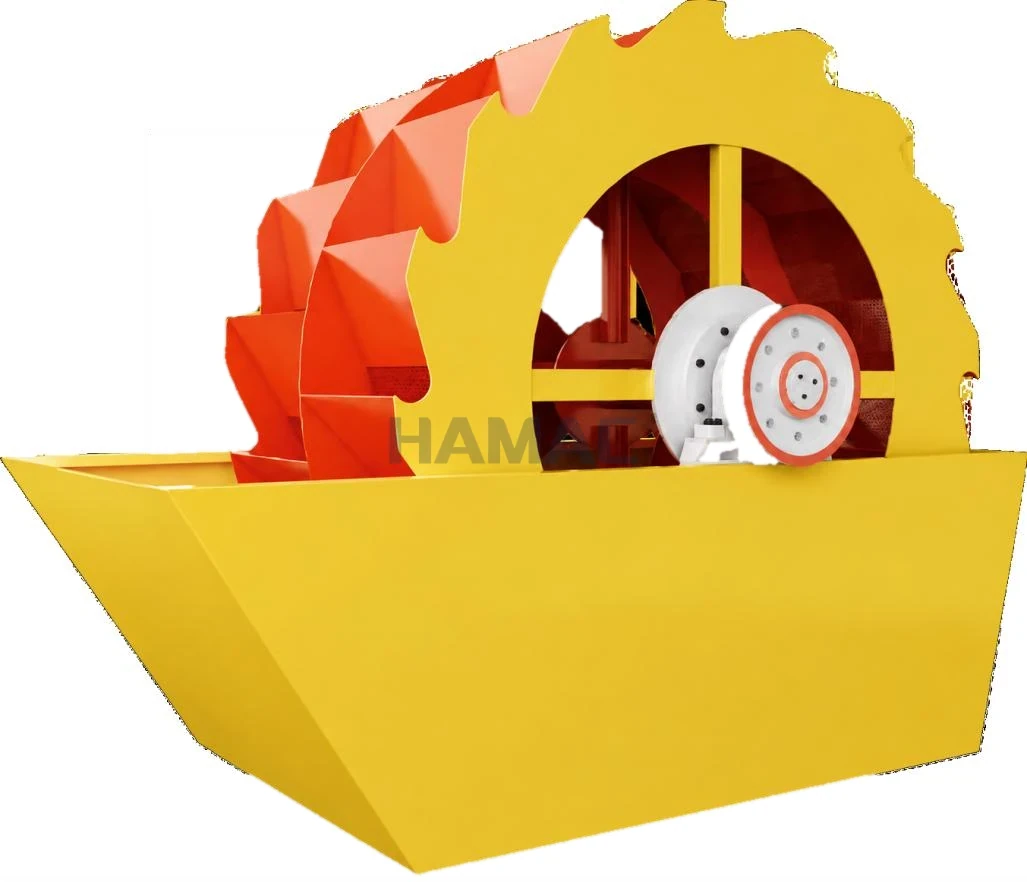
Overview
Buying a Wheel Bucket Type Sand Washer direct from HAMAC removes the trading margin and gives you engineering support from enquiry to commissioning.
Why buy direct
- One project manager for the whole order.
- Workshop assembly, test and container loading plan.
- Flow-sheet design, layout and foundation reference.
- Installation supervision, training and 24h technical response.
Export & documentation
Quoted FOB / CFR / CIF. Documentation applicable to your market (CE where required), Spanish manuals for LatAm, motors set to local voltage.
How to order
Send project data → receive design + budget in 24h → refine drawings → manufacture → install.
Reference data for this configuration
| Parameter | Reference value |
|---|---|
| Machine line | Wheel Bucket Type Sand Washer |
| Category | Sand Making & Washing |
| Assumed duty | cement raw-meal preparation |
| Evaluation horizon | seven-year view |
The figures above are transcribed from published HAMAC data and from the material properties of the feed; site measurements take precedence.
Published Wheel Bucket Type Sand Washer model data
| Model | Impeller (mm) | Feeding size (mm) | Capacity (t/h) | Power (kW) | Overall dimension (mm) |
|---|---|---|---|---|---|
| XSD2610 | φ2600 | ≤10 | 30–60 | 7.5 | 3320 × 2125 × 2670 |
| XSD2900 | φ2900 | ≤10 | 50–90 | 15 | 3810 × 2686 × 3085 |
| XSD3016 | φ3000 | ≤10 | 80–120 | 18.5 | 3845 × 3000 × 3080 |
| XSD3220 | φ3000 | ≤10 | 120–200 | 22 | 4150 × 3780 × 3400 |
| XSD3620 | φ3600 | ≤10 | 150–280 | 30 | 4600 × 3780 × 3900 |
XSD wheel bucket sand washers, 30–280 t/h, with low fines loss and compact footprint for washed sand and aggregate. Read the table column by column against cement raw-meal preparation: the model you pick is the one whose published range brackets your target tonnage, not simply the largest machine in the series. Availability, motor rating and shipping data are re-confirmed for a confined urban yard in the written HAMAC proposal.
Project profile these notes assume
| Assumption | Value |
|---|---|
| Operating duty | cement raw-meal preparation |
| Primary objective | fast mobilisation |
| Evaluation horizon | seven-year view |
| Site condition | a confined urban yard |
| Operating team | a small contractor crew |
Change any one of these assumptions and the recommended configuration for wheel bucket type sand washer may change. HAMAC re-runs the same checks against your own numbers once the enquiry data sheet is received.
From enquiry to the first saleable tonne
- Run a sieve analysis on a representative sample and attach the grading curve to the enquiry.
- Commission with graded load, sample the product grading, then train operators on liner change-out and daily checks.
- Size the primary stage for your target tonnage with a 10–20% surge allowance — never on nameplate throughput alone.
- Log tonnes per liner set and kWh per tonne from day one so you have a real cost baseline within a quarter.
- Budget for water, dust extraction and spillage handling as part of the plant, not as an afterthought.
- Choose compression or impact reduction according to hardness, silica content and required particle shape.
- Set the maintenance stock list from the expected wear rate, not from a percentage of the equipment price.
- Sequence delivery so foundations cure while the equipment is still in manufacture.
- Set the closed-side setting or rotor speed against the required product fractions, then verify the expected reduction ratio.
Most delays at this stage come from missing feed data rather than from manufacturing capacity.
What to verify before you sign
- Closed-side setting range and whether automatic setting regulation is included.
- Liner alloy: high-chrome iron matched to the rock, not to the lowest purchase price.
- After-sales response time, technician availability and the warranty exclusions in writing.
- Choke-feed arrangement: surge bin, feeder control and level indication.
- Screen deck count, aperture and area; ask for the efficiency calculation, not just the mesh size.
- Availability of a small contractor crew for liner changes and the lifting equipment on site.
- Dust and noise control designed to the local emission limits for your market.
- Wear-part interchangeability across machines in the same circuit.
- Spare motor, gearbox and hydraulic pump lead times from the nearest HAMAC stock point.
Bring this list to the design review — it is cheaper to resolve an omission on paper than during commissioning.
Where the money actually goes
| Cost line | Indicative share | What moves the number |
|---|---|---|
| Equipment & drive packages | 54% | Model size, number of stages and automation level |
| Ocean freight & insurance | 8% | Destination port, container count and out-of-gauge cargo |
| Civil works & foundations | 8% | Soil conditions, dynamic loads and site preparation |
| Erection, commissioning & training | 7% | Local labour, supervision scope and schedule |
| First-year wear parts | 15% | Rock abrasiveness, liner grade and operating hours |
| Power, lubricants & consumables | 8% | kWh per tonne, local tariff and dust suppression water |
Freight to your market is volatile; ask for the quotation to state validity and the port basis rather than a single delivered number.
Mistakes that cost more than the machine
- Comparing quotations with different port terms and calling the lower number cheaper.
- Skipping a geotechnical check and discovering settlement under the primary crusher at a confined urban yard.
- Undersizing the screen, then blaming the crusher for a plant that never reaches your target tonnage.
- Choosing screen apertures before the concrete or asphalt mix design is fixed.
- Skipping the acceptance test, so no one has a baseline to measure degradation against.
- Leaving tramp-iron protection out of the scope to save a small percentage of capital.
- Ordering no spares with the plant and waiting six weeks for the first liner set.
- Ignoring clay and moisture until the first wet season, when decks blind and chambers pack.
Review the list with a small contractor crew before the order is placed — they will recognise most of them.
Commissioning checklist
- Verify rotation direction on every motor before coupling.
- Measure noise and dust at the operator position against the local limit.
- Agree the punch list, sign the hand-over protocol and file the as-built drawings.
- Introduce feed in graded steps: 25%, 50%, 75%, then full load.
- Check lubrication levels, grease lines and oil cooler operation.
- Check belt tracking, chute build-up and transfer-point dust.
- Record power draw, tonnage and chamber pressure at steady state.
- Verify chute liners, skirt rubber and impact bars after the first hour of feed.
For a small contractor crew, run through this list twice — once with the supervisor and once without.