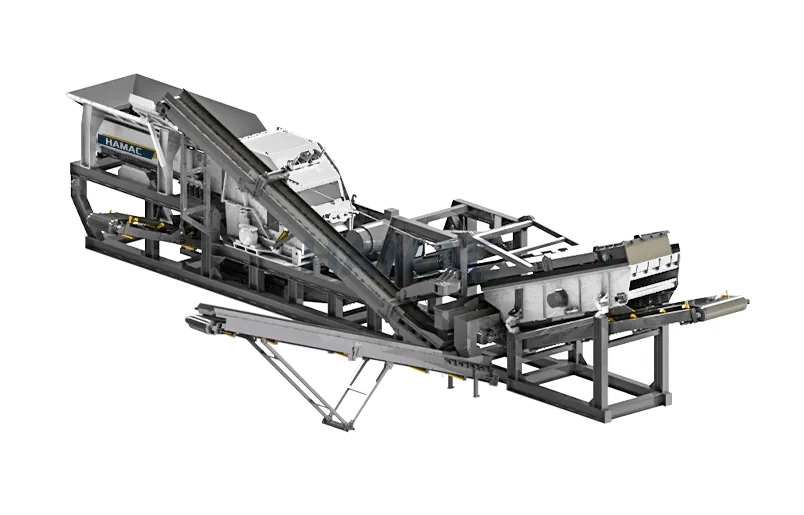
Overview
Published Modular Type Crusher Plant specifications below are nominal values transcribed from HAMAC data. Actual performance depends on feed gradation, moisture, setting and screening efficiency.
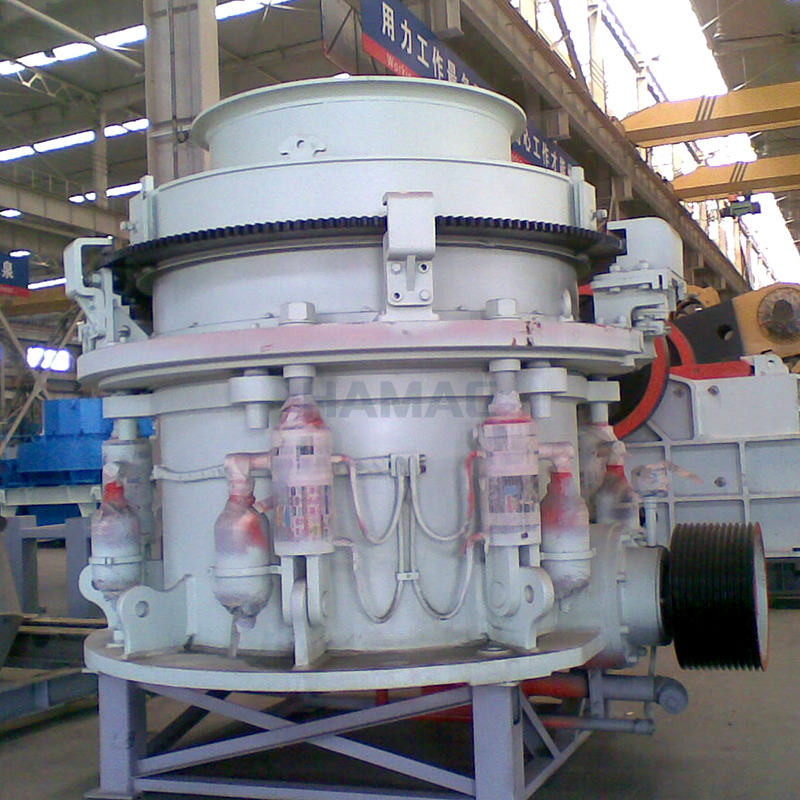
Specification table
| Parameter | Value |
|---|---|
| Main machine model | 6CX96 6CX106 |
| Main belt conveyor | B800*9М B1000*9М |
| Feeding capacity | 300 t/h 430 t/h |
| Max. feeding size | 600 mm 650 mm |
| Capacity | 100-330 t/h 140-420 t/h |
| Adjusting range of discharge opening | 70-200 mm 70-200 mm |
| Jaw crusher power | 90 kW 110 kW |
How to read the data
- Rated capacity is at a specified CSS / setting and material — treat it as saleable product, not crusher throughput.
- Feed size limit protects the chamber; oversize feed causes bridging.
- Motor power scales with rotor / chamber size, not linearly with capacity.
Selecting the right model
Match the model to your target t/h at the required product size, then confirm with a HAMAC engineer before order.
Reference data for this configuration
| Parameter | Reference value |
|---|---|
| Machine line | Modular Type Crusher Plant |
| Category | Modular Crushing Plant |
| Assumed duty | contract crushing on short-term sites |
| Evaluation horizon | five-year view |
Treat this as a living sheet. Every revision of the flow sheet for your market should update the same fields so the equipment list stays traceable.
Published Modular Type Crusher Plant model data
| Item | HMC-C96 | HMC-C106 | HMC-C110 |
|---|---|---|---|
| Main machine model | 6CX96 | 6CX106 | 6CX110 |
| Main belt conveyor | B800*9М | B1000*9М | B1200*9М |
| Feeding capacity | 300 t/h | 430 t/h | 600 t/h |
| Max. feeding size | 600 mm | 650 mm | 680 mm |
| Capacity | 100-330 t/h | 140-420 t/h | 170-600 t/h |
| Adjusting range of discharge opening | 70-200 mm | 70-200 mm | 80-200 mm |
| Jaw crusher power | 90 kW | 110 kW | 130 kW |
| Whole machine power | 115.5 kW | 137.5 kW | 164.5 kW |
Discover the power of efficiency with our Modular Type Crusher Plant. Read the table column by column against contract crushing on short-term sites: the model you pick is the one whose published range brackets your target tonnage, not simply the largest machine in the series. Availability, motor rating and shipping data are re-confirmed for an existing quarry bench in the written HAMAC proposal.
Project profile these notes assume
| Assumption | Value |
|---|---|
| Operating duty | contract crushing on short-term sites |
| Primary objective | simple operator maintenance |
| Evaluation horizon | five-year view |
| Site condition | an existing quarry bench |
| Operating team | a rotating shift crew |
Change any one of these assumptions and the recommended configuration for modular type crusher plant may change. HAMAC re-runs the same checks against your own numbers once the enquiry data sheet is received.
From enquiry to the first saleable tonne
- Review the crusher chamber profile with the liner supplier against the feed material.
- Size the primary stage for your target tonnage with a 10–20% surge allowance — never on nameplate throughput alone.
- Run a sieve analysis on a representative sample and attach the grading curve to the enquiry.
- Lay out conveyors, access ways, stockpile capacity and drainage before ordering steelwork.
- Verify the electrical single-line diagram, cable sizing and starter type with the local utility.
- Log tonnes per liner set and kWh per tonne from day one so you have a real cost baseline within a quarter.
- Record the as-built settings and give the operator a written daily, weekly and monthly schedule.
- Survey the feed: the feed material; record top size, bulk density, moisture and clay content before fixing the flow sheet.
- Allocate screen area per deck; blinding and pegging are the most common hidden bottlenecks in a new plant.
A HAMAC project manager stays with the order from the first data sheet through hand-over in your market.
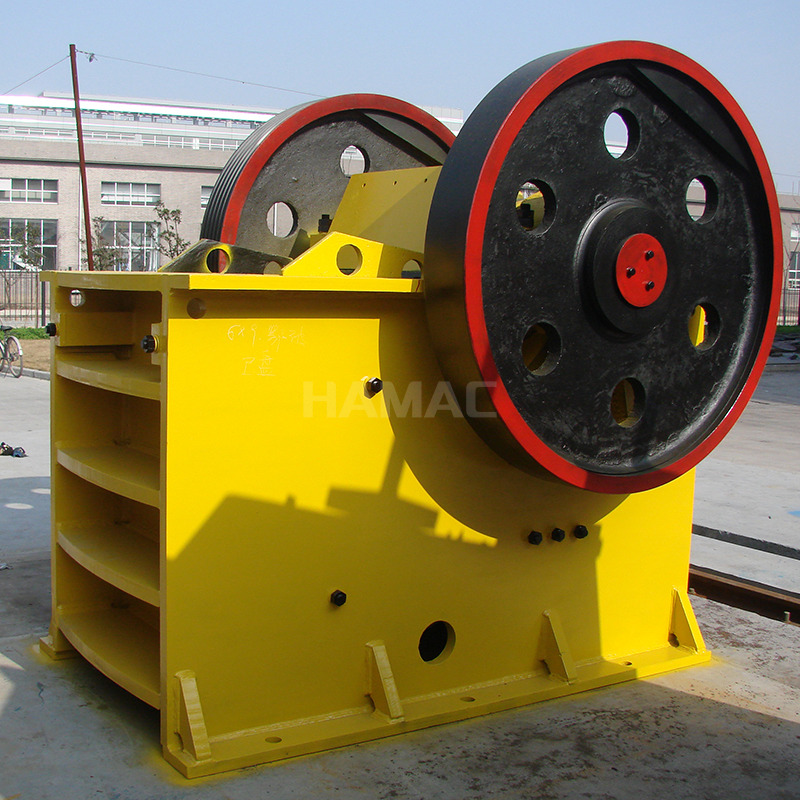
What to verify before you sign
- Saleable tonnes per hour at each product size, not gross crusher throughput, for your target tonnage.
- Guaranteed power draw and the simple operator maintenance trade-off it implies.
- Availability of a rotating shift crew for liner changes and the lifting equipment on site.
- Dust and noise control designed to the local emission limits for your market.
- Energy draw in kW and the expected kWh per tonne at the design duty.
- Choke-feed arrangement: surge bin, feeder control and level indication.
- Local service partner, technician travel time and visa requirements for your market.
- Closed-side setting range and whether automatic setting regulation is included.
- Decommissioning or relocation value at the end of a five-year horizon.
The cheapest offer usually wins on equipment and loses on one of the last six items — freight terms, spares or the acceptance test.
Where the money actually goes
| Cost line | Indicative share | What moves the number |
|---|---|---|
| Equipment & drive packages | 54% | Model size, number of stages and automation level |
| Ocean freight & insurance | 8% | Destination port, container count and out-of-gauge cargo |
| Civil works & foundations | 8% | Soil conditions, dynamic loads and site preparation |
| Erection, commissioning & training | 7% | Local labour, supervision scope and schedule |
| First-year wear parts | 15% | Rock abrasiveness, liner grade and operating hours |
| Power, lubricants & consumables | 8% | kWh per tonne, local tariff and dust suppression water |
Model a low, base and high case for tonnes per liner set. The spread tells you more than a single optimistic estimate.
Mistakes that cost more than the machine
- Using one liner profile for both secondary and tertiary stages.
- Buying on nameplate t/h without converting to saleable product at the specified fractions.
- Specifying motors for the wrong voltage or frequency and rewinding them on site.
- Letting the contract crushing on short-term sites duty be defined verbally instead of in the contract.
- Leaving tramp-iron protection out of the scope to save a small percentage of capital.
- Ordering no spares with the plant and waiting six weeks for the first liner set.
- Assuming a mobile plant can match a stationary line on high-tonnage, multi-product duty.
- Planning the crusher but not the conveyors, transfer chutes and stockpile capacity around it.
On an existing quarry bench, the civil and logistics items deserve as much attention as the crusher itself.
Commissioning checklist
- Verify rotation direction on every motor before coupling.
- Measure noise and dust at the operator position against the local limit.
- Introduce feed in graded steps: 25%, 50%, 75%, then full load.
- Verify chute liners, skirt rubber and impact bars after the first hour of feed.
- Sample each product fraction and compare with the specification.
- Hand over the spare-parts list, manuals and maintenance schedule.
- Record power draw, tonnage and chamber pressure at steady state.
- Check belt tracking, chute build-up and transfer-point dust.
On an existing quarry bench, allow extra time for the dust and noise measurements.