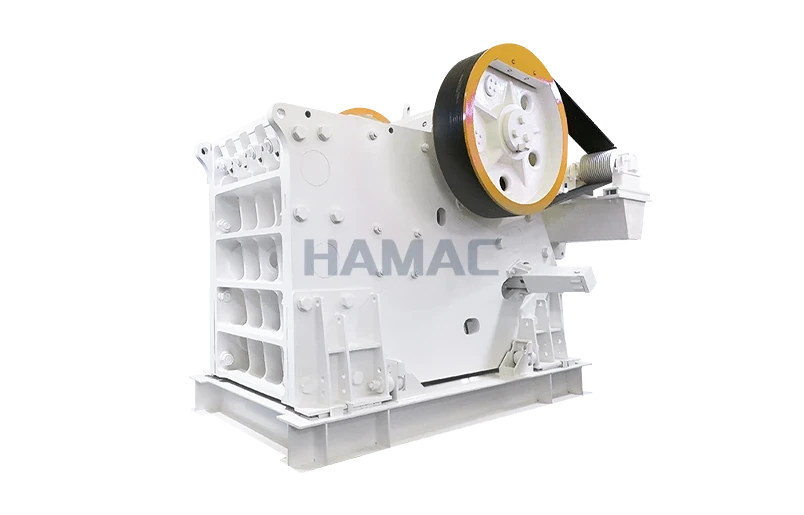
Overview
Published European Tech. Jaw Crusher specifications below are nominal values transcribed from HAMAC data. Actual performance depends on feed gradation, moisture, setting and screening efficiency.
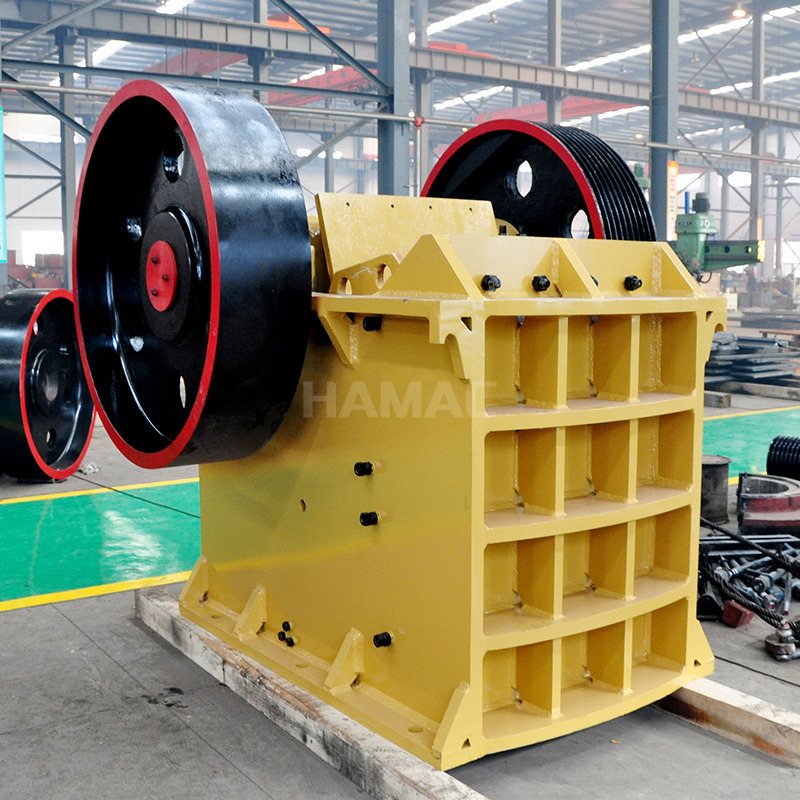
Specification table
| Parameter | Value |
|---|---|
| 6CX80 | 800×510 mm 75 kW |
| 6CX96 | 930×580 mm 75(90) kW |
| 6CX106 | 1060×700 mm 110 kW |
| 6CX110 | 1100×850 mm 132(160) kW |
| 6CX125 | 1250×950 mm 160(132) kW |
| 6CX140 | 1400×1070 mm 200(160) kW |
| 6CX145 | 1400×1100 mm 200 kW |
How to read the data
- Rated capacity is at a specified CSS / setting and material — treat it as saleable product, not crusher throughput.
- Feed size limit protects the chamber; oversize feed causes bridging.
- Motor power scales with rotor / chamber size, not linearly with capacity.
Selecting the right model
Match the model to your target t/h at the required product size, then confirm with a HAMAC engineer before order.
Reference data for this configuration
| Parameter | Reference value |
|---|---|
| Machine line | European Tech. Jaw Crusher |
| Category | Jaw Crusher |
| Assumed duty | contract crushing on short-term sites |
| Evaluation horizon | seven-year view |
Ask for the same table from any competing supplier; without it, an offer for european tech. jaw crusher cannot be compared on scope.
Published European Tech. Jaw Crusher model data
| Model | Feed opening | Motor Power | Rotation speed | Jaw plate length | Max single part weight | Total weight |
|---|---|---|---|---|---|---|
| 6CX80 | 800×510 mm | 75 kW | 350 rpm | 1100 mm | 2870 kg | 7520 kg |
| 6CX96 | 930×580 mm | 75(90) kW | 300 rpm | 1380 mm | 4500 kg | 12000 kg |
| 6CX106 | 1060×700 mm | 110 kW | 280 rpm | 1450 mm | 7800 kg | 19000 kg |
| 6CX110 | 1100×850 mm | 132(160) kW | 230 rpm | 1800 mm | 9000 kg | 25060 kg |
| 6CX125 | 1250×950 mm | 160(132) kW | 220 rpm | 2000 mm | 12960 kg | 36700 kg |
| 6CX140 | 1400×1070 mm | 200(160) kW | 220 rpm | 2100 mm | 15950 kg | 45300 kg |
| 6CX145 | 1400×1100 mm | 200 kW | 220 rpm | 2300 mm | 18600 kg | 53800 kg |
| 6CX160 | 1600×1200 mm | 250(200) kW | 220 rpm | 2500 mm | 21380 kg | 68600 kg |
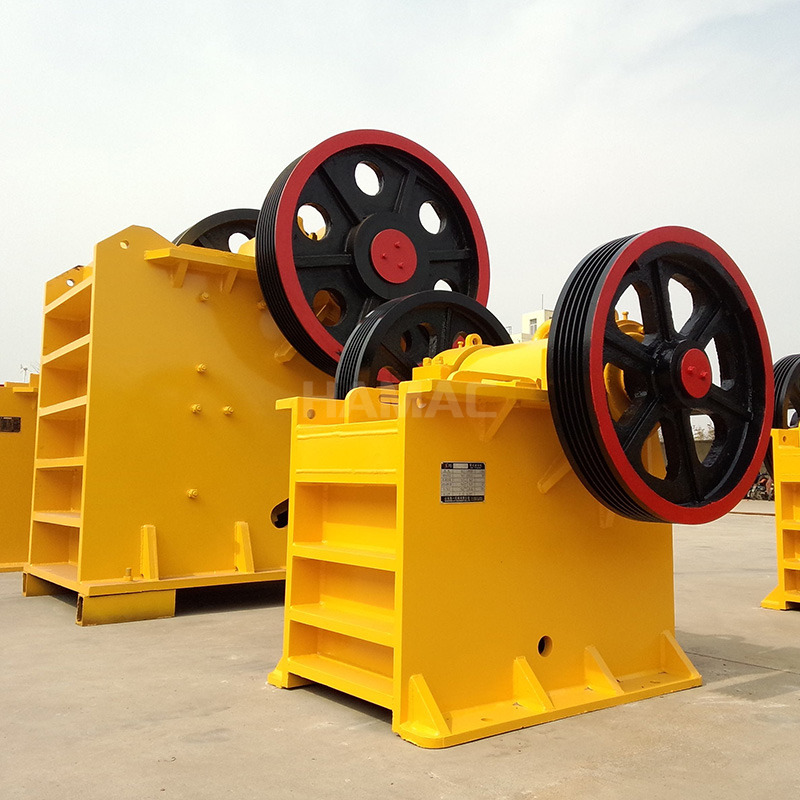
The European Tech. jaw crusher, developed using advanced international crushing technology, is designed for high-efficiency crushing of hard, abrasive materials. Read the table column by column against contract crushing on short-term sites: the model you pick is the one whose published range brackets your target tonnage, not simply the largest machine in the series. Availability, motor rating and shipping data are re-confirmed for a confined urban yard in the written HAMAC proposal.
Project profile these notes assume
| Assumption | Value |
|---|---|
| Operating duty | contract crushing on short-term sites |
| Primary objective | lowest energy per tonne |
| Evaluation horizon | seven-year view |
| Site condition | a confined urban yard |
| Operating team | a mixed local and expatriate team |
Change any one of these assumptions and the recommended configuration for european tech. jaw crusher may change. HAMAC re-runs the same checks against your own numbers once the enquiry data sheet is received.
From enquiry to the first saleable tonne
- Lay out conveyors, access ways, stockpile capacity and drainage before ordering steelwork.
- Check bearing and lubrication arrangements against the ambient temperature range at the site.
- Include dust suppression, guarding, emergency stops and lock-out points in the layout drawing.
- Log tonnes per liner set and kWh per tonne from day one so you have a real cost baseline within a quarter.
- Choose compression or impact reduction according to hardness, silica content and required particle shape.
- Size the primary stage for your target tonnage with a 10–20% surge allowance — never on nameplate throughput alone.
- Confirm site voltage, frequency and applicable conformity standards before manufacture.
- Confirm the haul-road and stockpile plan with a confined urban yard in mind before fixing conveyor lengths.
- Define the acceptance test: sampling points, test duration, moisture range and who signs the protocol.
Shortening this sequence is possible on a confined urban yard, but only where the feed and product specification are already fully defined.
What to verify before you sign
- Spare-parts consignment: one full liner or blow-bar set plus meshes, belts, bearings and seals.
- Tramp-iron protection — hydraulic release, magnet and metal detection on the feed belt.
- Screen deck count, aperture and area; ask for the efficiency calculation, not just the mesh size.
- Choke-feed arrangement: surge bin, feeder control and level indication.
- Local service partner, technician travel time and visa requirements for your market.
- Guaranteed power draw and the lowest energy per tonne trade-off it implies.
- After-sales response time, technician availability and the warranty exclusions in writing.
- Saleable tonnes per hour at each product size, not gross crusher throughput, for your target tonnage.
- Control system language, telemetry and remote diagnostics availability.
Score each supplier against the same ten items and keep the score sheet with the purchase file for the seven-year review.
Where the money actually goes
| Cost line | Indicative share | What moves the number |
|---|---|---|
| Equipment & drive packages | 54% | Model size, number of stages and automation level |
| Ocean freight & insurance | 8% | Destination port, container count and out-of-gauge cargo |
| Civil works & foundations | 8% | Soil conditions, dynamic loads and site preparation |
| Erection, commissioning & training | 7% | Local labour, supervision scope and schedule |
| First-year wear parts | 15% | Rock abrasiveness, liner grade and operating hours |
| Power, lubricants & consumables | 8% | kWh per tonne, local tariff and dust suppression water |
A seven-year view normally reverses the ranking of two otherwise similar offers once wear and energy are included.
Mistakes that cost more than the machine
- Skipping a geotechnical check and discovering settlement under the primary crusher at a confined urban yard.
- Skipping the acceptance test, so no one has a baseline to measure degradation against.
- Comparing quotations with different port terms and calling the lower number cheaper.
- Letting the contract crushing on short-term sites duty be defined verbally instead of in the contract.
- Ignoring clay and moisture until the first wet season, when decks blind and chambers pack.
- Leaving tramp-iron protection out of the scope to save a small percentage of capital.
- Using one liner profile for both secondary and tertiary stages.
- Assuming the manufacturer's warranty covers wear parts and consumables.
On a confined urban yard, the civil and logistics items deserve as much attention as the crusher itself.
Commissioning checklist
- Calibrate the belt scale and any level probes against a known load.
- Check belt tracking, chute build-up and transfer-point dust.
- Verify chute liners, skirt rubber and impact bars after the first hour of feed.
- Confirm all guards, emergency stops and pull-wire switches function.
- Agree the punch list, sign the hand-over protocol and file the as-built drawings.
- Measure noise and dust at the operator position against the local limit.
- Introduce feed in graded steps: 25%, 50%, 75%, then full load.
- Test emergency stops, pull wires and interlock trips in sequence.
The commissioning record becomes the reference for every liner change in the seven-year plan.