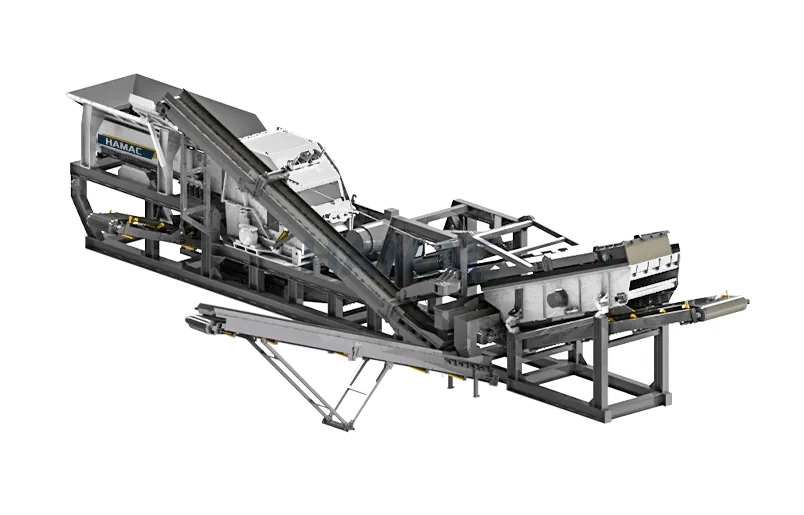
Overview
Practical, numbers-first guidance on the Modular Type Crusher Plant — written for engineers specifying, buying and running crushing plants.
Capacity factors
- Chamber / CSS and material.
- Feed gradation and moisture.
- Screen efficiency downstream.
- Continuous vs surge feed.
Rule of thumb
Rated capacity is stated at a given CSS and material; treat it as saleable product, not crusher throughput. Size the plant to 10–20% above target.
Reference data for this configuration
| Parameter | Reference value |
|---|---|
| Machine line | Modular Type Crusher Plant |
| Category | Modular Crushing Plant |
| Assumed duty | contract crushing on short-term sites |
| Evaluation horizon | five-year view |
Where a value is shown as nominal, the written proposal states the guaranteed figure for your material, feed grading and five-year operating plan.
Published Modular Type Crusher Plant model data
| Item | HMC-C96 | HMC-C106 | HMC-C110 |
|---|---|---|---|
| Main machine model | 6CX96 | 6CX106 | 6CX110 |
| Main belt conveyor | B800*9М | B1000*9М | B1200*9М |
| Feeding capacity | 300 t/h | 430 t/h | 600 t/h |
| Max. feeding size | 600 mm | 650 mm | 680 mm |
| Capacity | 100-330 t/h | 140-420 t/h | 170-600 t/h |
| Adjusting range of discharge opening | 70-200 mm | 70-200 mm | 80-200 mm |
| Jaw crusher power | 90 kW | 110 kW | 130 kW |
| Whole machine power | 115.5 kW | 137.5 kW | 164.5 kW |
Discover the power of efficiency with our Modular Type Crusher Plant. Read the table column by column against contract crushing on short-term sites: the model you pick is the one whose published range brackets your target tonnage, not simply the largest machine in the series. Availability, motor rating and shipping data are re-confirmed for a greenfield site in the written HAMAC proposal.
Project profile these notes assume
| Assumption | Value |
|---|---|
| Operating duty | contract crushing on short-term sites |
| Primary objective | maximum mechanical availability |
| Evaluation horizon | five-year view |
| Site condition | a greenfield site |
| Operating team | a small contractor crew |
Change any one of these assumptions and the recommended configuration for modular type crusher plant may change. HAMAC re-runs the same checks against your own numbers once the enquiry data sheet is received.
From enquiry to the first saleable tonne
- Log tonnes per liner set and kWh per tonne from day one so you have a real cost baseline within a quarter.
- Book shipping, prepare the packing list and confirm the container loading plan.
- Sequence delivery so foundations cure while the equipment is still in manufacture.
- Include dust suppression, guarding, emergency stops and lock-out points in the layout drawing.
- Run a sieve analysis on a representative sample and attach the grading curve to the enquiry.
- Commission with graded load, sample the product grading, then train operators on liner change-out and daily checks.
- Verify the electrical single-line diagram, cable sizing and starter type with the local utility.
- Record the as-built settings and give the operator a written daily, weekly and monthly schedule.
- Plan training for a small contractor crew on CSS adjustment, liner change-out and lock-out / tag-out.
Most delays at this stage come from missing feed data rather than from manufacturing capacity.
What to verify before you sign
- Guaranteed power draw and the maximum mechanical availability trade-off it implies.
- Access for liner change-out — crane radius, lifting points and clearance around the chamber.
- Screen deck count, aperture and area; ask for the efficiency calculation, not just the mesh size.
- Ambient temperature, altitude and dust load derating for motors and hydraulics.
- Choke-feed arrangement: surge bin, feeder control and level indication.
- Delivery terms (FOB / CFR / CIF) with the destination port named explicitly.
- Control system language, telemetry and remote diagnostics availability.
- Maximum feed lump and gradation — a chamber that cannot accept the top size will bridge on day one.
- Tramp-iron protection — hydraulic release, magnet and metal detection on the feed belt.
Share this list with a small contractor crew as well as procurement; operators are the ones who live with the omissions.
Where the money actually goes
| Cost line | Indicative share | What moves the number |
|---|---|---|
| Equipment & drive packages | 54% | Model size, number of stages and automation level |
| Ocean freight & insurance | 8% | Destination port, container count and out-of-gauge cargo |
| Civil works & foundations | 8% | Soil conditions, dynamic loads and site preparation |
| Erection, commissioning & training | 7% | Local labour, supervision scope and schedule |
| First-year wear parts | 15% | Rock abrasiveness, liner grade and operating hours |
| Power, lubricants & consumables | 8% | kWh per tonne, local tariff and dust suppression water |
On contract crushing on short-term sites, the maximum mechanical availability objective changes which line deserves the most attention during value engineering.
Mistakes that cost more than the machine
- Comparing quotations with different port terms and calling the lower number cheaper.
- Ignoring clay and moisture until the first wet season, when decks blind and chambers pack.
- Buying maximum mechanical availability on price alone and losing it in availability.
- Buying on nameplate t/h without converting to saleable product at the specified fractions.
- Assuming the manufacturer's warranty covers wear parts and consumables.
- Undersizing the screen, then blaming the crusher for a plant that never reaches your target tonnage.
- Leaving tramp-iron protection out of the scope to save a small percentage of capital.
- Assuming a mobile plant can match a stationary line on high-tonnage, multi-product duty.
For contract crushing on short-term sites, protect the maximum mechanical availability requirement explicitly in the contract documents.
Commissioning checklist
- Measure and log the as-new CSS / setting for future wear comparison.
- Measure noise and dust at the operator position against the local limit.
- Agree the punch list, sign the hand-over protocol and file the as-built drawings.
- Check lubrication levels, grease lines and oil cooler operation.
- Check hydraulic pressure, accumulator pre-charge and tramp-release function.
- Record power draw, tonnage and chamber pressure at steady state.
- Test emergency stops, pull wires and interlock trips in sequence.
- Record the baseline grading curve for each product fraction.
On a greenfield site, allow extra time for the dust and noise measurements.