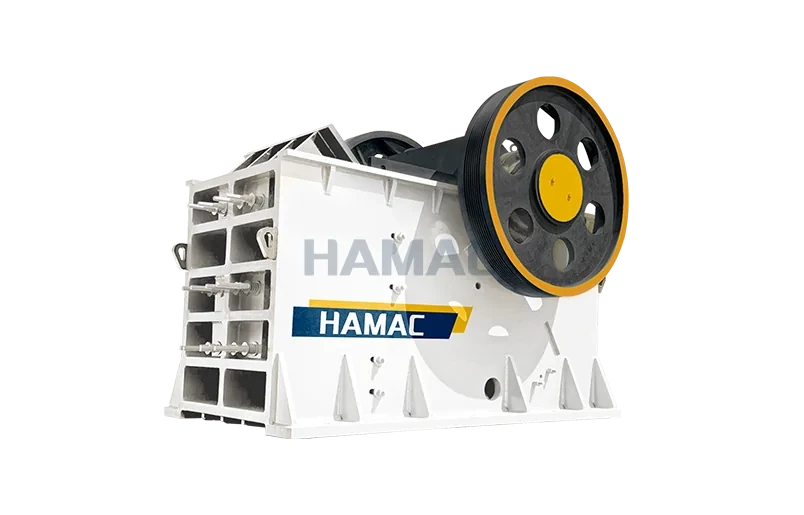
Overview
This page brings together the published PE Series Jaw Crusher model data and the practical details of importing it into Myanmar — power supply, standards, shipping and commissioning. Popular feed materials in the market include Limestone, Aggregates.
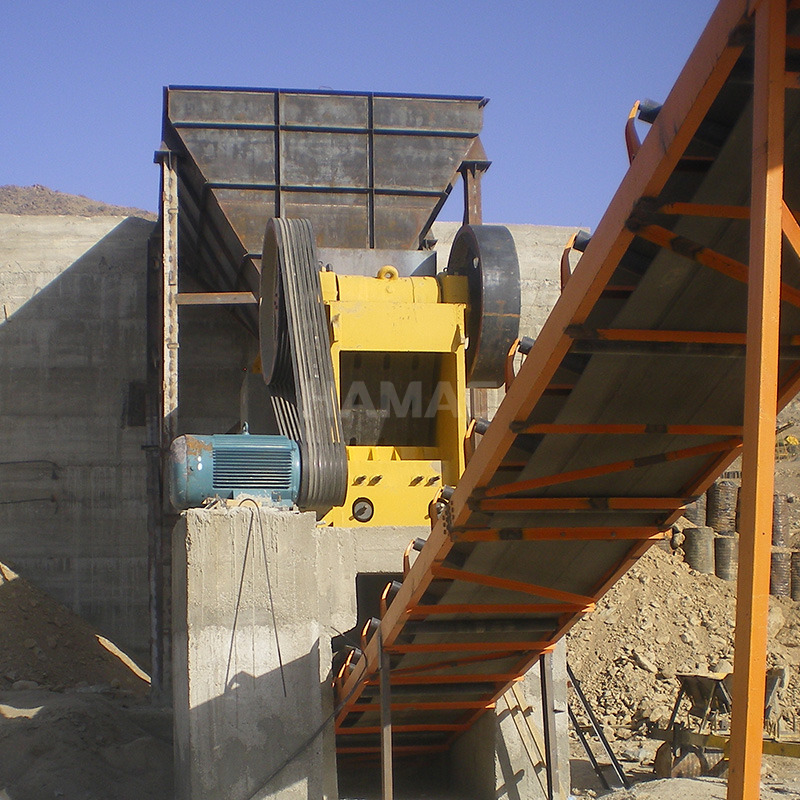
Published PE Series Jaw Crusher data
| Published parameter | Nominal value |
|---|---|
| PEX250x750 | 250x750 mm 210 mm |
| PEX250x1000 | 250x1000 mm 210 mm |
| PEX250x1200 | 250x1200 mm 210 mm |
| PEX300x1300 | 300x1300 mm 250 mm |
| PE400×600 | 400×600 mm 340 mm |
| PE500×750 | 500×750 mm 425 mm |
Local conditions in Myanmar
- Destination port: Yangon.
- Site supply: 380V 50Hz.
- Standards: MSS.
- Common materials: Limestone, Aggregates.
- Region: Asia.
Delivery scope
HAMAC quotes FOB, CFR or CIF to Yangon, sets motors and starters to 380V 50Hz, and supplies the certificate set applicable to MSS. Workshop assembly, test, container loading plan and installation supervision are included in a turnkey scope.
Reference data for this configuration
| Parameter | Reference value |
|---|---|
| Destination port | Yangon |
| Site supply | 380V 50Hz |
| Local standards | MSS |
| Region | Asia |
| Machine line | PE Series Jaw Crusher |
| Category | Jaw Crusher |
| Assumed duty | manufactured-sand production |
| Evaluation horizon | five-year view |
Where a value is shown as nominal, the written proposal states the guaranteed figure for your material, feed grading and five-year operating plan.
Published PE Series Jaw Crusher model data
| Model | Input Size | Max Feeding Size | Output Range | Capacity | Engine Power | Weight |
|---|---|---|---|---|---|---|
| PEX250x750 | 250x750 mm | 210 mm | 25-60 mm | 13-35 T/H | 30 KW | 5.5 T |
| PEX250x1000 | 250x1000 mm | 210 mm | 25-60 mm | 16-52 T/H | 37 KW | 7 T |
| PEX250x1200 | 250x1200 mm | 210 mm | 25-60 mm | 20-61 T/H | 55 KW | 9.5 T |
| PEX300x1300 | 300x1300 mm | 250 mm | 20-90 mm | 16-105 T/H | 75 KW | 15.6 T |
| PE400×600 | 400×600 mm | 340 mm | 40-100 mm | 16-60 T/H | 30 KW | 6.7 T |
| PE500×750 | 500×750 mm | 425 mm | 50-100 mm | 40-110 T/H | 55 KW | 11.7 T |
| PE600×900 | 600×900 mm | 500 mm | 65-180 mm | 80-180 T/H | 55-75 KW | 16.1 T |
| PE750×1060 | 750×1060 mm | 630 mm | 80-180 mm | 110-320 T/H | 90-110 KW | 30.1 T |
Jaw crushers are often used for primary crushing in mine material crushing. Read the table column by column against manufactured-sand production: the model you pick is the one whose published range brackets your target tonnage, not simply the largest machine in the series. Availability, motor rating and shipping data are re-confirmed for a coastal export terminal in the written HAMAC proposal.
Project profile these notes assume
| Assumption | Value |
|---|---|
| Operating duty | manufactured-sand production |
| Primary objective | lowest cost per tonne |
| Evaluation horizon | five-year view |
| Site condition | a coastal export terminal |
| Operating team | a small contractor crew |
Change any one of these assumptions and the recommended configuration for pe series jaw crusher may change. HAMAC re-runs the same checks against your own numbers once the enquiry data sheet is received.
From enquiry to the first saleable tonne
- Sequence delivery so foundations cure while the equipment is still in manufacture.
- Set the maintenance stock list from the expected wear rate, not from a percentage of the equipment price.
- Run a sieve analysis on a representative sample and attach the grading curve to the enquiry.
- Book container or flat-rack space to Yangon and prepare the customs document set in advance.
- Commission with graded load, sample the product grading, then train operators on liner change-out and daily checks.
- Allocate screen area per deck; blinding and pegging are the most common hidden bottlenecks in a new plant.
- Record the as-built settings and give the operator a written daily, weekly and monthly schedule.
- Survey the feed: the feed material; record top size, bulk density, moisture and clay content before fixing the flow sheet.
- Budget for water, dust extraction and spillage handling as part of the plant, not as an afterthought.
Each step has an owner and a document: flow sheet, general arrangement, foundation reference, packing list and acceptance protocol.
What to verify before you sign
- Closed-side setting range and whether automatic setting regulation is included.
- Choke-feed arrangement: surge bin, feeder control and level indication.
- Product sampling points and the lab equipment needed for routine grading checks.
- After-sales response time, technician availability and the warranty exclusions in writing.
- Dust and noise control designed to the local emission limits for Myanmar.
- Energy draw in kW and the expected kWh per tonne at the design duty.
- Access for liner change-out — crane radius, lifting points and clearance around the chamber.
- Guaranteed power draw and the lowest cost per tonne trade-off it implies.
- Control system language, telemetry and remote diagnostics availability.
Ask each supplier to price the same list. Quotations for pe series jaw crusher only become comparable when the scope is identical.
Where the money actually goes
| Cost line | Indicative share | What moves the number |
|---|---|---|
| Equipment & drive packages | 53% | Model size, number of stages and automation level |
| Ocean freight & insurance | 11% | Destination port, container count and out-of-gauge cargo |
| Civil works & foundations | 8% | Soil conditions, dynamic loads and site preparation |
| Erection, commissioning & training | 7% | Local labour, supervision scope and schedule |
| First-year wear parts | 14% | Rock abrasiveness, liner grade and operating hours |
| Power, lubricants & consumables | 7% | kWh per tonne, local tariff and dust suppression water |
For pe series jaw crusher at your target tonnage, wear parts and energy usually outweigh the difference between two purchase prices within three to five years.
Mistakes that cost more than the machine
- Undersizing the screen, then blaming the crusher for a plant that never reaches your target tonnage.
- Assuming the manufacturer's warranty covers wear parts and consumables.
- Letting the manufactured-sand production duty be defined verbally instead of in the contract.
- Assuming a mobile plant can match a stationary line on high-tonnage, multi-product duty.
- Selecting the cheapest liner alloy for hard, high-silica rock and paying for it in change-outs.
- Buying on nameplate t/h without converting to saleable product at the specified fractions.
- Specifying motors for the wrong voltage or frequency and rewinding them on site.
- Leaving tramp-iron protection out of the scope to save a small percentage of capital.
Review the list with a small contractor crew before the order is placed — they will recognise most of them.
Commissioning checklist
- Check lubrication levels, grease lines and oil cooler operation.
- Measure noise and dust at the operator position against the local limit.
- Verify chute liners, skirt rubber and impact bars after the first hour of feed.
- Introduce feed in graded steps: 25%, 50%, 75%, then full load.
- Hand over the spare-parts list, manuals and maintenance schedule.
- Sample each product fraction and compare with the specification.
- Calibrate the belt scale and any level probes against a known load.
- Record the baseline grading curve for each product fraction.
Keep the signed record; it is the only defensible baseline for later performance disputes.