Overview
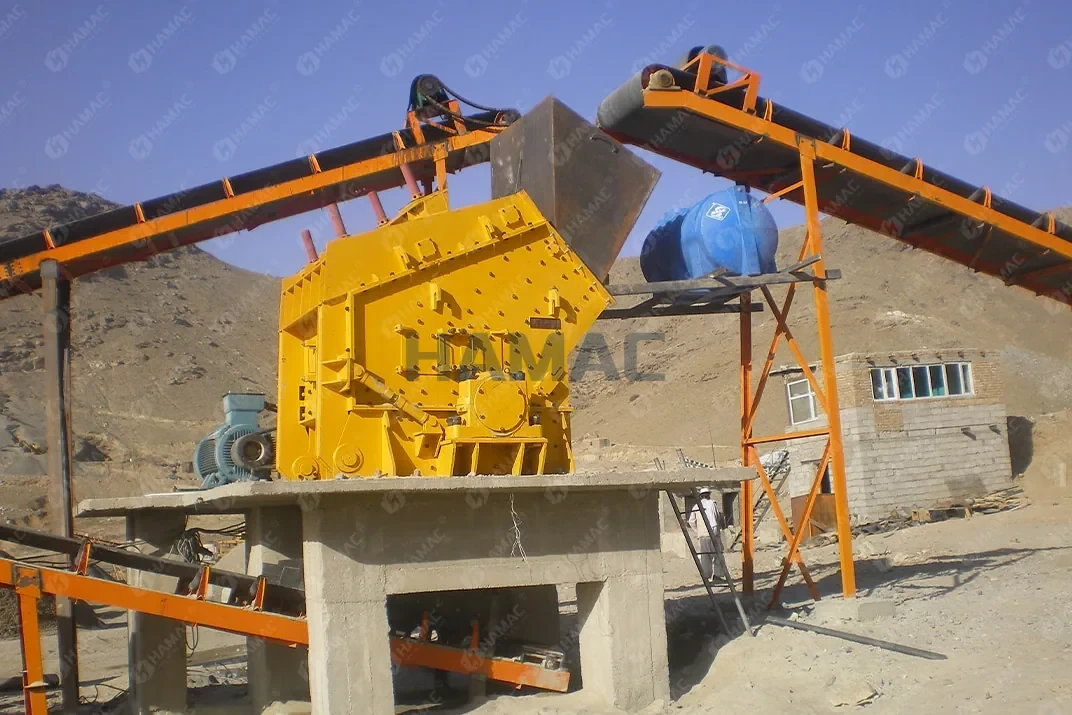
This page brings together the published PF Impact Crusher model data and the practical details of importing it into Italy — power supply, standards, shipping and commissioning. Popular feed materials in the market include Marble, Granite.
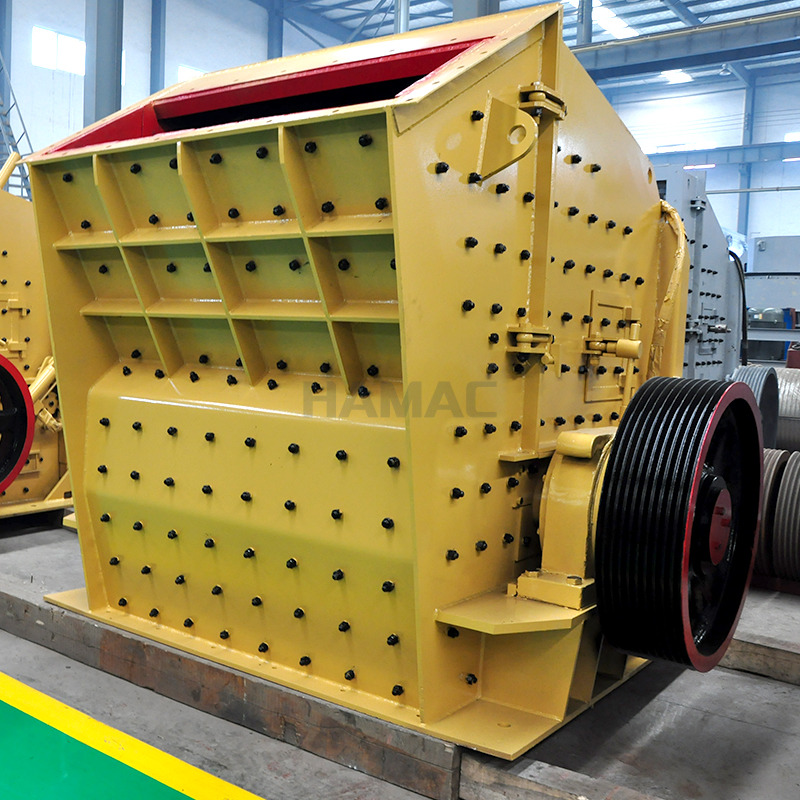
Published PF Impact Crusher data
| Published parameter | Nominal value |
|---|---|
| PF-1007 | Φ1000×700 mm 400×730 mm |
| PF-1010 | Φ1000×1050 mm 400×1080 mm |
| PF-1210 | Φ1250×1050 mm 400×1080 mm |
| PF-1214 | Φ1250×1400 mm 400×1430 mm |
| PF-1315 | Φ1320×1500 mm 860×1520 mm |
| PF-1520 | Φ1500×2000 mm 830×2040 mm |
Local conditions in Italy
- Destination port: Genoa.
- Site supply: 400V 50Hz.
- Standards: UNI EN.
- Common materials: Marble, Granite.
- Region: Europe.
Delivery scope
HAMAC quotes FOB, CFR or CIF to Genoa, sets motors and starters to 400V 50Hz, and supplies the certificate set applicable to UNI EN. Workshop assembly, test, container loading plan and installation supervision are included in a turnkey scope.
Reference data for this configuration
| Parameter | Reference value |
|---|---|
| Destination port | Genoa |
| Site supply | 400V 50Hz |
| Local standards | UNI EN |
| Region | Europe |
| Machine line | PF Impact Crusher |
| Category | Impact Crusher |
| Assumed duty | seasonal road-project supply |
| Evaluation horizon | seven-year view |
The figures above are transcribed from published HAMAC data and from the material properties of the feed; site measurements take precedence.
Published PF Impact Crusher model data
| Model | Rotor size | Feed opening | Max. Feeding size | Capacity | Motor Power | Weight | Overall dimension |
|---|---|---|---|---|---|---|---|
| PF-1007 | Φ1000×700 mm | 400×730 mm | 300 mm | 30-70 t/h | 37-45 kW | 12 t | 2330×1660×2300 mm |
| PF-1010 | Φ1000×1050 mm | 400×1080 mm | 350 mm | 50-90 t/h | 45-55 kW | 15 t | 2370×1700×2390 mm |
| PF-1210 | Φ1250×1050 mm | 400×1080 mm | 350 mm | 70-130 t/h | 110 kW | 17.7 t | 2680×2160×2800 mm |
| PF-1214 | Φ1250×1400 mm | 400×1430 mm | 350 mm | 100-180 t/h | 132 kW | 22.4 t | 2650×2460×2800 mm |
| PF-1315 | Φ1320×1500 mm | 860×1520 mm | 500 mm | 130-250 t/h | 220 kW | 27 t | 3180×2720×2620 mm |
| PF-1520 | Φ1500×2000 mm | 830×2040 mm | 700 mm | 300-550 t/h | 315-400 kW | 50.6 t | 3959×3564×3330 mm |
| PF-1620 | Φ1600×2000 mm | 2000×1600 mm | 500 mm | 400-700 t/h | 400-500 kW | 58 t | 4259×3660×3450 mm |
| PF-1820 | Φ1800×2000 mm | 1260×2040 mm | 800 mm | 600-800 t/h | 630-710 kW | 83.21 t | 4400×3866×4009 mm |
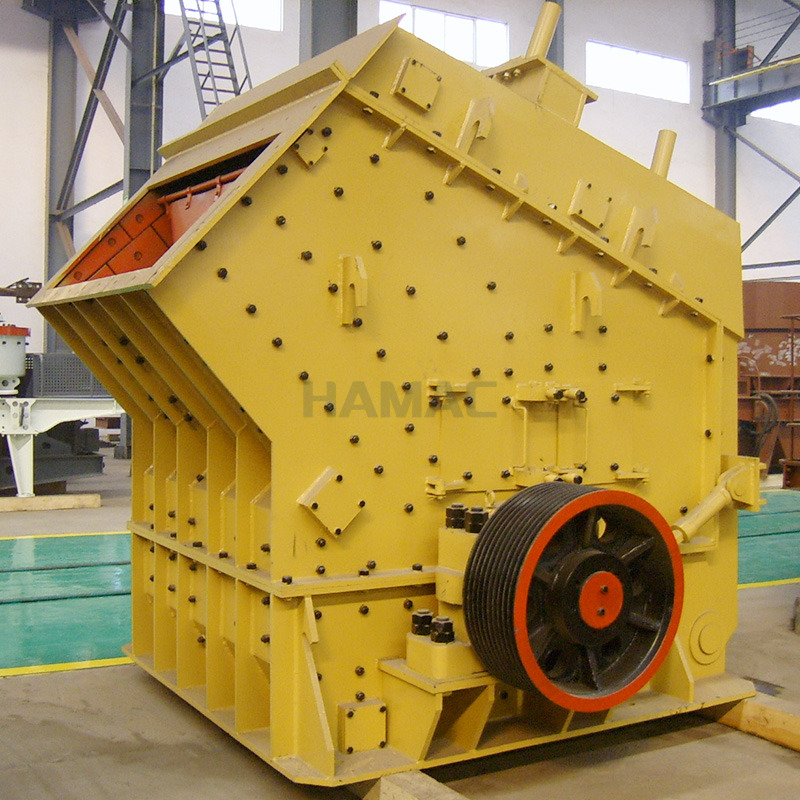
The impact crusher (impact crusher) is a new generation of impact crusher developed in combination with the specific working conditions of the sand and gravel. Read the table column by column against seasonal road-project supply: the model you pick is the one whose published range brackets your target tonnage, not simply the largest machine in the series. Availability, motor rating and shipping data are re-confirmed for a brownfield extension in the written HAMAC proposal.
Project profile these notes assume
| Assumption | Value |
|---|---|
| Operating duty | seasonal road-project supply |
| Primary objective | lowest energy per tonne |
| Evaluation horizon | seven-year view |
| Site condition | a brownfield extension |
| Operating team | a mixed local and expatriate team |
Change any one of these assumptions and the recommended configuration for pf impact crusher may change. HAMAC re-runs the same checks against your own numbers once the enquiry data sheet is received.
From enquiry to the first saleable tonne
- Book container or flat-rack space to Genoa and prepare the customs document set in advance.
- Log tonnes per liner set and kWh per tonne from day one so you have a real cost baseline within a quarter.
- Confirm the haul-road and stockpile plan with a brownfield extension in mind before fixing conveyor lengths.
- Set the closed-side setting or rotor speed against the required product fractions, then verify the expected reduction ratio.
- Commission with graded load, sample the product grading, then train operators on liner change-out and daily checks.
- Plan training for a mixed local and expatriate team on CSS adjustment, liner change-out and lock-out / tag-out.
- Choose compression or impact reduction according to hardness, silica content and required particle shape.
- Run a sieve analysis on a representative sample and attach the grading curve to the enquiry.
- Budget for water, dust extraction and spillage handling as part of the plant, not as an afterthought.
Most delays at this stage come from missing feed data rather than from manufacturing capacity.
What to verify before you sign
- Ambient temperature, altitude and dust load derating for motors and hydraulics.
- Saleable tonnes per hour at each product size, not gross crusher throughput, for your target tonnage.
- Wear-part interchangeability across machines in the same circuit.
- Spare-parts consignment: one full liner or blow-bar set plus meshes, belts, bearings and seals.
- Closed-side setting range and whether automatic setting regulation is included.
- Nameplate data for 400V 50Hz and the UNI EN certificate set.
- Spare motor, gearbox and hydraulic pump lead times from the nearest HAMAC stock point.
- Availability of a mixed local and expatriate team for liner changes and the lifting equipment on site.
- Local service partner, technician travel time and visa requirements for Italy.
For seasonal road-project supply, give the lowest energy per tonne line extra weight; a generic checklist will not rank the offers correctly.
Where the money actually goes
| Cost line | Indicative share | What moves the number |
|---|---|---|
| Equipment & drive packages | 53% | Model size, number of stages and automation level |
| Ocean freight & insurance | 11% | Destination port, container count and out-of-gauge cargo |
| Civil works & foundations | 8% | Soil conditions, dynamic loads and site preparation |
| Erection, commissioning & training | 7% | Local labour, supervision scope and schedule |
| First-year wear parts | 14% | Rock abrasiveness, liner grade and operating hours |
| Power, lubricants & consumables | 7% | kWh per tonne, local tariff and dust suppression water |
Include downtime in the model. An unplanned liner change on a remote site costs far more than the casting itself.
Mistakes that cost more than the machine
- Skipping the acceptance test, so no one has a baseline to measure degradation against.
- Comparing quotations with different port terms and calling the lower number cheaper.
- Using one liner profile for both secondary and tertiary stages.
- Undersizing the screen, then blaming the crusher for a plant that never reaches your target tonnage.
- Planning the crusher but not the conveyors, transfer chutes and stockpile capacity around it.
- Forgetting surge capacity — an intermittent loader starves the chamber and ruins particle shape.
- Skipping a geotechnical check and discovering settlement under the primary crusher at a brownfield extension.
- Assuming the manufacturer's warranty covers wear parts and consumables.
Every item on this list has cost someone a commissioning date; none of them requires new technology to avoid.
Commissioning checklist
- Check hydraulic pressure, accumulator pre-charge and tramp-release function.
- Check belt tracking, chute build-up and transfer-point dust.
- Dry-run the plant empty for the specified period and record vibration.
- Record power draw, tonnage and chamber pressure at steady state.
- Confirm all guards, emergency stops and pull-wire switches function.
- Measure and log the as-new CSS / setting for future wear comparison.
- Check lubrication levels, grease lines and oil cooler operation.
- Test emergency stops, pull wires and interlock trips in sequence.
On a brownfield extension, allow extra time for the dust and noise measurements.